Flying Cars Are Finally Here: Elon Musk Just Made One Fly
Tesla has unveiled a SpaceX-powered Roadster that can briefly lift off the ground, maneuver in the air and land using rocket-style thrusters and high-powered fans.
For generations, the flying car has been one of technology’s most persistent promises.
This week, Elon Musk brought that promise considerably closer to reality.
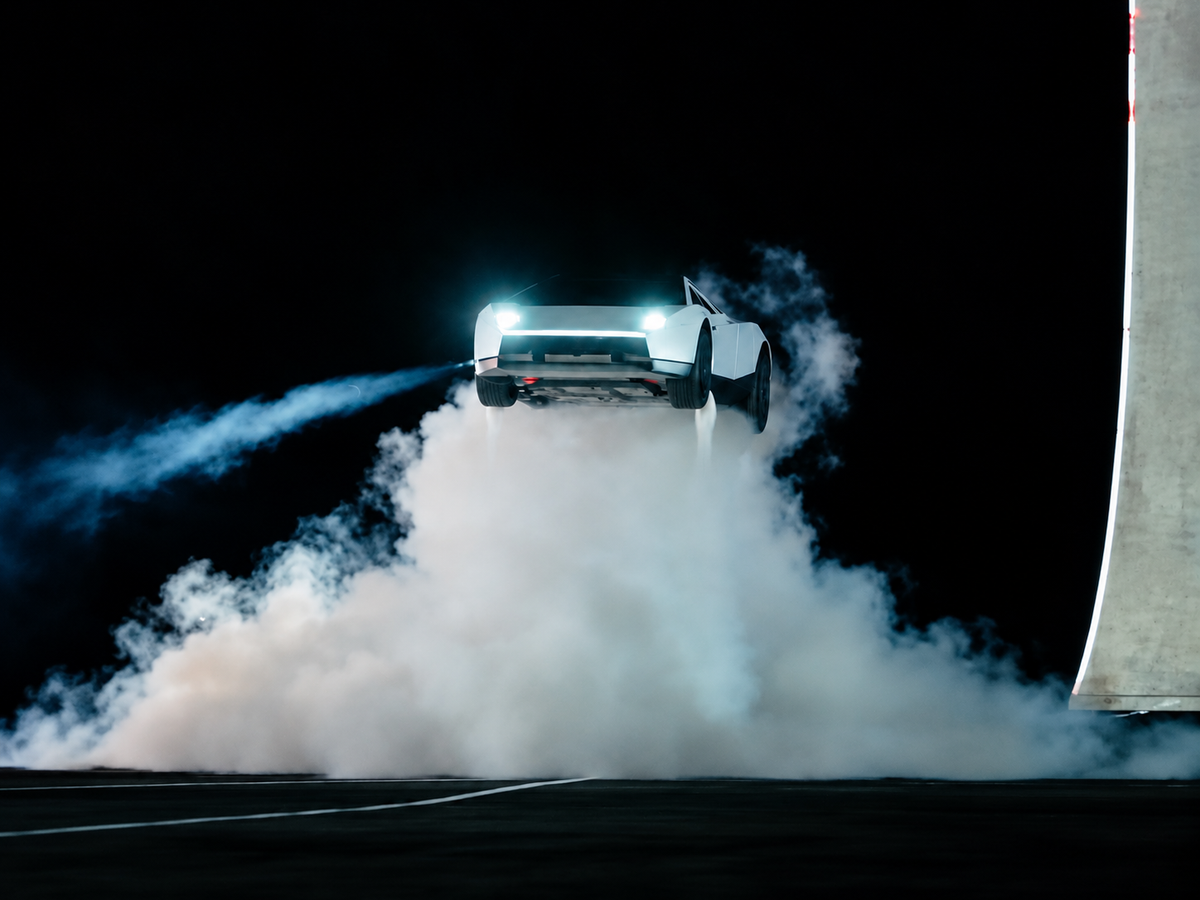
Tesla unveiled its long-delayed next-generation Roadster at SpaceX’s McGregor facility in Texas, where the car did something no normal production-oriented sports car has done before: it left the ground, maneuvered in the air and landed again using a combination of SpaceX-developed thrusters and high-powered fans.
It was not a computer rendering.
It was not another concept video.
The prototype actually flew.
During the demonstration, the Roadster accelerated up an inverted ramp, rotated while airborne and lowered itself back onto the pavement. It also used its propulsion system to lift over a line of Tesla vehicles while moving. TechCrunch
Musk has been teasing this idea since 2018, when he first suggested that a future Roadster equipped with a SpaceX package could use small rocket thrusters to dramatically improve acceleration, braking and cornering and might even allow the car to fly.
Eight years later, Tesla has demonstrated it.
The system is unlike the technology being developed by most companies working on flying cars.
Traditional flying-car and eVTOL projects essentially combine cars with small aircraft. They generally rely on large electric rotors or propellers to achieve vertical takeoff and sustained flight.
Tesla has taken a very different approach.
The Roadster remains fundamentally a car.
Its extreme version uses an ultra-high-pressure propulsion system developed with SpaceX engineers, combined with powerful fans, to generate enough force to briefly lift and control the vehicle in the air.
In other words, Musk did not build a small airplane that can drive.
He built a car that can temporarily behave like a rocket.
The engineering results extend far beyond flight.
Tesla demonstrated the Roadster accelerating from zero to 60 miles per hour in approximately 0.8 to one second, putting it into territory previously considered nearly impossible for a road vehicle. Tesla says its top speed will exceed 230 mph.
Three versions are planned: Performance, Thrust and Rocket.
The most extreme Rocket version is expected to sacrifice passenger capacity in exchange for the full propulsion package, while more conventional versions will retain the Roadster’s role as a high-performance electric sports car.
This does not mean commuters will be flying over traffic next year.
Several major obstacles remain.
The Roadster demonstrated short controlled aerial maneuvers, not sustained aircraft-style flight.
Tesla has not demonstrated that the vehicle can fly significant distances or operate like an airplane or helicopter.
It is also not currently approved for public-road use in its demonstrated configuration, and any vehicle deliberately leaving the ground would potentially face aviation regulations in addition to ordinary vehicle rules.
Tesla is currently targeting production in 2028.
And that timeline deserves caution.
The second-generation Roadster was originally unveiled in 2017 with production initially expected around 2020. It has since been delayed repeatedly as Tesla prioritized the Model 3, Model Y, Cybertruck, autonomous driving, robotaxis and humanoid robots.
So this is not yet a mass-market flying car.
But that should not obscure what happened in Texas.
For decades, flying cars existed mostly in science fiction because the engineering compromises were enormous.
Aircraft need lift.
Cars need to remain compact, stable and safe on roads.
Combining both usually produces something that is neither a particularly good car nor a particularly efficient aircraft.
Tesla approached the problem from the opposite direction.
Instead of trying to make a vehicle capable of flying across cities, it asked whether aerospace technology could give a normal car entirely new capabilities.
That distinction matters.
The first practical applications of this technology may have nothing to do with commuting through the sky.
Thrusters capable of lifting a vehicle can also dramatically improve acceleration, braking, stability and control.
A propulsion system able to exert force independently of tire grip could potentially change the limits of vehicle performance.
Conventional cars are constrained by friction between tires and asphalt.
Rocket-assisted vehicles are not constrained in exactly the same way.
That is why Musk has described the Roadster as a technological showcase rather than an important source of Tesla revenue.
He has acknowledged that the car itself probably will not materially change Tesla’s finances.
That may actually make the Roadster more interesting.
Tesla’s original Roadster served a similar purpose almost two decades ago.
Electric cars existed before Tesla.
But the first Roadster demonstrated that an electric vehicle did not need to be slow, unattractive or compromised.
Tesla then took what it learned and eventually built mass-market cars around electric propulsion.
The new Roadster may perform a similar role for technologies borrowed from aerospace.
Cold-gas propulsion.
Ultra-high-pressure storage.
Advanced control systems.
Fan-generated downforce.
Integration between automotive software and aerospace engineering.
Whether those technologies eventually reach ordinary cars remains unknown.
But the broader significance is already visible.
Tesla and SpaceX have effectively begun sharing engineering ideas between industries that historically had very little overlap.
One company builds electric cars.
The other builds reusable rockets.
The Roadster sits somewhere between them.
And that may ultimately be more important than whether owners are legally allowed to fly one across Los Angeles.
The flying cars imagined in the 1950s were essentially small airplanes parked in suburban garages.
The first real version may look nothing like that.
It may simply look like a Tesla Roadster until someone presses the right button.
Flying cars have not yet become an everyday reality.
But after this week, they are no longer purely science fiction either.
For the first time, Elon Musk has shown a car designed for eventual production leaving the ground under its own propulsion, maneuvering in the air and landing again.
The question has changed.
It is no longer whether a Tesla can fly.
We have now seen one do it.
The question is whether Musk can turn that spectacular demonstration into a machine people can actually buy and legally use.
If anyone can, it's him.