Lebanese Buyers Are Standing Out in Paris Real Estate, Leading Foreign Purchases in the 16th Arrondissement
Lebanese nationals are now the largest group of foreign property buyers in Paris’s prestigious 16th arrondissement, ahead of Chinese and American purchasers.
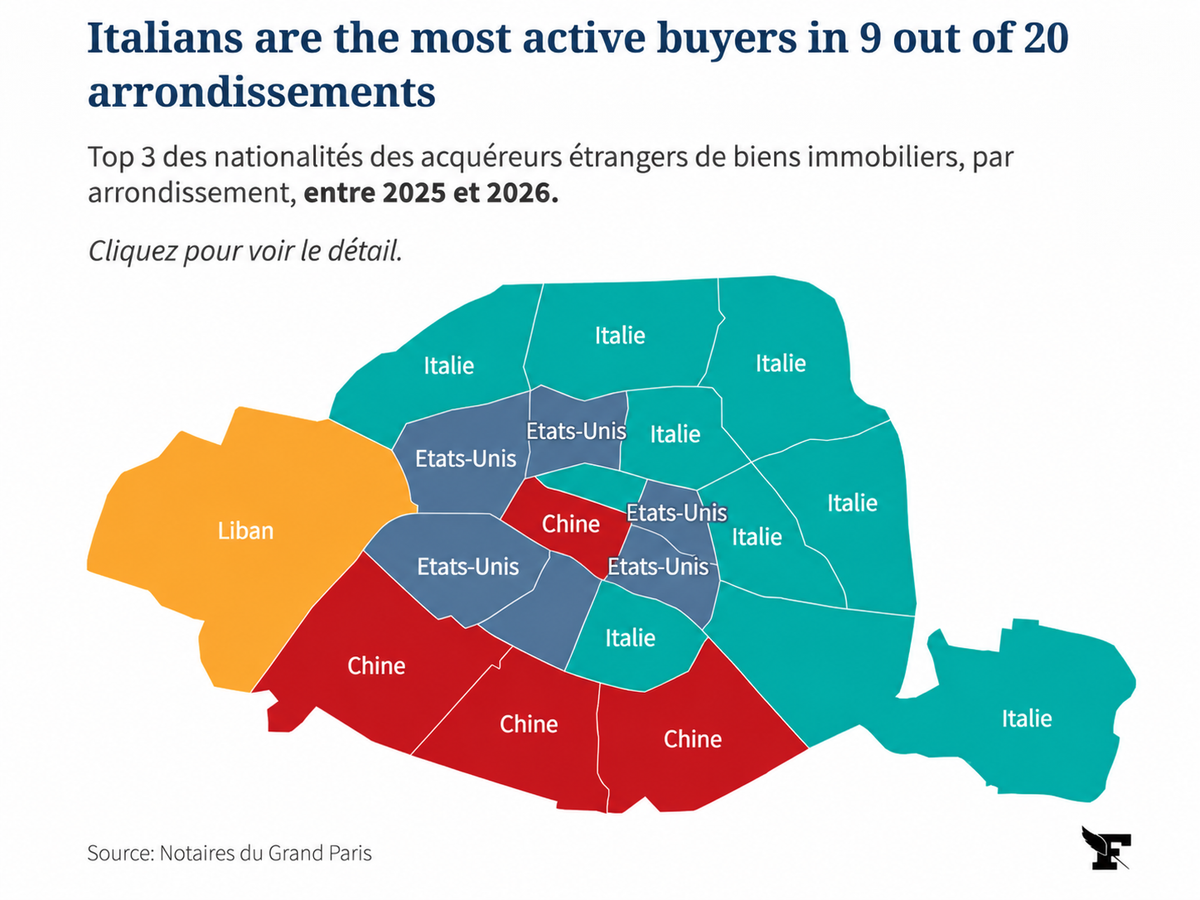
Lebanese buyers are becoming increasingly visible in Paris real estate, particularly in some of the French capital’s wealthiest western neighborhoods.
New data from the Notaires du Grand Paris shows that Lebanese nationals are now the largest group of foreign buyers in Paris’s 16th arrondissement, ahead of Chinese and American buyers. The 16th is one of the city’s most prestigious residential districts, known for areas such as Passy, Trocadéro, Auteuil and Avenue Foch.
The shift is notable because Lebanon’s presence in the Paris property market has expanded significantly over the past several years.
In 2018 and 2019, Lebanese buyers appeared among the top three foreign nationalities in only one Paris arrondissement: the 8th. They are now leading foreign purchases in the 16th, reflecting the growing concentration of Lebanese wealth and families in western Paris.
This is not an entirely new phenomenon.
Lebanese buyers have long been among the most active Middle Eastern purchasers of property in Paris. In 2023, they accounted for 12% of purchases by foreign non-residents in the capital, second only to Americans at 25% and ahead of Italians at 9%. The median Lebanese purchase that year was €521,500 for an apartment of around 48 square meters.
Across the wider Paris region, Lebanese non-residents made 132 purchases in 2023, again placing them second behind Americans.
The reasons are partly historical.
Lebanon and France have exceptionally deep cultural, educational and linguistic ties. Generations of Lebanese studied in French schools, attended universities in France and maintained family or business links with Paris.
For many Lebanese families, Paris is therefore not simply another foreign property market.
It is familiar.
French is widely spoken in Lebanon. Flights are frequent. Large Lebanese communities already exist in and around the city. And many families have children studying or working in France.
The 16th arrondissement fits those preferences particularly well.
It is residential rather than heavily touristic, offers large family apartments and prestigious schools, and is close to the Trocadéro, Bois de Boulogne and western business districts. Real-estate agents say buyers from Lebanon and the Gulf frequently favor the 8th and 16th arrondissements over some of the more tourist-heavy areas of central Paris.
Recent instability in Lebanon and the wider region appears to be reinforcing that trend.
Paris-based luxury agents have reported renewed demand from Lebanese families, including those based in the Gulf, who are looking for property in France as a stable long-term asset and a potential second home. Sotheby’s Paris West recently said Lebanese families based in Dubai had become particularly active in searching the 16th arrondissement and Neuilly-sur-Seine.
That motivation is not difficult to understand.
Since 2019, Lebanese households have experienced a banking collapse, severe currency depreciation, restrictions on deposits, political instability and successive rounds of conflict.
For families able to move capital abroad, real estate in Paris offers something Lebanon’s domestic financial system has struggled to provide: perceived legal stability, a liquid property market and an asset denominated in euros.
This makes the trend as much about wealth preservation as lifestyle.
A Paris apartment can serve several functions at once.
It can house children attending university.
It can act as a second residence.
It can generate rental income.
And, perhaps most importantly for Lebanese who experienced the destruction of savings inside banks, it is a tangible asset held outside Lebanon’s financial system.
That mentality predates the current crisis.
During the Arab Spring and the Syrian war, French real-estate agents were already reporting strong Lebanese demand for expensive Paris apartments. In 2012, Le Figaro described Lebanese as among the most active Middle Eastern buyers of luxury property in Paris, with some transactions reaching several million euros.
The difference today is that the trend has become measurable at the arrondissement level.
Lebanese buyers are no longer simply a visible niche among wealthy foreign purchasers.
In the 16th arrondissement, they are now number one.
There is also a broader demographic explanation.
France has become one of the principal destinations for Lebanese emigration since the 2019 crisis, particularly among students, professionals and families with existing French connections.
As more Lebanese establish themselves permanently or semi-permanently in France, property purchases naturally follow.
The relationship has become significant enough that the Paris Chamber of Notaries organized a dedicated conference in 2024 specifically on real-estate acquisition in France in the Franco-Lebanese context, covering taxation, ownership structures and inheritance issues for Lebanese and dual-national buyers.
The current Paris market may also be helping.
After a prolonged slowdown driven by higher interest rates, activity in the wider Île-de-France market has begun recovering. Existing-home sales rose 10% year-on-year in the second quarter of 2026, while apartment prices remained broadly stable.
For cash-rich foreign buyers, that environment can be attractive.
Unlike many French households who depend heavily on mortgages, overseas buyers with liquid capital may be less exposed to borrowing costs and therefore better positioned to take advantage of weaker prices or greater negotiating power.
But the trend also tells a wider story about Lebanon.
Large amounts of Lebanese private wealth continue to be invested abroad while the domestic economy struggles to generate investment at home.
Lebanese capital buys apartments in Paris, businesses in Dubai and financial assets overseas because many investors still view those environments as safer than Lebanon itself.
That is rational at the individual level.
At the national level, however, it highlights the country’s continuing inability to convince its own citizens that their wealth is secure inside Lebanon.
The same Lebanese families who once kept their savings in Beirut banks increasingly diversify through foreign accounts, foreign companies and foreign property.
Paris has become one of the clearest beneficiaries.
For France, Lebanese demand remains a relatively small part of the enormous Paris property market.
For Lebanon, however, its significance is larger than the raw number of transactions suggests.
The fact that Lebanese nationals now lead foreign buyers in one of Paris’s most expensive districts says something about both the global reach of Lebanese wealth and the degree to which that wealth increasingly looks abroad for security.
Lebanese buyers have always loved Paris.
What has changed is how strongly economic instability at home has reinforced the attraction.