Nepal’s Himalayan Flood Disaster Has Killed More Than 1,100 as Thousands Remain Missing
Nepal is still recovering from a catastrophic Himalayan flood that began on August 26 after a suspected glacier collapse sent ice, rock and mud through the country’s northern valleys. More than 1,100 people have been confirmed dead, while thousands remain missing.
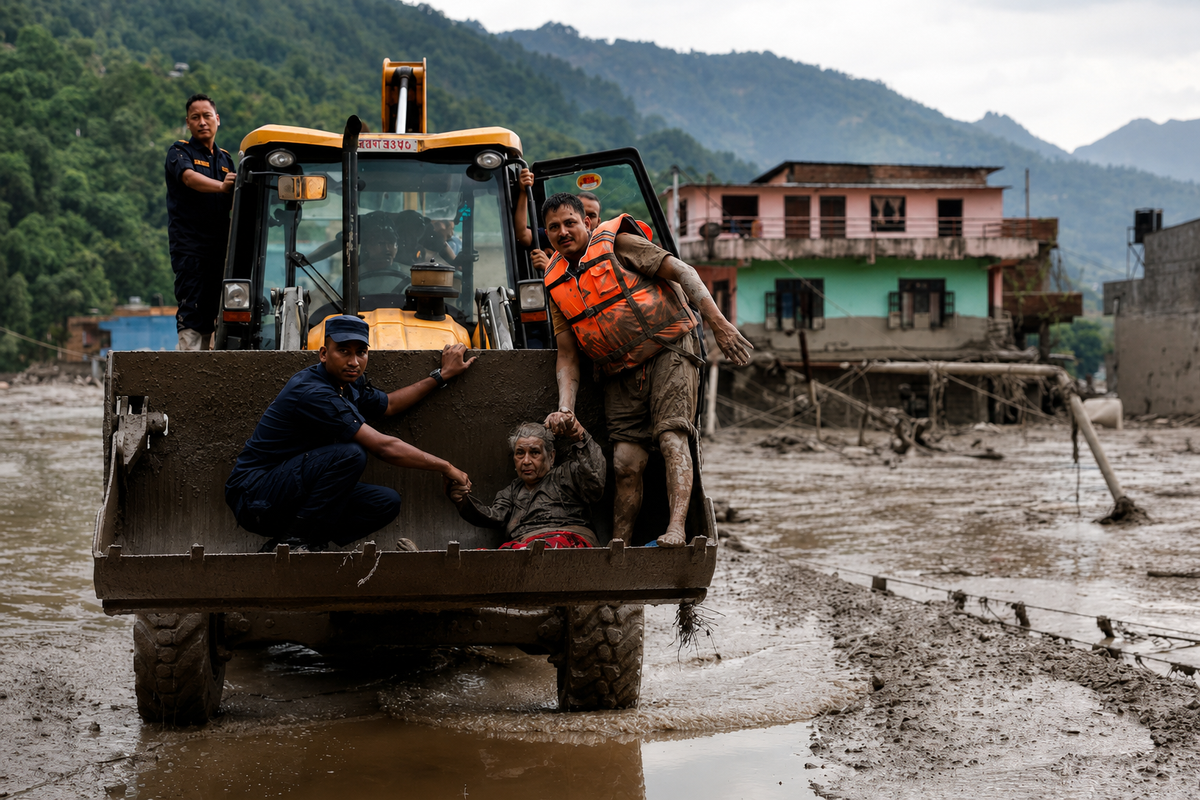
Nepal is still reeling from one of the worst natural disasters in its recent history after a massive glacial collapse triggered catastrophic flooding across the country’s northern Himalayan region. The disaster began on August 26, when a torrent of ice, rock, mud and water surged through the Lhende Khola river system near the Nepal-Tibet border, destroying villages, roads, bridges, hydropower facilities and sections of the route linking Kathmandu with Tibet.
The first hours were chaotic. Hundreds were reported missing almost immediately, including foreign tourists and pilgrims travelling toward Mount Kailash. Within a day, the confirmed death toll had already climbed into the hundreds as rescue teams struggled to reach isolated mountain communities. Helicopters, soldiers and emergency crews were deployed, but damaged roads, landslides and unstable terrain repeatedly slowed operations.
As the scale of the disaster became clearer, the toll rose sharply. Entire settlements were buried under debris, while hydropower projects were inundated and workers became trapped underground. Nepal eventually opened the country to foreign rescue teams, with assistance arriving from countries including India, China, South Korea and Singapore. More than 9,000 Nepali soldiers have been involved in rescue and recovery work.
By September 2, at least 1,114 people had been confirmed dead in Nepal and 2,916 remained officially missing, according to authorities cited by Reuters. The flood generated an estimated 2.2 million tonnes of debris and damaged eight operating and four under-construction hydropower projects, temporarily knocking out around 10% of Nepal’s electricity generation. Economic losses are being estimated at roughly $4–5 billion.
Search operations are still continuing, particularly inside flooded hydropower tunnels where rescuers believe some trapped workers could still be alive. At the same time, hopes of finding survivors elsewhere are fading as families begin holding symbolic funerals for relatives who remain missing.
Scientists believe the disaster was triggered by a glacier collapse, likely worsened by unusually warm conditions and long-term glacial retreat in the Himalayas. Nepal has lost nearly a third of its mountain ice over the past three decades, raising concerns that similar high-altitude disasters could become more frequent as temperatures continue to rise.