Airstrikes Are Multiplying in South Lebanon, Is The Third Israel-Hezbollah War Upon Us?
Israeli airstrikes across southern Lebanon have intensified again as Hezbollah continues launching explosive drones toward Israeli forces, while Israeli military officials openly say the Lebanon campaign is not over.
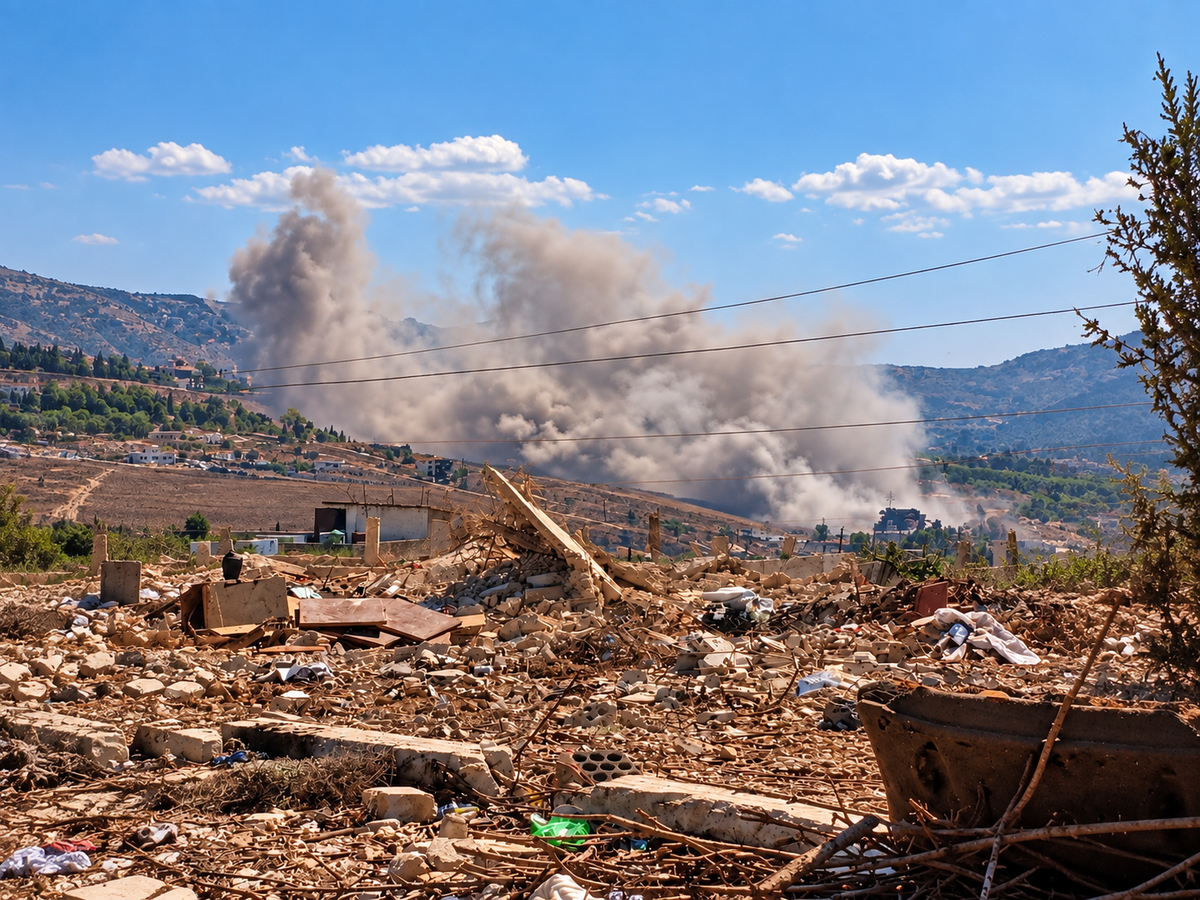
Southern Lebanon is moving in the wrong direction.
Over the past several days, Israeli airstrikes, artillery fire and demolition operations have intensified across the south, while Hezbollah has continued launching explosive drones toward Israeli forces operating inside Lebanon.
The pattern is increasingly difficult to dismiss as isolated incidents.
On September 26, Israeli aircraft struck Sojod and the Jezzine heights, with explosions reportedly heard more than 40 kilometers away in Saida. Lebanese reporting said the strikes came in areas where Israeli media had claimed Hezbollah was moving weapons and equipment farther inland after losing positions around the Ali al-Taher ridge.
The following night, Hezbollah launched an explosive drone toward Israeli troops in southern Lebanon, according to the Israeli military. Israel responded with strikes against what it described as drone-launching sites, anti-tank positions and other Hezbollah infrastructure across several areas of the south. No Israeli soldiers were reported wounded in that incident.
Lebanese reporting described the response as a sharp escalation, with airstrikes, artillery, machine-gun fire and explosions affecting several localities between Saturday night and Sunday.
This follows an already tense September.
Earlier this month, Israel carried out at least eight airstrikes in a single day and around a dozen demolition operations in occupied villages, while also killing a Hezbollah fighter in a drone strike near Nabatieh.
The important question is no longer whether the June understandings are fragile.
They clearly are.
The more important question is whether the current cycle is beginning to resemble the early stages of another major war.
Israeli military thinking appears increasingly focused on that possibility.
Israel Hayom reported this month that the Israeli army was preparing operational plans for the possibility that Hezbollah resumes broader fighting even as Israel reduced the number of troops deployed in parts of its southern Lebanon security zone.
Israeli reporting has also warned that Tehran could encourage Hezbollah to reopen the northern front as part of its confrontation with Israel and the United States. Those assessments are Israeli claims rather than confirmed Hezbollah intentions, but they show the scenario Israeli planners are actively preparing for.
Israel’s military leadership has meanwhile made clear that it does not consider the Lebanon campaign finished.
Chief of Staff Eyal Zamir said during a visit to the northern front this month that “the campaign is still not over” and that Israel would not allow Hezbollah to rebuild its capabilities.
Days later, Israeli reporting described what the military called a “new phase” in southern Lebanon, focused on destroying remaining Hezbollah infrastructure, consolidating Israeli positions and preparing for a longer-term defensive posture.
That is one side of the escalation.
The other is Hezbollah.
Despite suffering enormous losses during the previous rounds of war, Hezbollah has not disarmed and continues to use drones and other weapons against Israeli forces inside Lebanon.
The Israeli military says the group has repeatedly targeted troops operating in what Israel calls its security zone and is attempting to rebuild military capabilities farther north.
Hezbollah, for its part, argues that Israeli troops remain on Lebanese territory and that Israeli attacks have continued despite ceasefire arrangements.
Both realities now reinforce each other.
Israel says it cannot withdraw while Hezbollah remains capable of attacking and rebuilding.
Hezbollah points to Israel’s continued occupation and strikes as justification for maintaining weapons and resisting Israeli forces.
That produces a dangerous loop.
Every Hezbollah drone provides Israel with a justification for another strike.
Every Israeli strike strengthens Hezbollah’s argument that the conflict has not ended.
Every expansion of Israeli positions makes a full withdrawal harder.
Every attempt by Hezbollah to rebuild increases the likelihood of another Israeli operation.
And every new casualty makes political compromise more difficult.
Lebanon has already seen where that logic leads.
The first major Israel-Hezbollah war in 2006 devastated large parts of the country.
The second, beginning with the post-October 7 confrontation and expanding dramatically through 2024 and again in 2026, caused far greater destruction, displacement and casualties.
A third major round would begin from an even worse starting point.
Israeli forces are already positioned inside southern Lebanon.
Hezbollah is weakened but still armed.
The Lebanese Army is being asked to assume greater responsibility while operating in a landscape where Israel, Hezbollah and international actors all retain competing security roles.
And the wider region remains unstable, with Iran, Israel and the United States still engaged in a confrontation that can spill into Lebanon with little warning.
The Ali al-Taher ridge illustrates the problem.
Israel has turned the strategic area into a central military objective, destroying Hezbollah underground infrastructure and declaring that it intends to prevent the organization from returning. Israeli Defense Minister Israel Katz has said anyone attempting to reestablish a presence there would be targeted.
Israeli forces have also reduced some troop numbers after consolidating control over key positions, but they have explicitly said that the reduction does not mean withdrawal.
That distinction matters.
A smaller Israeli deployment does not necessarily mean de-escalation if Israel intends to maintain permanent or semi-permanent positions from which it can continue striking Hezbollah.
At the same time, Israeli media reports suggest Hezbollah is shifting parts of its infrastructure farther inland, toward areas such as Iqlim al-Tuffah, Jabal al-Rihan and Jabal Safi. Israel says this reflects an attempt to rebuild outside the immediate range of its current positions.
If that assessment is correct, the battlefield is not disappearing.
It is moving.
That may explain why strikes are increasingly appearing farther from the immediate border area.
The danger is that Lebanon gradually becomes accustomed to a supposedly limited war.
One drone.
One strike.
One assassination.
One demolished building.
One artillery exchange.
Until suddenly the thresholds change.
That is essentially what happened before.
Neither side necessarily needs to make a formal decision to begin a full war.
Wars can emerge through accumulated retaliation, miscalculation and expanding definitions of what constitutes a legitimate response.
An explosive drone that kills no one produces several airstrikes.
The next drone kills soldiers.
Israel responds more heavily.
Hezbollah fires rockets deeper into Israel.
Israel expands targets northward.
Within days, what was described as containment becomes another front-wide conflict.
It is too early to say that a third major war is inevitable.
There is no publicly confirmed evidence that Hezbollah has made a decision to reopen the northern front at full scale, and Israeli media reports about its intentions should be treated as assessments rather than established fact.
But the warning signs are increasingly visible.
Airstrikes are becoming more frequent.
Hezbollah attacks are continuing.
Israel is consolidating military positions inside Lebanon.
Both sides are preparing for renewed escalation.
And Israeli military officials are openly saying the campaign is not finished.
Lebanon therefore finds itself once again in the most dangerous phase of these confrontations: the period in which everyone insists they are responding to the other side while the space for restraint becomes progressively smaller.
The country has already endured two devastating Israel-Hezbollah wars.
The current trajectory does not prove that a third is coming.
But it increasingly shows how one could begin.