Ali Hassan Khalil’s Son’s Wedding Turns Into a Political Storm
A planned event connected to the wedding of Ali Hassan Khalil’s son at Sursock Palace sparked a political storm, with critics questioning the optics of an upscale celebration while hundreds of thousands remain displaced from southern Lebanon.
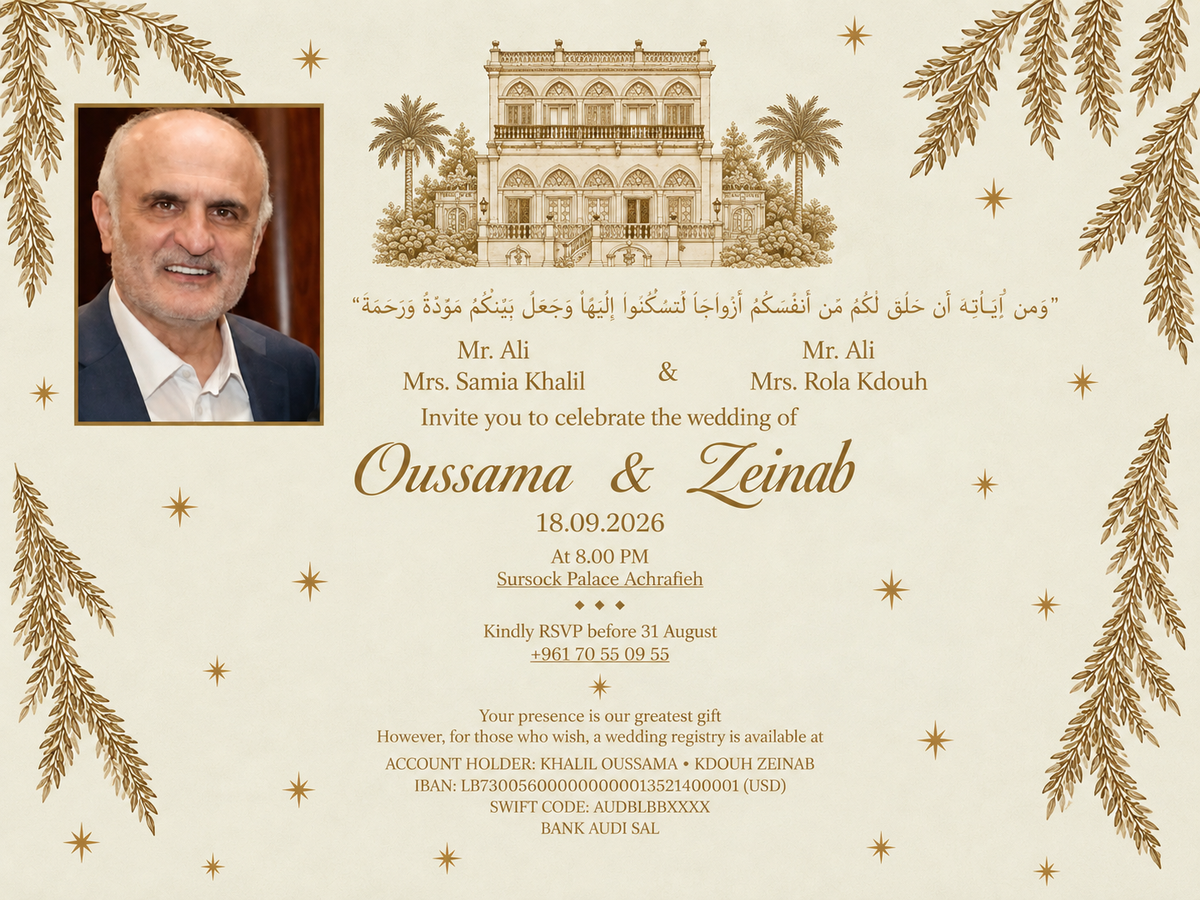
Over the past 24 hours, a private family event involving MP and former finance minister Ali Hassan Khalil has turned into one of Lebanon’s most discussed political controversies, touching everything from southern displacement to wealth, political privilege and the unresolved Beirut port investigation.
The controversy began after an invitation circulated online for an event connected to the wedding of Khalil’s son, Osama, at Beirut’s historic Sursock Palace on September 18. The choice of venue immediately drew criticism because of the palace’s prestige and the perceived cost of holding a major celebration there.
But the criticism quickly became political.
Much of it came from Lebanese, including people from the south and within the broader Shiite community, questioning the optics of a senior Amal Movement figure holding an upscale celebration while hundreds of thousands of Lebanese remain displaced and southern towns continue to suffer the consequences of war.
The location added another layer of controversy. Sursock Palace itself was badly damaged in the August 4, 2020 Beirut port explosion, while Khalil remains one of the senior political figures pursued by investigating judge Tarek Bitar in connection with the blast investigation. Critics therefore portrayed the event as particularly provocative given the symbolism of the venue.
By Sunday evening, the planned event had been canceled.
Sursock Palace initially announced that, following communication and coordination with the relevant parties, it had been agreed that the event would not go ahead. Reports at first portrayed this as the palace canceling the celebration following the public backlash.
That account was subsequently clarified by Fact Check Lebanon at the Ministry of Information. After contacting Sursock Palace management, it reported that the cancellation had actually been initiated by the party organizing the event rather than by the palace itself.
Some Lebanese outlets also reported that opponents were considering demonstrating outside the palace if the celebration proceeded, further raising the political cost of holding the event.
Khalil then issued his own response late Sunday night, accusing critics of spreading fabricated stories and engaging in a campaign of defamation.
He said his son had already married several days earlier in the bride’s home in a gathering restricted to the two families. He added that a separate wedding celebration originally planned at the family home in Khiam for June 6 had been canceled long ago, together with its dinner, because of the situation in the country.
Khalil did not, however, fully resolve the questions raised by the circulated Sursock invitation in that statement. He broadly described other claims surrounding the wedding as fabricated and also rejected a separate image being circulated online that supposedly showed him celebrating in France, saying it was actually taken at a 2016 ceremony honoring journalists in Khiam.
The controversy may also have created tensions inside Amal itself. LebanonFiles reported that Parliament Speaker Nabih Berri had reproached Khalil over the Sursock invitation because of the political damage that a lavish wedding could cause while the Shiite community continues to endure displacement and economic hardship. That report is based on unnamed sources and has not been publicly confirmed by either Berri or Khalil.
What began as a wedding invitation therefore became something much larger.
The backlash reflects the increasingly difficult political environment facing Lebanon’s traditional political class. With southern villages destroyed, hundreds of thousands displaced, household finances strained and public anger toward the political establishment remaining high, displays perceived as extravagant can quickly become symbols of the divide between Lebanon’s political elite and the communities they claim to represent.
For Ali Hassan Khalil, the controversy was particularly potent because it combined several of Lebanon’s most sensitive issues at once: the war in the south, the suffering of his own political constituency, political wealth and privilege, and the still-unresolved Beirut port explosion.
The celebration may have been canceled, but the reaction to it has already become the bigger story.