European Union Establishes Three-Year Security Mission in Lebanon
The European Union has established a new three-year security mission in Lebanon to train and advise the Lebanese Army and Internal Security Forces in border security, intelligence, anti-smuggling operations, cybercrime and port security.
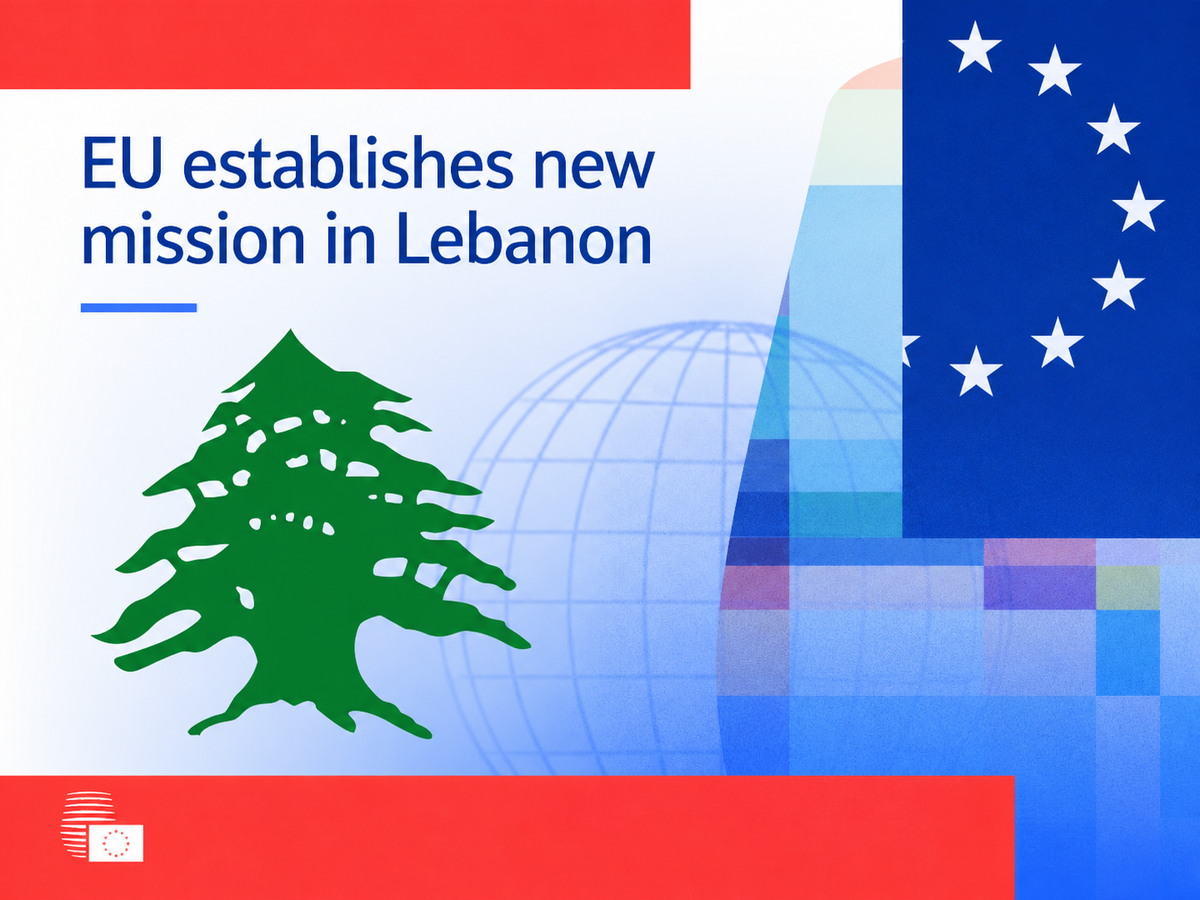
The European Union has formally established a new three-year security mission in Lebanon, marking one of the most significant expansions of European involvement in the country’s security sector in years.
The mission, known as the European Union Support Mission in Lebanon, or EUSM Lebanon, was approved by EU foreign ministers on October 12 under the bloc’s Common Security and Defence Policy. It will advise and train both the Lebanese Armed Forces and the Internal Security Forces, while also supporting maritime security and port governance.
The initial mandate will last three years.
The mission will have two pillars.
The military component will support the Lebanese Army in land and maritime border security, surveillance, intelligence gathering, reconnaissance, counter-smuggling operations and operational coordination.
The civilian component will work with the Internal Security Forces on areas including cybercrime, anti-smuggling operations and sustainable training structures. It will also support port security governance, including at the Port of Beirut.
EU foreign policy chief Kaja Kallas described the move as a major upgrade in security relations between Europe and Lebanon.
She said the mission is intended to strengthen Lebanon’s territorial control, border security and internal security while supporting state institutions in restoring full sovereignty.
That last point is the most important.
This is not simply another foreign training program.
The mission is being established at a time when Lebanon is under intense pressure to prove that the state, not Hezbollah or any other armed organization, controls the country’s territory, borders and security institutions.
It is also arriving just as UNIFIL prepares to leave.
The United Nations Interim Force in Lebanon is scheduled to begin withdrawing at the end of 2026 after the Security Council decided last year to terminate its mandate.
UNIFIL has been deployed in southern Lebanon since 1978 and currently includes roughly 7,500 personnel from nearly 50 countries.
That creates a serious security question.
Who fills the gap when UN peacekeepers leave?
The EU has been careful to say that its new mission will not replace UNIFIL.
EUSM Lebanon will not be a peacekeeping force deployed between Lebanon and Israel, and it will not be limited to southern Lebanon.
Instead, its purpose is to strengthen Lebanese institutions so that the state itself becomes more capable of performing tasks that have historically required outside assistance.
In theory, that is exactly what Lebanon needs.
For decades, the country has relied on international forces, foreign donors and outside mediation to compensate for weaknesses in its own institutions.
The long-term objective should not be to replace UNIFIL with another foreign force indefinitely.
It should be to create a Lebanese Army capable of securing the borders, enforcing state authority and preventing armed groups from operating independently.
But that is where the new European mission confronts Lebanon’s central contradiction.
Training is not the same as political authority.
The Lebanese Army can receive more equipment, better surveillance capabilities and stronger intelligence training.
It can improve border control.
It can become better at intercepting smuggling.
But none of that solves the Hezbollah problem unless Lebanon’s political leadership is willing to authorize the Army to establish exclusive state control over weapons.
Washington has been increasingly explicit on this point.
The United States has told Beirut that political commitments are no longer enough and that it expects measurable and verifiable progress toward Hezbollah’s disarmament.
U.S. officials have also signaled that reconstruction assistance, sanctions policy and support for Lebanese institutions could become increasingly tied to results.
Europe’s approach is somewhat different.
Rather than relying primarily on financial pressure, the EU is trying to strengthen the institutions that would eventually have to enforce sovereignty.
That makes EUSM Lebanon part of a broader Western strategy.
The United States applies pressure.
Europe builds institutional capacity.
The Lebanese state is expected to do the actual work.
More than ten EU member states are reportedly prepared to provide personnel and resources for the mission, according to Reuters. Operational planning is still underway, and the Council must adopt a separate decision before the mission formally deploys on the ground. EU officials hope it can become operational within the coming months.
The mission will also complement existing European financial assistance.
Over the past three years, the EU has provided around €160 million in military support to Lebanon, largely through the European Peace Facility. The new mission is intended to turn some of that financial assistance into a more permanent security partnership.
There is also a maritime dimension that has received less attention.
Lebanon’s coastline and ports are central to smuggling, trade and national security.
The explosion at the Port of Beirut in 2020 exposed catastrophic failures in port governance and state oversight.
The new EU mission will directly support maritime security and port management, including at Beirut Port.
That could eventually become important for weapons trafficking, customs enforcement and the movement of sanctioned goods.
But again, capacity only matters if the state uses it.
Lebanon’s institutions have rarely lacked international advice.
They have lacked political decisions.
The country has received billions in foreign assistance over decades.
The Army has been trained by the United States, France, Britain and other partners.
European governments have funded border-control programs.
International donors have supported customs reform and security agencies.
Yet Hezbollah retained its independent arsenal, smuggling networks remained active and the state repeatedly avoided direct confrontation with parallel military power.
That is why the success of EUSM Lebanon will not ultimately be measured by the number of training courses delivered.
It will be measured by whether Lebanese institutions gain actual control.
Can the Army secure the Syrian border?
Can the state prevent weapons smuggling?
Can the ISF enforce the law without political interference?
Can Beirut Port operate under credible security oversight?
And most importantly, can the Lebanese government finally enforce the principle that only the state possesses weapons?
If the answer remains no, then Europe will simply have created a better-trained security apparatus inside the same dysfunctional political framework.
The mission is therefore both an opportunity and a test.
Europe is committing itself to Lebanon for at least three years.
It is offering training, expertise and institutional support at exactly the moment when UNIFIL is preparing to withdraw and the Lebanese state is being asked to assume greater responsibility.
But foreign governments cannot restore Lebanese sovereignty on Lebanon’s behalf.
They can provide the tools.
Beirut still has to decide whether it is willing to use them.