France Burns as the Palestinian Flag Flies Over Paris
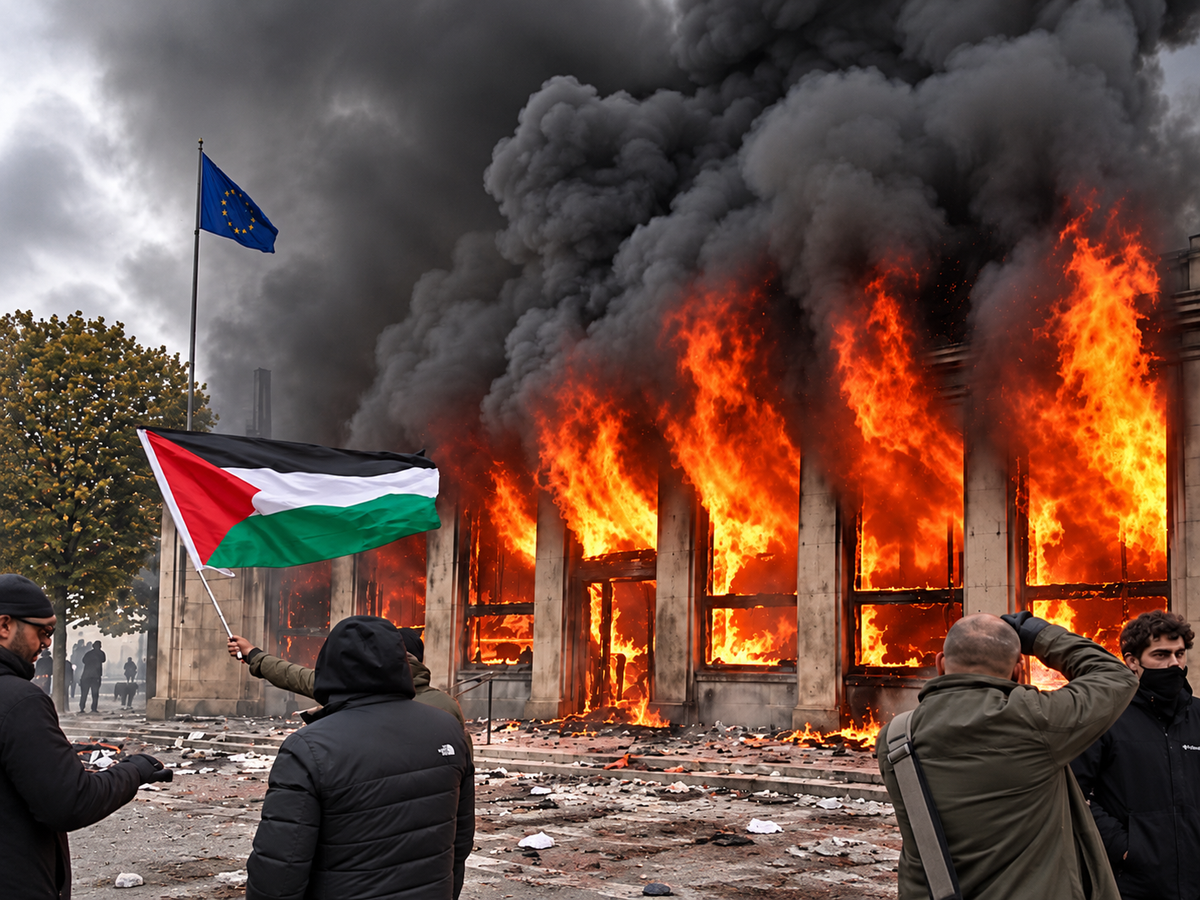
France endured some of its worst unrest in years as cars burned, public buildings were attacked and more than 1,200 people were arrested. Above the clashes at Place de la République, protesters raised a Palestinian flag.
France is burning again.
Cars were torched, shops looted, public buildings attacked and police assaulted as nationwide demonstrations descended into some of the country’s worst unrest in years. More than 1,200 people were arrested and at least 150 police officers were injured, according to Reuters. France’s prime minister blamed “ultra-left” groups and criminals for much of the violence.
And in the middle of Paris, above the chaos at Place de la République, flew the Palestinian flag. Reuters photographs showed protesters standing on the monument holding French and Palestinian flags as clashes unfolded nearby.
It is an image that captures the political crisis France has spent years creating for itself.
A European country struggling with collapsing public confidence, deteriorating schools, enormous public debt and recurring street violence has spent years pursuing an immigration model that continually increases the number of newcomers while struggling to integrate those already there.
France issued 377,000 first residence permits in 2025, up 9.2% in one year. Nearly 4.5 million non-EU foreigners held valid residence permits by the end of 2025. Another 116,944 first-time asylum applications were filed that year.
At the same time, the French state consumes extraordinary amounts of money.
Public expenditure reached 57.2% of GDP in 2025, around 7.4 percentage points above the euro-area average, while the OECD says outcomes in areas including health and education continue to lag behind the best-performing countries. Public debt is projected to approach 119% of GDP this year.
France taxes heavily.
France spends heavily.
Yet teachers complain about deteriorating schools, citizens complain about purchasing power, police repeatedly confront riots, and public debt keeps climbing.
That is not a lack of government.
It is a failure of government.
Then there is the radical left.
French intelligence services told a government crisis meeting earlier this month that elements linked to the hard-left France Unbowed movement and its affiliates were helping organize the wave of school protests. LFI denied orchestrating the unrest, but Interior Minister Laurent Nuñez said agitators were deliberately moving between schools to provoke disorder.
By Saturday, demonstrations had spread nationally.
Jean-Luc Mélenchon joined the Paris protest while masked groups elsewhere smashed property, attacked police and burned public buildings.
This is what happens when a political culture spends years romanticizing confrontation with the state.
Police become the enemy.
Borders become morally suspect.
National identity becomes embarrassing.
Every foreign grievance becomes a French domestic cause.
And when the consequences arrive in the streets, the same political class acts surprised.
The Palestinian flag above Paris is therefore more than an incidental image.
France has allowed the Israeli-Palestinian conflict to become deeply embedded in its domestic political life.
Pro-Palestinian activism now occupies universities, municipal politics and demonstrations that often have nothing to do with the Middle East.
The result is a country increasingly importing the passions and conflicts of other societies into its own already fractured political environment.
Meanwhile, France’s own problems remain unsolved.
Its schools are struggling.
Its debt is climbing.
Its streets repeatedly erupt.
Its integration model remains deeply contested.
Its police are stretched.
And its political extremes continue gaining ground.
Immigration policy belongs in that discussion.
France can decide democratically how much immigration it wants. But admitting hundreds of thousands of new residents every year while large parts of the country are already struggling with integration, housing, education and social cohesion is not a cost-free decision.
The French left has too often treated anyone questioning that model as morally suspect rather than confronting whether the model itself is working.
Saturday offered another reminder that social cohesion cannot simply be assumed.
Nor can public order.
Limoges City Hall was set ablaze.
The Lyon tourism office burned.
A municipal police station in Marseille was attacked.
Shops were looted.
Cars were set on fire.
Masked protesters fought riot police across major cities.
These are not acts of political courage.
They are the destruction of the country protesters claim to want improved.
Burning a town hall does not strengthen public services.
Looting stores does not lower prices.
Assaulting police does not repair schools.
And raising a foreign flag over Paris while French cities burn is unlikely to reassure citizens who already believe their political class has lost sight of its most basic responsibility: France itself.
For years, European leaders believed prosperity, welfare spending and liberal social policy could absorb almost unlimited political and cultural tensions.
France is discovering the limits of that assumption.
A state can redistribute enormous amounts of money and still lose social cohesion.
It can welcome large numbers of newcomers and still fail at integration.
It can champion international causes while neglecting domestic confidence.
It can tolerate increasingly radical street politics until disorder becomes routine.
And eventually the bill arrives.
France's fires are not the product of one decision made last week.
They are the accumulated consequence of years in which the state expanded while its authority weakened.
That is the contradiction now visible in the streets.
One of Europe's largest governments increasingly struggles to perform one of government's oldest duties:
Keep order.
France is burning.
And above the smoke in Paris, the Palestinian flag was flying.