Houthi Attack on Riyadh Airport Kills 12 and Injures More Than 300
A Houthi attack on Riyadh’s King Khalid International Airport has killed at least 12 people and wounded more than 300, making it the deadliest strike on Saudi soil in more than a decade.
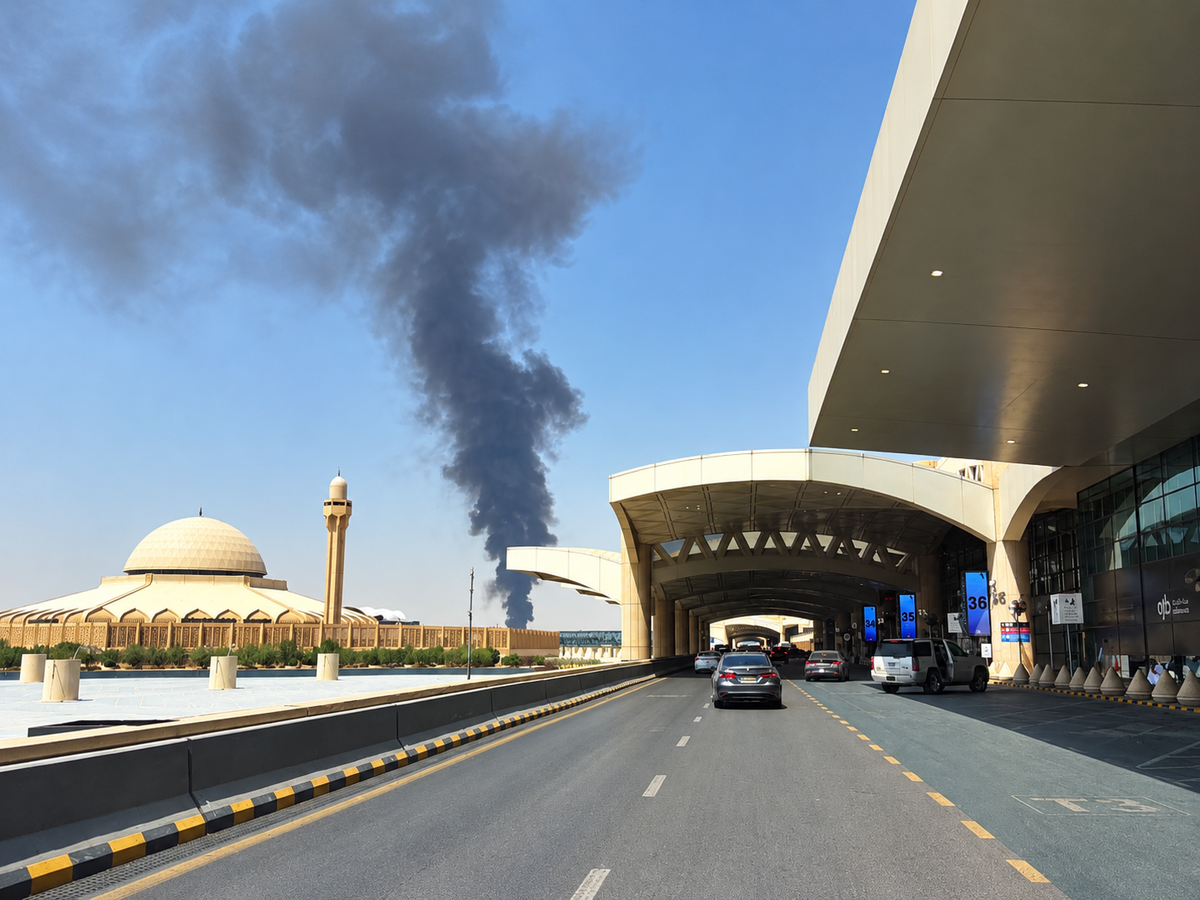
A Houthi attack on Riyadh’s King Khalid International Airport has killed at least 12 people and injured more than 300, marking the deadliest strike on Saudi soil in more than a decade and a major escalation in the renewed war between Saudi Arabia and Yemen’s Houthis.
Saudi authorities said the October 10 attack struck a passenger terminal at the airport. The dead included nationals from Saudi Arabia, the United States, Jordan, Palestine, Syria, Sudan, Egypt and Bangladesh. Several of the more than 300 wounded remain in critical condition.
The Saudi-led coalition blamed the Iran-backed Houthis and described the strike as a “fully fledged war crime,” saying a civilian airport had been deliberately targeted. The Houthis have been launching repeated missile attacks against Saudi aviation and infrastructure since fighting in Yemen sharply escalated again this month.
This was not an isolated incident.
Only two days earlier, another Houthi attack on the same airport damaged a parked Saudia passenger aircraft after missile debris or another projectile struck the plane and caused a fire. Three Saudis were later confirmed killed in attacks around the airport that week.
The latest strike was far more destructive.
Flights were suspended and aircraft diverted as emergency crews responded to the terminal. Airlines have already begun reconsidering operations to Riyadh, while governments including Britain, France and Germany have issued updated travel warnings.
The Houthis have also warned commercial airlines to avoid Saudi airspace, effectively attempting to turn one of the Middle East’s largest aviation markets into a conflict zone.
That is the strategic significance of the attack.
Saudi Arabia is no longer dealing with occasional missile interceptions over distant border regions.
The war has reached the kingdom’s capital.
King Khalid International Airport is not simply another civilian facility. It is the main gateway to Riyadh, the political and economic center of the country, and an increasingly important hub for the kingdom’s attempt to transform itself into a global investment, tourism and business destination.
Riyadh is preparing to host major international events, including the World Petroleum Congress and the Future Investment Initiative.
Saudi organizers say both will proceed despite the attack.
That decision reflects the dilemma facing the kingdom.
Cancelling major conferences would hand the Houthis exactly the strategic effect they are seeking: demonstrating that missile attacks can disrupt normal life, damage confidence and impose economic costs far beyond Yemen.
But continuing as normal becomes harder when an airport terminal has been struck and hundreds of civilians have been wounded.
The attack is also raising difficult questions about Saudi air defenses.
Saudi Arabia possesses some of the most advanced Western air-defense systems in the region, including American Patriot batteries.
Yet repeated missiles have still reached Riyadh.
Interception itself can also create danger. Even when incoming weapons are destroyed, falling debris can hit populated areas, aircraft or infrastructure, as appears to have happened during earlier attacks this week.
Saudi Arabia is therefore pressing allies for additional air-defense support as its interceptor stocks come under pressure.
The wider conflict began accelerating after Saudi-backed Yemeni government forces launched a major offensive against Houthi positions near Bab el-Mandeb.
Government forces retook strategic territory around the strait and pushed the Houthis back from parts of Yemen’s western coast.
Bab el-Mandeb is one of the most important maritime chokepoints in the world, connecting the Red Sea and Suez Canal to the Indian Ocean.
Saudi Arabia considers Houthi control of that coastline a direct threat to its trade and energy security, particularly while instability around the Strait of Hormuz has increased the importance of Red Sea routes.
The Houthis have responded by taking the fight into Saudi Arabia.
Their recent campaign has targeted airports, energy facilities and major cities rather than concentrating only on Saudi-backed forces inside Yemen.
That changes the political calculation in Riyadh.
Saudi Arabia spent years trying to disengage from the Yemen war after its 2015 intervention failed to defeat the Houthis.
The 2022 ceasefire dramatically reduced cross-border attacks and allowed Riyadh to focus on economic development rather than permanent military confrontation.
That period is now over.
The Yemen conflict has again become one of the central fronts of the wider regional struggle involving Iran, the United States and their respective allies.
Washington is already reassessing its own role.
President Donald Trump has said the United States is considering joining Saudi military operations against the Houthis following the airport attack, while Secretary of State Marco Rubio has condemned the strike.
That would represent another important escalation.
The United States has already provided intelligence and military support to Saudi-backed forces.
Direct American participation would move Washington much closer to becoming an active combatant in the renewed Yemen war.
Turkey and Pakistan are also involved through the recently activated Mecca Defence Agreement with Saudi Arabia, while Syria has reportedly considered offering military assistance.
The conflict is therefore rapidly expanding beyond its original Yemeni battlefield.
For the Houthis, the logic appears straightforward.
If Saudi Arabia supports an offensive against them inside Yemen, they will make the cost felt inside Saudi Arabia itself.
But attacking civilian airports also carries enormous risk.
The latest victims were travelers and airport workers from across the region and beyond.
That makes the strike harder to frame simply as retaliation against the Saudi military.
It also increases the likelihood of a much larger response.
Twelve people are dead.
More than 300 are injured.
A major international airport has been repeatedly attacked in a matter of days.
And Saudi Arabia is now facing one of the most serious domestic security challenges it has experienced in years.
The Yemen war was once something Riyadh was trying to leave behind.
It is now landing directly inside the Saudi capital.