Houthi Missile Strikes Saudi Aramco Headquarters Complex
A ballistic missile has struck an administrative tower inside Saudi Aramco’s headquarters complex in Dhahran, damaging its upper floors and causing a fire. No casualties were reported and oil production was not immediately affected.
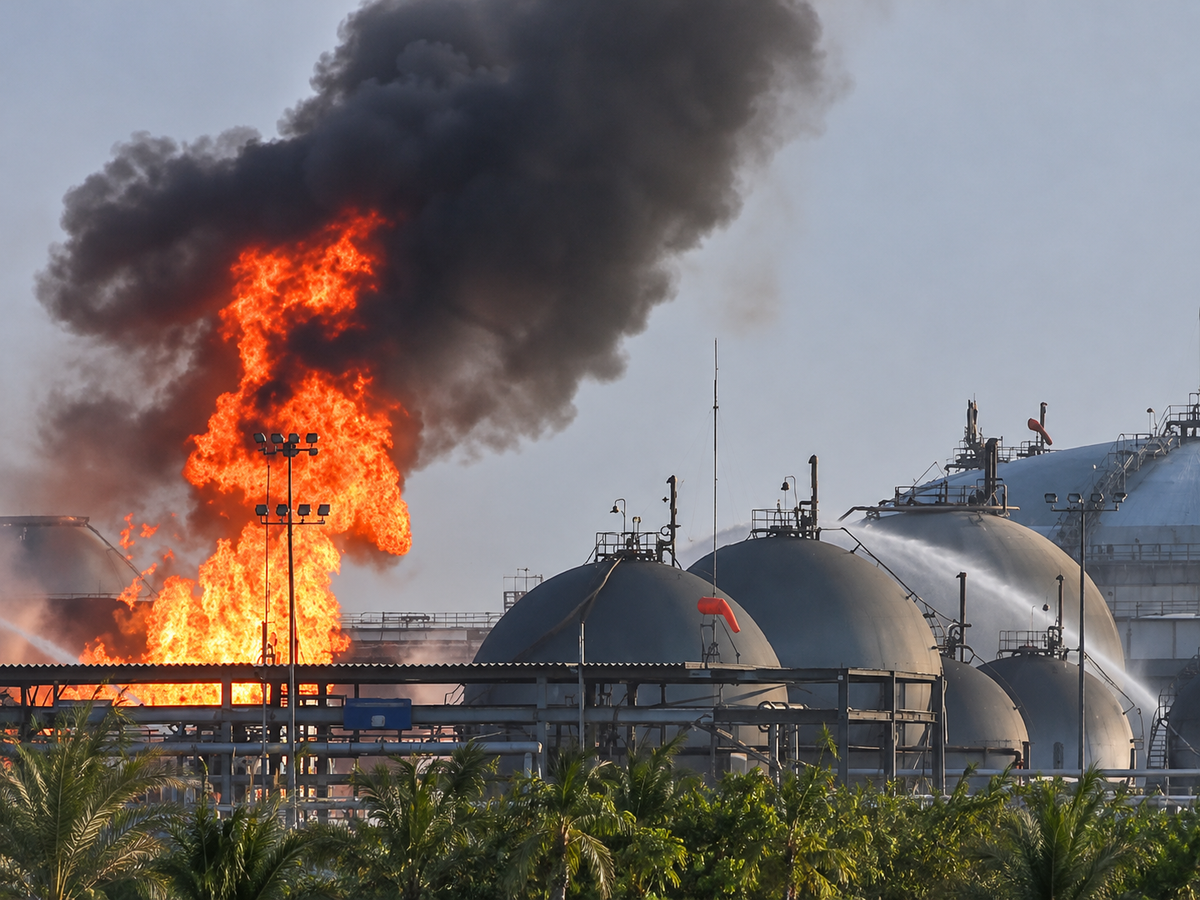
A ballistic missile has struck the headquarters complex of Saudi Aramco in Dhahran, bringing the renewed war with Yemen’s Houthis directly to the center of Saudi Arabia’s oil industry.
Saudi Arabia’s Energy Ministry confirmed that an administrative building inside the Aramco complex was attacked late Tuesday, causing a limited fire. No deaths or injuries were reported. A company source told Reuters that an office tower was hit and that its top three floors were damaged.
The significance of the target is difficult to overstate.
Dhahran is not simply another Aramco facility.
The headquarters complex contains a major operations center responsible for overseeing an enormous network of oil fields, pipelines, refineries and export terminals across the kingdom.
The attack therefore represents a direct strike at the administrative heart of the world’s largest oil company.
Saudi authorities said they responded quickly and contained the fire. There was no immediate indication that oil production or exports had been disrupted.
But the Houthis did not choose the target accidentally.
Hours before the strike, Houthi military spokesman Yahya Saree had explicitly warned workers and civilians to stay away from Saudi Aramco facilities, naming the company’s headquarters and other energy infrastructure as possible targets.
The warning followed Saudi-led airstrikes against Houthi-controlled fuel infrastructure around Sanaa.
The coalition said the strikes were intended to reduce the Houthis’ ability to threaten Saudi Arabia, Yemen and international shipping. Houthi officials promised a “harsh and painful” response.
That response appears to have begun almost immediately.
The Aramco strike is part of a broader barrage of missiles and drones that has hit or targeted Saudi Arabia over the past week.
Riyadh’s King Khalid International Airport has been attacked repeatedly, including a ballistic missile strike that killed 13 people and wounded more than 300. International airlines subsequently suspended or reduced services as the security situation deteriorated.
Saudi air defenses have intercepted additional missiles and drones over Riyadh and other parts of the kingdom.
But interceptions do not eliminate the danger.
Four people, including a child, were injured in Riyadh after debris from intercepted Houthi missiles fell into residential neighborhoods, damaging 15 homes.
The attack on Dhahran highlights a larger problem for Saudi Arabia.
The kingdom has spent enormous sums building one of the most sophisticated air-defense networks in the region.
It operates Patriot systems, advanced combat aircraft and other Western military technology.
Yet the Houthis continue to demonstrate that relatively inexpensive ballistic missiles and drones can penetrate or overwhelm parts of that defensive umbrella.
The Financial Times reported that Saudi defenses are being strained by the intensity of the attacks and by pressure on interceptor inventories as conflict spreads across the region.
That imbalance has always been one of the Houthis’ greatest advantages.
They do not need to destroy Saudi Arabia’s oil industry.
They only need to demonstrate that they can threaten it.
A missile landing inside Aramco’s headquarters complex sends exactly that message.
The same principle applies to airports.
A single successful strike can ground flights, force airlines to reroute aircraft and increase insurance costs across an entire aviation market.
Energy infrastructure is even more sensitive.
Saudi Arabia remains one of the world’s most important oil exporters, and global markets depend heavily on its ability to produce and ship crude without interruption.
Dhahran sits at the center of that system.
Saudi Arabia’s largest oil fields are concentrated in the Eastern Province and offshore in the Gulf, while Aramco’s headquarters coordinates operations extending across the kingdom.
Other Saudi energy assets have already come under attack.
A refinery at Jazan has been shut following an earlier strike, while an important Red Sea oil export facility has also been targeted. A cross-country pipeline used to move crude toward western export terminals was temporarily disrupted last month following another attack.
The cumulative effect matters more than any single incident.
Every successful strike raises the perceived risk around Saudi energy infrastructure.
Higher risk means higher insurance premiums.
Higher insurance costs affect shipping.
Potential disruption to production pushes traders to price additional uncertainty into oil markets.
And the wider regional economy becomes more vulnerable.
The Houthis appear to understand that pressure point.
Their current strategy is increasingly focused on targets that create economic disruption far beyond the physical damage caused by the missile itself.
The renewed confrontation began after Saudi Arabia intensified support for Yemeni government forces fighting the Houthis, particularly around strategic territory near Bab el-Mandeb.
Saudi-backed forces have been trying to regain areas controlling one of the world’s most important maritime chokepoints.
The Houthis have responded by widening the battlefield into Saudi Arabia itself.
Airports.
Oil facilities.
Major cities.
Now Aramco headquarters.
This represents a return to a pattern Saudi Arabia had spent years trying to escape.
After the kingdom intervened militarily in Yemen in 2015, the Houthis repeatedly targeted Saudi energy facilities, airports and cities.
A 2019 attack on the Abqaiq oil-processing facility temporarily knocked out roughly half of Saudi crude production and demonstrated just how vulnerable even heavily protected infrastructure could be.
Years of negotiations and relative calm eventually reduced cross-border attacks.
That period is effectively over.
The current conflict is also unfolding inside a much more dangerous regional environment.
Iran, the Houthis’ principal external supporter, is already engaged in a wider confrontation with the United States and Israel.
Red Sea shipping remains vulnerable.
Energy markets are already tight.
And Saudi Arabia is simultaneously trying to preserve its role as both an energy superpower and a rapidly developing global investment hub.
That makes continued Houthi attacks strategically costly even when physical damage remains limited.
The Aramco strike did not shut down Saudi oil production.
It did something else.
It demonstrated that the Houthis can still reach one of the most symbolically and economically important locations in the kingdom.
Saudi Arabia now faces a difficult choice.
It can intensify military pressure inside Yemen and risk further retaliation against its cities and energy infrastructure.
Or it can search for another negotiated settlement with an armed movement that has repeatedly shown it can impose serious costs on the kingdom.
For now, Riyadh appears to be choosing escalation.
The Saudi cabinet has warned that the Houthis will face consequences for the recent attacks, while coalition aircraft have already struck fuel and military targets around Sanaa.
But every new round of strikes creates the possibility of another missile headed toward Riyadh, Dhahran or Saudi Arabia’s oil infrastructure.
The fire at Aramco headquarters was limited.
The warning it delivered was not.