Israel Ties Withdrawal From Southern Lebanon to the Lebanese Army’s Ability to Replace Hezbollah
Israel is increasingly linking its withdrawal from southern Lebanon to the Lebanese Army’s performance on the ground.
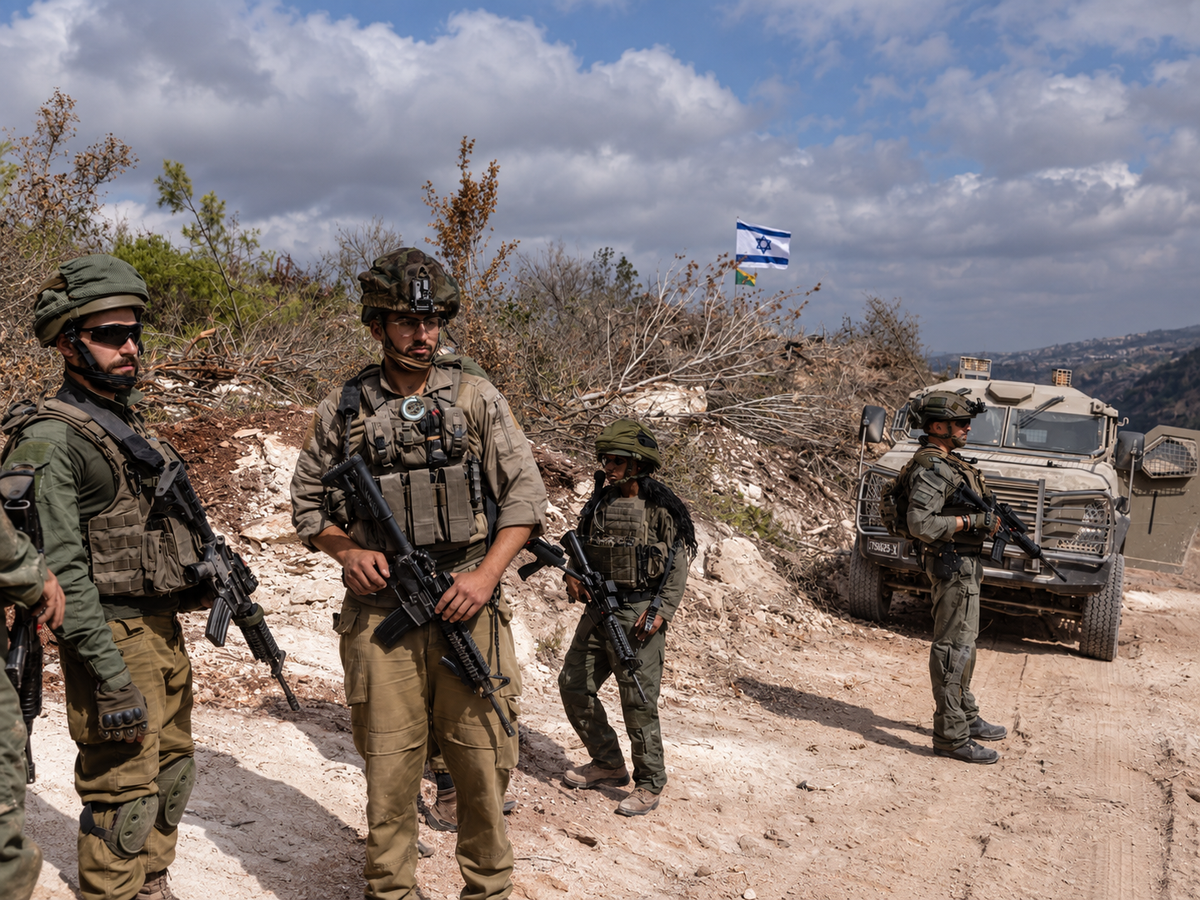
Israel is making its position on southern Lebanon increasingly explicit: withdrawal will depend not only on political agreements, but on whether the Lebanese Army can actually take control of the territory and prevent Hezbollah from returning.
The clearest statement came from Israeli military chief Lt. Gen. Eyal Zamir, who said the broader objective of disarming Hezbollah “cannot be advanced” through an agreement with Beirut unless the Lebanese Army “significantly improves its effectiveness on the ground.”
That language matters because it shifts the discussion from what Lebanon has promised to what its army is demonstrably capable of doing.
The U.S.-brokered framework agreed in June already linked Israeli withdrawals to the deployment of Lebanese forces and the dismantling of Hezbollah’s military presence. Under the arrangement, Israel would withdraw from parts of southern Lebanon in stages while the Lebanese Army entered so-called pilot zones, confiscated unauthorized weapons and established state control.
But implementation has stalled.
Hezbollah has rejected the framework and refused to disarm under its current terms. Israel, meanwhile, says the Lebanese Army has not moved quickly or forcefully enough to dismantle Hezbollah infrastructure or prevent the group from rebuilding.
Israel has already withdrawn from several limited pilot areas where Lebanese troops were deployed, but it says there will be no broader withdrawal until the security conditions change.
That means the Lebanese Army is increasingly becoming the central variable in the entire agreement.
From Israel’s perspective, the question is no longer simply whether Beirut declares that the state should hold a monopoly over weapons.
It is whether the Army can enter former Hezbollah areas, find and dismantle military infrastructure, stop weapons from returning and hold the territory after Israeli forces leave.
That is also why Israel’s seizure of Ali al-Taher has become so important.
Israeli forces took control of the strategic ridge near Nabatieh and later destroyed what they described as a large Hezbollah underground complex containing tunnels, command facilities, weapons storage and other military infrastructure. Israel said the site had functioned as a major command center for Hezbollah’s Badr unit.
Defense Minister Israel Katz subsequently said Israel would continue controlling the ridge and would not withdraw until Hezbollah was disarmed throughout Lebanon. He warned that Israel would prevent any attempt by Hezbollah or another armed force to return to the area.
The message is increasingly blunt.
Israel does not appear prepared to leave territory simply because a diplomatic timetable says it should.
It wants evidence that whoever replaces the Israeli military can prevent Hezbollah from re-establishing itself.
That puts enormous pressure on the Lebanese Army.
President Joseph Aoun has argued that Lebanon has already done what was required and that continued Israeli occupation and strikes are preventing full implementation of the agreement. Lebanese officials also argue that the Army cannot reasonably establish complete control while Israeli forces remain inside Lebanese territory and continue conducting operations.
That argument has support from France and other international partners, which have repeatedly said continued Israeli military action complicates Lebanon’s effort to expand state authority.
But Israel is now effectively presenting the reverse argument.
It says it cannot withdraw until it is convinced that Lebanese state forces are strong and effective enough to take over.
That creates a circular problem.
Lebanon argues that Israel must withdraw so the Lebanese Army can exercise sovereignty.
Israel argues that the Lebanese Army must first demonstrate sufficient sovereignty before Israel withdraws.
Hezbollah’s refusal to disarm sits in the middle of that deadlock.
The result is that southern Lebanon risks settling into a prolonged stalemate.
Israel currently controls a security zone extending roughly 10 kilometers into Lebanese territory in some areas and has said it will maintain that presence until Hezbollah no longer poses a military threat. Prime Minister Benjamin Netanyahu has similarly said Israel will not withdraw while Hezbollah remains capable of threatening northern Israel.
At the same time, UNIFIL is preparing to leave.
The UN peacekeeping mission, which has operated in southern Lebanon for nearly five decades, is scheduled to begin its drawdown at the end of 2026. Its commander has warned that the transition must be carefully managed because Lebanese forces will need to assume responsibilities previously supported by thousands of international peacekeepers.
That is why France, Jordan and other international partners are now discussing how to strengthen the Lebanese Army before UNIFIL departs.
The Paris talks held this week focused specifically on training, equipment, intelligence and financial support for the Army, as well as possible alternatives to the UN mission.
The international community is therefore converging on the same institution.
Lebanon says the Army is the mechanism through which sovereignty will be restored.
France says it must be strengthened so it can replace UNIFIL and secure the south.
The United States is increasingly tying its support to measurable results.
And Israel is now saying openly that withdrawal depends on whether the Army can actually perform the role being assigned to it.
That gives Lebanon’s military an importance it has arguably never had before.
But it also creates an uncomfortable test.
For decades, Lebanese governments have argued that Hezbollah’s weapons could not simply be removed by force because doing so risked civil conflict.
That problem has not disappeared.
The Lebanese Army remains underfunded, politically constrained and tasked with operating in areas where Hezbollah retains deep social and organizational influence. International partners can provide weapons, training and salaries, but they cannot make the political decisions for Beirut.
This distinction is becoming increasingly important.
If the Army is not authorized to confront unauthorized military infrastructure, then strengthening it materially may not change much.
And if the government does authorize it, the political consequences inside Lebanon could be severe.
Israel’s position therefore places responsibility not only on the Lebanese Army, but on Lebanon’s political leadership.
The question is not simply whether the Army is strong enough.
It is whether the state is willing to use it to establish a genuine monopoly over force.
There is also an important limit to Israel’s argument.
Linking withdrawal indefinitely to Lebanon meeting conditions defined by Israel could allow a temporary security zone to become effectively permanent. Israeli officials have already used increasingly open language about maintaining control in southern Lebanon, while Lebanese officials argue that continued occupation itself undermines the state forces Israel says it wants strengthened.
That is why the next phase of negotiations will matter.
A workable agreement would require both sides to move in parallel: Lebanese forces replacing Hezbollah’s military infrastructure as Israeli forces withdraw, with outside verification that neither side reverses the process.
Without that sequencing, each side has an incentive to wait for the other.
For now, however, Israel’s condition is becoming increasingly clear.
It is no longer saying simply that Hezbollah must disarm.
It is saying the Lebanese Army must prove that it can replace Hezbollah before Israel is prepared to leave.
And that makes the future of southern Lebanon increasingly dependent on whether Lebanon’s state institutions can finally exercise the sovereignty they have promised for decades.