Kundarji: The Ottoman History Behind the Lebanese Word for Shoemaker
The Lebanese word kundarji (كندرجي), meaning shoemaker, comes from Ottoman Turkish kunduracı. Its origins reach further back to Byzantine Greek, revealing centuries of linguistic exchange across the eastern Mediterranean.
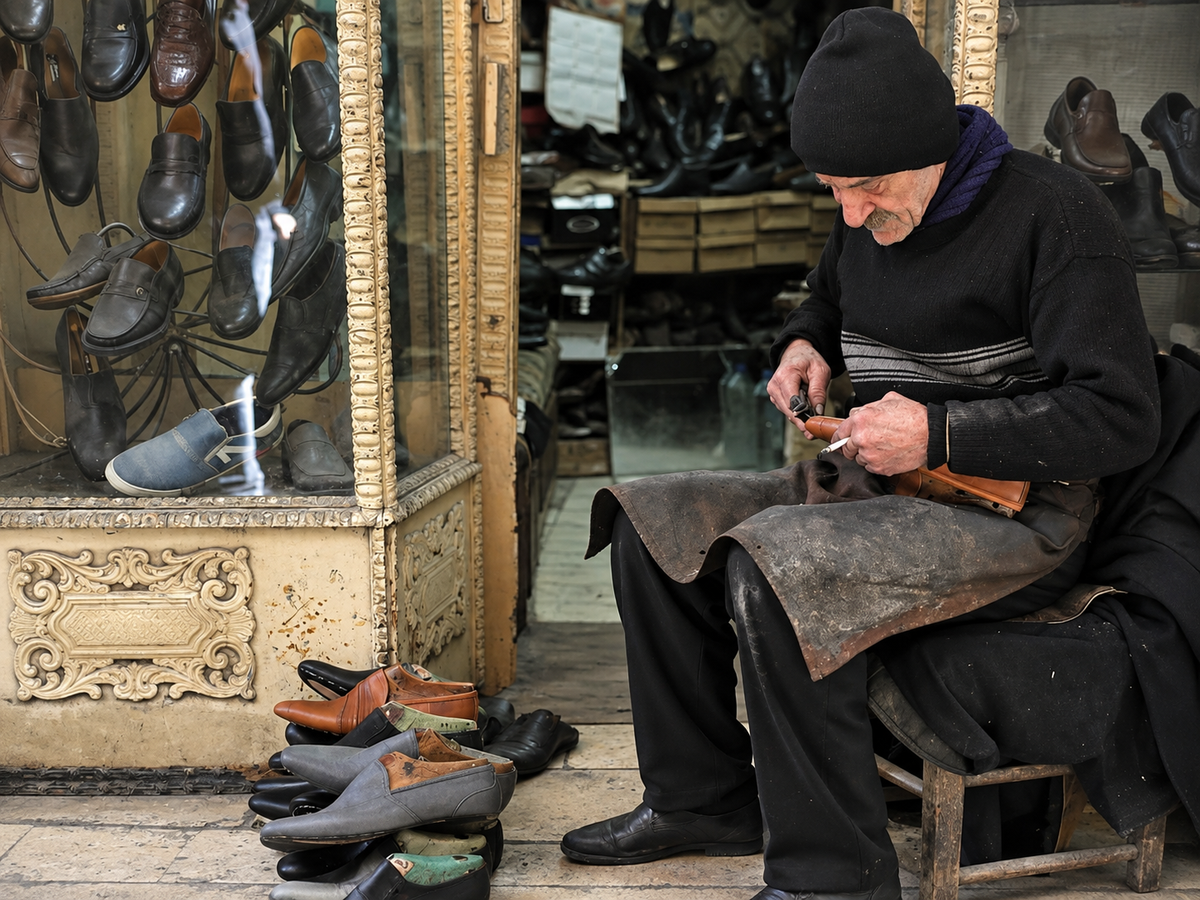
In older Lebanese neighborhoods, there was once a craftsman who could give a worn-out pair of shoes a second life.
He repaired broken heels, replaced leather soles, stitched torn shoes and polished footwear until it looked almost new.
People called him the kundarji (كندرجي).
The word remains familiar to many Lebanese, particularly older generations. But its origins reveal something much larger than the history of a traditional profession.
It is a linguistic reminder of the Ottoman Empire and the centuries during which Turkish vocabulary entered everyday Lebanese Arabic.
And the story begins with a shoe.
Where Does the Word Kundarji Come From?
The Lebanese word kundarji, also pronounced kendarji, comes from Ottoman Turkish kunduracı, meaning shoemaker.
The word can be divided into two elements.
Kundura means shoe, while the Turkish occupational suffix -cı, which also appears as -ci, -cu or -cü, identifies someone associated with a particular occupation or activity.
Together, they produce kunduracı: a person who makes or works with shoes.
As the word entered Arabic dialects, its pronunciation changed.
The Turkish occupational ending became the familiar colloquial suffix -ji (جي), producing kundarji.
But there is another linguistic layer.
The Ottoman Turkish word kundura itself has roots in Byzantine Greek, with scholars tracing it to Greek terms associated with footwear.
The Lebanese expression therefore preserves a history of linguistic borrowing connecting Greek, Ottoman Turkish and Arabic.
A single word carries the traces of several civilizations that influenced the eastern Mediterranean.
Four Centuries of Ottoman Influence
The Ottoman Empire established control over much of the territory of present-day Lebanon in 1516.
For approximately four centuries, the region remained within the Ottoman political system, until Ottoman rule ended in 1918.
Arabic continued to be the principal spoken language of the local population, but Ottoman Turkish influenced administration, military affairs, commerce and everyday vocabulary.
People encountered Turkish expressions through officials, soldiers, merchants, craftsmen and commercial networks.
Over time, some became so familiar that speakers no longer recognized them as foreign.
This was particularly noticeable in the vocabulary of occupations.
The suffix -ji became an established feature of colloquial Arabic, used to describe people associated with specific trades and activities.
The kundarji was one example of this linguistic inheritance.
Why So Many Lebanese Professions End in Ji
The influence of Ottoman Turkish extends well beyond shoemaking.
Lebanese Arabic contains numerous occupational names ending in -ji.
The kahwaji (قهوجي) prepares or serves coffee.
The saatji (ساعاتجي) repairs or sells watches and clocks.
The boyaji (بوياجي) is associated with painting or polishing, depending on local usage.
The arabaji (عربجي) traditionally drove a horse-drawn carriage.
Not all these words have identical linguistic histories. Some combine Arabic roots with a Turkish-derived ending, while others were borrowed more directly from Ottoman Turkish.
That distinction is important.
The suffix eventually became so familiar that Arabic speakers could attach it to words from different origins.
It was no longer necessary for the entire expression to be Turkish.
This helps explain why Ottoman linguistic influence survived long after Ottoman rule ended.
The empire disappeared, but parts of its vocabulary became ordinary Lebanese speech.
The Kundarji in the Old Lebanese Neighborhood
The profession itself has a much older history than the Ottoman word used to describe it.
Shoemakers and leatherworkers existed throughout the Middle East for centuries.
In traditional towns, artisans often operated small workshops close to markets and other trades.
The kundarji worked with leather, thread, nails, adhesives and specialized tools.
His work demanded precision.
A damaged sole needed to be removed without ruining the shoe. A replacement heel had to fit properly. Leather required cutting, shaping and stitching.
Repairing footwear was particularly important when replacing shoes represented a significant household expense.
Rather than discard a damaged pair, families could return to the same craftsman repeatedly.
The kundarji became a recognizable figure in neighborhood life, serving customers who often knew him personally.
His workshop was both a workplace and a small part of the local social landscape.
Tripoli's Souk al-Kundarjiyeh
One of the clearest examples of the profession's historical importance survives in Tripoli.
The old city contains a market historically known as Souk al-Kundarjiyeh, also called Souk al-Kandarjiyeh, named after the shoemakers associated with the area.
Tripoli's traditional markets developed through centuries of Mamluk and Ottoman urban life.
Different streets and commercial areas became associated with particular trades, including metalworking, perfumes, jewelry, textiles and leather goods.
The former shoemakers' market is also known as Souk al-Arid, or the Wide Market.
As commerce changed, the area became increasingly associated with ready-made footwear rather than traditional shoe production.
Historical research published in 2020 documented shoe repair workshops still operating in adjoining covered passages.
The market's name preserved the memory of the craftsmen who once defined its commercial identity.
Even when businesses changed, the old occupational name remained part of the city's history.
From Making Shoes to Repairing Them
The role of the kundarji changed significantly during the twentieth century.
As factory-made footwear became more widely available, traditional shoemaking faced increasing competition.
Imported shoes, mass production and changing consumer habits reduced demand for individually crafted footwear.
Many workshops shifted toward repairs.
Instead of making an entire shoe, the craftsman increasingly replaced soles, repaired heels, fixed stitching or restored damaged leather.
Some workshops closed as younger generations pursued other occupations.
Yet the trade did not disappear completely.
Traditional shoemaking and repair continue in parts of Lebanon, including Tripoli's historic markets, although the profession no longer occupies the same place in everyday commercial life.
For customers seeking to extend the life of their footwear, the kundarji still offers an alternative to purchasing a replacement.
A Word That Outlived an Empire
What makes kundarji particularly interesting is that Lebanese speakers continued using it long after the Ottoman Empire disappeared.
The same is true of many other expressions inherited from Ottoman Turkish.
These words became part of the local dialect because people used them in ordinary situations, not because they consciously preserved an imperial legacy.
Language rarely changes all at once when political borders or governments change.
Older expressions remain useful, familiar and embedded in daily life.
Eventually, their origins become almost invisible.
Someone asking for the neighborhood kundarji is unlikely to think about Byzantine Greek, Ottoman Turkish or centuries of linguistic contact.
They simply want their shoes repaired.
Yet the word preserves those historical layers.
The History Hidden in Lebanese Arabic
Lebanese Arabic reflects centuries of linguistic exchange.
Its foundations are Arabic, but its vocabulary also preserves influences from Aramaic, Syriac, Turkish, Persian, French, Italian and other languages.
Some borrowed words describe food. Others refer to clothing, household objects, administration or occupations.
They reveal the routes through which goods, customs and ideas entered the country.
Kundarji is a particularly revealing example because both the word and the profession belong to Lebanon's everyday social history.
The shoemaker's workshop may be less common than it once was.
But the name remains a reminder of the craftsmen who served generations of Lebanese families.
Behind that familiar name lies a much older story.
A word with Greek origins entered Ottoman Turkish, became associated with a profession and eventually found its way into the vocabulary of Lebanese neighborhoods.
Centuries later, Lebanese people still use it.
Sometimes, the history of a country is preserved not in monuments or museums, but in the ordinary words people say without thinking.