Why Was Beirut Once Known for Its Roman Law School?
Nearly 1,800 years ago, Beirut was home to one of the Roman Empire's most prestigious law schools. Known as Berytus, the city attracted students from across the eastern Mediterranean and earned a reputation as the Mother of Laws.
Why Was Beirut Once Known for Its Roman Law School?
Nearly 1,800 years ago, students traveled to Beirut from across the Roman Empire to study law.
They came from Syria, Palestine, Asia Minor and other parts of the eastern Mediterranean, seeking an education that could open doors to careers in imperial administration and the courts.
Their destination was Berytus, the Roman name for Beirut.
Long before the city became known for its modern universities, it was home to one of the Roman Empire's most prestigious centers of legal education.
Its reputation was so remarkable that imperial legislation celebrated Beirut as a place where Roman law was nurtured.
But how did a Mediterranean port become an intellectual capital of the empire?
From Roman Colony to Legal Center
Beirut's transformation began under Roman rule.
During the reign of Augustus, in the late first century BC, Berytus became a Roman colony known as Colonia Iulia Augusta Felix Berytus.
The colony was settled by Roman military veterans and developed institutions closely connected to Roman political and legal traditions.
Latin held an important position in public life, even as Greek remained widely spoken throughout the eastern provinces.
This environment helped distinguish Beirut from many neighboring cities.
Roman law was not simply a distant imperial system. It was part of the colony's administrative identity.
The exact origins of Beirut's law school remain uncertain. Although legal teaching may have existed earlier, the institution's reputation became firmly established by the third century AD.
The School That Attracted the Empire
By late antiquity, Beirut had become one of the leading centers for studying Roman jurisprudence.
Students traveled there to learn how imperial laws were interpreted, applied and organized.
Legal education was particularly valuable in an empire governed through complex administrative institutions.
A successful student might pursue a career as an advocate, legal adviser, judge or imperial official.
Beirut's school offered access to teachers whose knowledge of Roman legal texts was respected far beyond the city.
Its reputation grew particularly strong during the fifth century, when distinguished professors developed influential methods of legal instruction.
Among its most famous later professors were Dorotheus and Anatolius, who participated in the legal reforms of Emperor Justinian.
Their involvement illustrates the school's standing within the empire.
Beirut was not merely teaching Roman law.
Its scholars were helping preserve and transmit it to future generations.
Why Was Beirut Called the Mother of Laws?
One of the city's most enduring historical titles was Nutrix Legum, more precisely translated as the Nurse or Nurturer of Laws.
The expression appeared in Justinian's sixth-century legislation and reflected Beirut's reputation as a center of legal education.
It is also commonly rendered as the Mother of Laws, emphasizing the city's role in cultivating Roman jurisprudence.
Its fame rested on the quality of its teaching and its close connection to Roman legal institutions.
Unlike modern universities, the law school did not necessarily operate within a single purpose-built campus.
Education involved professors, students, legal texts and lecture spaces within the urban environment.
The precise location of the school remains uncertain, despite archaeological discoveries in central Beirut.
What survives most clearly is its intellectual legacy rather than its buildings.
What Did Students Actually Study?
Studying law in Roman Beirut required years of demanding instruction.
Students examined the writings of prominent Roman jurists, imperial constitutions and principles governing legal disputes.
Their education involved interpreting complex legal texts and understanding how rules applied to practical cases.
In 533 AD, Justinian's educational reforms prescribed a formal five-year legal curriculum.
Students began with foundational concepts before progressing to increasingly advanced material.
The curriculum included Justinian's Institutes, Digest and Code, drawing extensively on earlier Roman jurists, particularly Ulpian and Papinian.
Latin remained central to the legal tradition, although Greek became increasingly important in legal instruction throughout the eastern empire.
For students whose everyday language was Greek, understanding Latin legal terminology could present a significant challenge.
The school therefore existed at the intersection of two major intellectual languages.
The Professors Who Helped Shape Justinian's Code
The greatest testament to Beirut's influence came during the reign of Emperor Justinian I, who ruled from 527 to 565.
Justinian launched an ambitious project to organize centuries of Roman legal material.
The resulting Corpus Juris Civilis, or Body of Civil Law, became one of the most influential legal compilations in history.
It included the Codex, a collection of imperial legislation; the Digest, selections from classical jurists; the Institutes, a legal textbook; and subsequent imperial legislation known as the Novels.
Two professors associated with Beirut, Dorotheus and Anatolius, served on the commission responsible for compiling the Digest.
Dorotheus also helped prepare the Institutes, alongside Tribonian and Theophilus.
Their participation connected Beirut directly to a legal project whose influence would extend far beyond the Roman Empire.
Centuries later, the revival of Roman legal studies helped shape European civil law traditions.
Legal systems around the world still reflect concepts transmitted through Roman jurisprudence.
A City Filled With Students
The presence of a major law school shaped everyday life in Beirut.
Students needed accommodation, food, books and places to gather.
The city's commercial activity and maritime connections made it accessible to travelers arriving from other provinces.
Historical accounts reveal student friendships, intellectual rivalries and religious debates.
Some students became involved in the theological controversies that characterized late antiquity.
One of the most valuable surviving accounts comes from Zacharias Scholasticus, a late fifth-century law student in Beirut who later became a prominent Christian writer.
His writings offer glimpses of student life, including friendships, religious controversies and the experience of studying law in the city.
They remind us that Roman Beirut was not simply a place of monuments and imperial buildings.
It was also a university town, populated by young people pursuing education and careers.
The Earthquake That Changed Everything
Beirut's prominence as a center of legal education suffered a devastating blow in the sixth century.
On July 9, 551 AD, a powerful earthquake struck the Lebanese coast.
The disaster caused widespread destruction in Beirut and surrounding areas, accompanied by a tsunami and destructive fires.
Ancient accounts describe collapsed buildings and substantial loss of life.
The earthquake severely damaged the city and disrupted the institutions associated with its intellectual life.
Following the disaster, legal teaching reportedly continued in nearby Sidon.
However, the surviving evidence does not establish precisely when or how the school's activities finally ended.
What is clear is that Beirut never regained its former prominence as an imperial center of legal education.
The disaster marked a turning point in an extraordinary chapter of the city's intellectual history.
What Remains of the Law School Today?
Unlike Baalbek's temples or Beirut's Roman baths, the law school has left no securely identified monumental building.
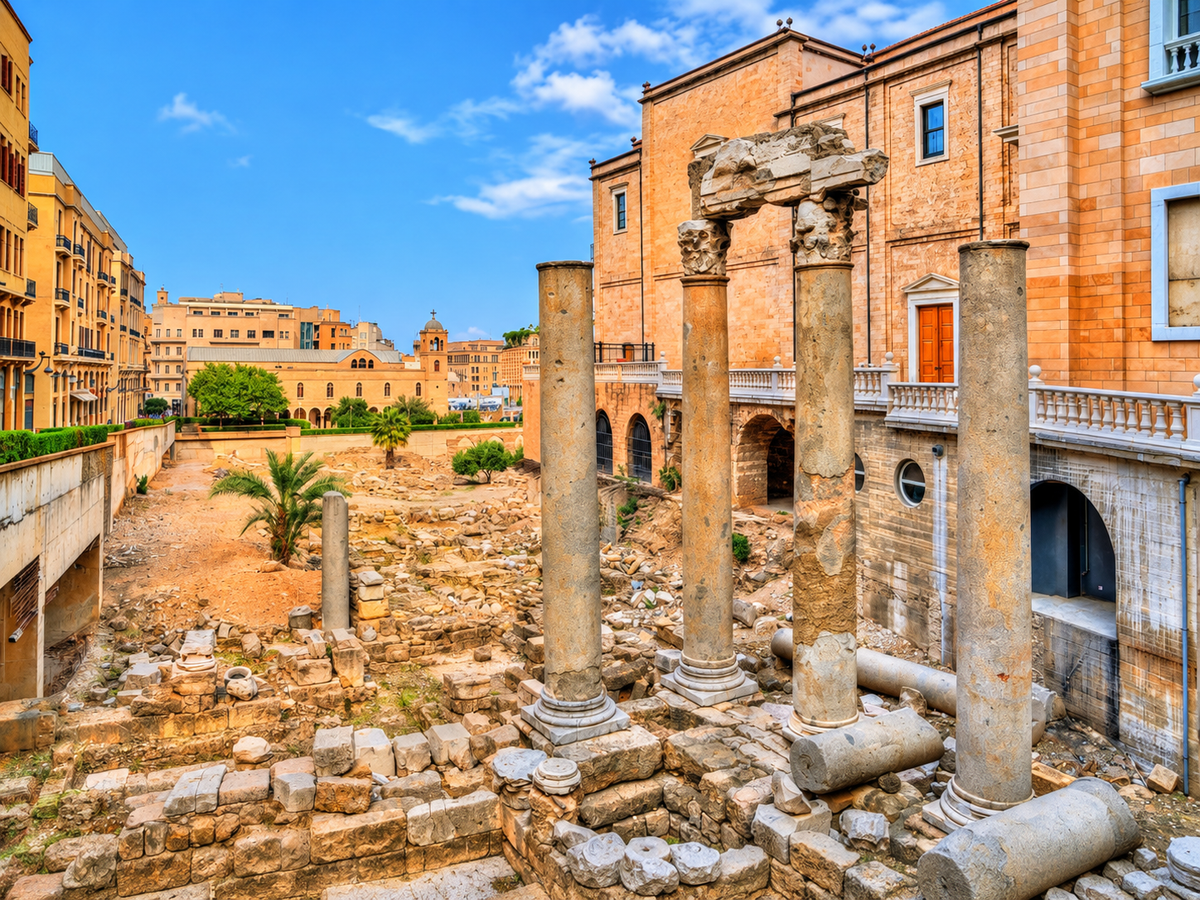
Archaeological excavations in downtown Beirut have revealed important remains from the Roman and Byzantine periods.
But the precise location of the institution remains debated.
Its greatest surviving legacy is found in legal history.
The work of Beirut's professors contributed to Justinian's codification, which later influenced legal education and civil law systems across Europe and beyond.
The city's role also challenges the assumption that the Roman Empire's intellectual centers were concentrated exclusively in Rome or Constantinople.
For centuries, the eastern Mediterranean produced scholars whose work shaped imperial institutions.
Beirut was among them.
Before Beirut's Modern Universities
Today, Beirut is associated with institutions such as the American University of Beirut and Université Saint-Joseph.
But the city's history as an educational center reaches much further back.
More than a millennium before these modern universities were founded, students were already traveling to Beirut for advanced professional education.
They studied laws governing contracts, property, inheritance, citizenship and legal disputes across a vast empire.
Some of their professors helped organize legal principles that would influence generations of jurists.
The earthquake of 551 devastated much of the physical city that supported this tradition.
Yet its intellectual legacy survived.
Modern Beirut has changed almost beyond recognition since the days of Berytus.
But there was a time when the city's name was associated not only with trade and the Mediterranean, but with the study of law itself.
And for students seeking to understand the legal foundations of the Roman world, Beirut was one of the most important places they could go.