Netanyahu Visits Mount Hermon and Declares Unprecedented Israeli Control Across the Region
Benjamin Netanyahu visited the summit of Mount Hermon in Syria and declared that Israel now exercises “absolute control” across an unprecedented stretch of territory, from the Hermon toward the Yarmouk and west to the Mediterranean.
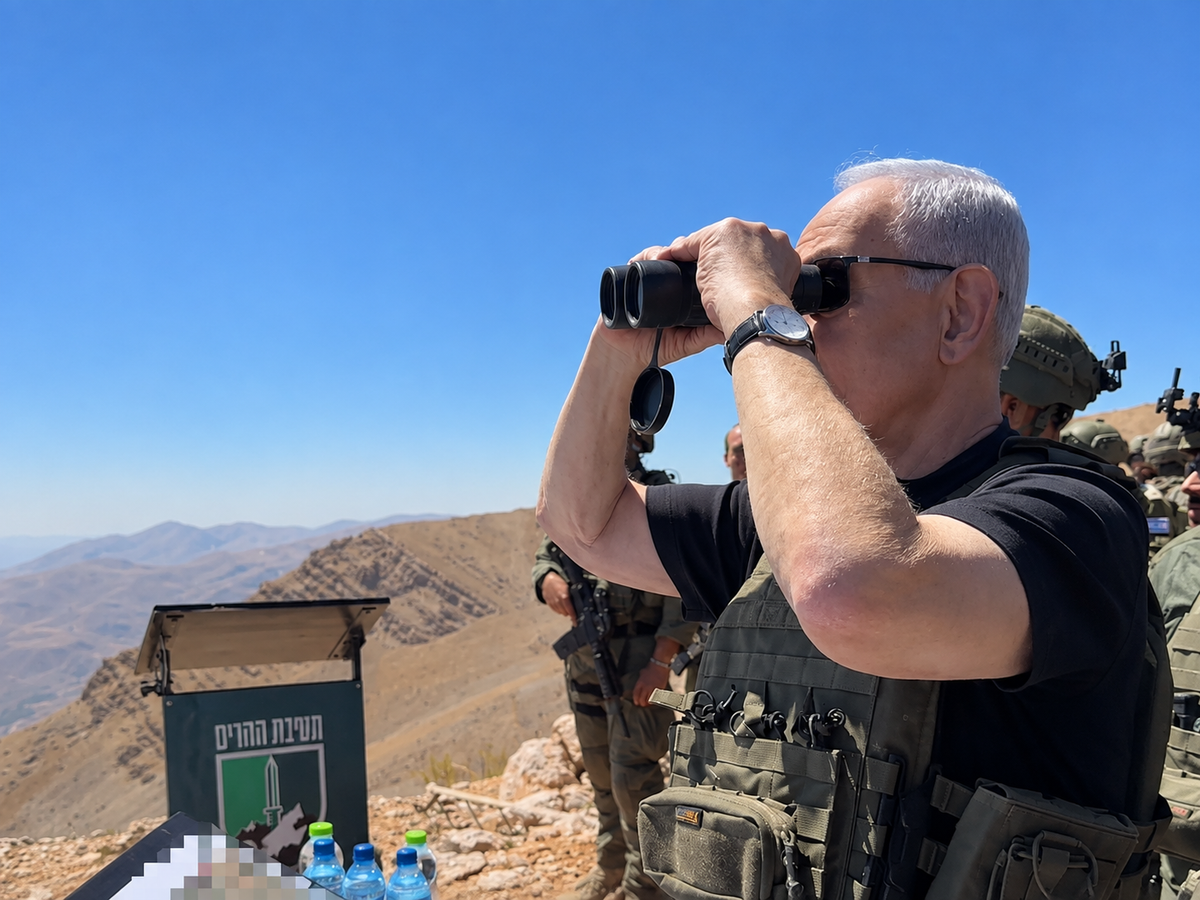
Israeli Prime Minister Benjamin Netanyahu visited the summit of Mount Hermon in Syria on September 9 alongside Defense Minister Israel Katz and senior military officials, using the highly symbolic trip to declare that Israel now exercises a level of territorial and military control in the region that it has never held before.
Standing at the summit, Netanyahu said Israel controls the entire area “from the summit of Mount Hermon to the Yarmouk, and from here to the Mediterranean Sea,” describing it as “absolute control unlike anything we have had before.” He also said Israel would not allow any hostile armed force to establish itself along its borders.
The visit comes nearly two years after Israeli forces moved into the UN-monitored buffer zone separating Israel and Syria following the collapse of Bashar al-Assad’s government in December 2024. Israel has since expanded its military presence across parts of southern Syria, including positions on Mount Hermon, arguing that the deployments are necessary to prevent armed groups from approaching its border.
Mount Hermon is strategically important because its elevation provides commanding surveillance over southern Syria, the Golan Heights, Lebanon and parts of northern Israel. Holding the summit gives Israel a significant intelligence and early-warning advantage and strengthens its ability to monitor movements across a broad section of the region.
Netanyahu’s language, however, went well beyond a discussion of border security. By framing Israeli control as extending from Mount Hermon toward the Yarmouk and west toward the Mediterranean, he presented Israel’s recent military gains in Syria and Lebanon as part of a much wider regional security architecture.
That declaration comes as Israel remains militarily engaged on multiple fronts. Israeli forces are entrenched in parts of southern Syria, fighting continues in Lebanon, and Israel is simultaneously confronting Iran and its remaining regional allies.
Netanyahu explicitly connected the Mount Hermon position to that wider conflict. He said the “main task” still ahead was to defeat Iran’s government, adding that Israel was “very close” to achieving that objective and predicting that the broader Iranian axis would eventually collapse.
The statement reflects how dramatically Israel’s strategic environment has changed since 2023. The Assad government has fallen, Hezbollah has been heavily weakened by war, Israeli forces have pushed deeper into southern Lebanon and Syria, and Iran itself is now engaged in direct military confrontation with Israel and the United States.
But Israel’s presence in Syria is also becoming increasingly controversial internationally. A UN Commission of Inquiry said this week that Israeli military activity in southern Syria has become increasingly “sustained and entrenched” and warned that some actions, including the detention and transfer of Syrian civilians, could amount to war crimes. Israel rejects those accusations and says its presence is temporary and defensive.
Damascus likewise considers the Israeli deployments a violation of Syrian sovereignty and has demanded a withdrawal to the lines established under the 1974 disengagement agreement.
The broader question is therefore whether Israel’s new positions are genuinely temporary or whether the security landscape created by the collapse of Assad and the wider regional war is becoming permanent.
Netanyahu’s visit to Mount Hermon offered perhaps the clearest indication yet of how Israel views the situation: not simply as a temporary defensive deployment, but as one of the major strategic achievements of the war.