U.S. Inflation Surprise Sends Stocks Lower and Strengthens December Rate-Hike Bets
Wall Street declined after US inflation exceeded expectations in October, strengthening bets that the Federal Reserve will raise interest rates in December.

American stocks declined and Treasury yields surged after stronger-than-expected inflation figures increased expectations that the Federal Reserve will raise interest rates in December, potentially by a larger margin than previously anticipated.
Wall Street ended Tuesday's trading session lower after US inflation exceeded economists' expectations, strengthening bets that the Federal Reserve will raise interest rates at its December meeting and adding pressure to technology stocks already struggling with concerns over artificial intelligence valuations.
The October Consumer Price Index (CPI) increased 0.4% from September, compared with economists' expectations of 0.3%, according to data released by the Bureau of Labor Statistics on November 10.
Core inflation, which excludes volatile food and energy prices, also exceeded forecasts, rising 0.3% against expectations of 0.2%. The reading marked the third consecutive month of 0.3% growth in core prices, reinforcing concerns that underlying inflation remains persistent.
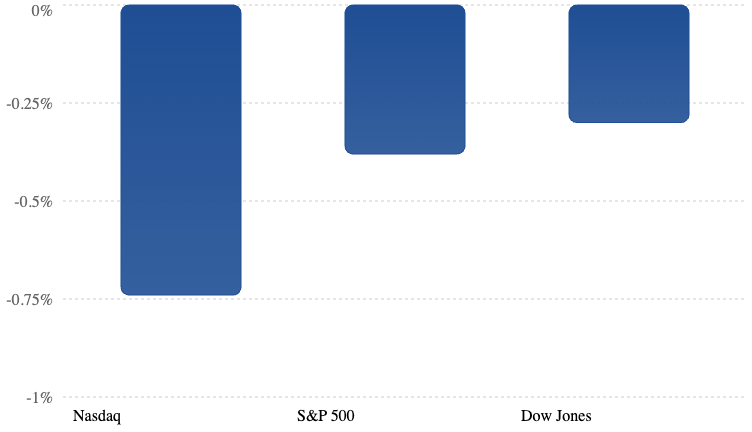
WALL STREET — NOVEMBER 10 CLOSING PERFORMANCE
Source: Reuters, November 10, 2026. Reuters
The technology-heavy Nasdaq Composite led declines, falling 0.74%, while the S&P 500 lost 0.38% and the Dow Jones Industrial Average declined 0.30%.
Bond markets reacted more sharply.
The yield on two-year US Treasury notes jumped approximately 19 basis points to 4.73%, while the benchmark 10-year yield approached 5%, reflecting expectations of tighter monetary policy.
Nvidia shares dropped approximately 5.4%, adding to recent losses amid separate company-specific concerns and continued pressure on AI-related stocks.
The inflation report significantly strengthened expectations that the Federal Reserve will raise borrowing costs at its December 8–9 policy meeting.
MARKET-IMPLIED DECEMBER FED DECISION PROBABILITIES
89%
25-basis-point increase
11%
50-basis-point increase
Approximate CME FedWatch probabilities following the inflation release; market pricing can change. Investing.com Canada
Before the report, investors had overwhelmingly expected a quarter-point increase. The higher inflation reading raised the possibility of a larger move.
Federal Reserve Governor Christopher Waller had warned earlier Tuesday that core inflation of 0.3% or higher would justify considering a half-percentage-point increase.
The actual data met that threshold.
Other Federal Reserve officials, including Lorie Logan and Jeff Schmid, also expressed concerns about persistent inflation, reinforcing expectations that monetary policy may need to remain restrictive.
Although headline inflation slowed from September's 0.6% monthly increase, price pressures remain widespread.
Food prices rose 0.5% in October, shelter costs increased 0.3%, and energy prices climbed 0.7%.
The persistence of inflation reflects several overlapping pressures, including earlier increases in energy costs, tariff-related expenses and businesses passing higher operating costs on to consumers.
The figures complicate the economic outlook for the Trump administration, which is already facing political pressure over affordability following Republican losses in the November midterm elections.
Higher interest rates could make mortgages, consumer credit and business financing more expensive, potentially slowing economic activity even as the central bank attempts to control inflation.
The prospect of higher interest rates presents another challenge for technology companies, particularly those investing heavily in AI infrastructure.
Higher Treasury yields can reduce the present value investors assign to future corporate earnings, placing pressure on growth-stock valuations.
Debt-dependent data-center developers could face additional financing costs, while companies with stronger balance sheets may prove more resilient.
However, the outlook is not entirely negative.
Oil prices have fallen substantially from their late-October highs, which could eventually ease energy-related inflation. Stronger employment figures also suggest that the American economy retains some resilience.
Investors will now monitor additional inflation data, Federal Reserve commentary and developments surrounding the Iran conflict before the December policy decision.
The central concern is that inflation may remain stubbornly elevated even as economic growth and technology valuations come under pressure. A larger-than-expected rate hike could intensify market volatility, particularly among companies most dependent on cheap financing and optimistic future earnings.