Ukraine Launches What Moscow Calls the Largest Drone Attack Ever Against the Russian Capital
Ukraine launched what Moscow authorities called the largest drone attack ever against the Russian capital, with hundreds of drones directed toward Moscow as part of a broader overnight assault involving more than 1,000 drones across Russia.
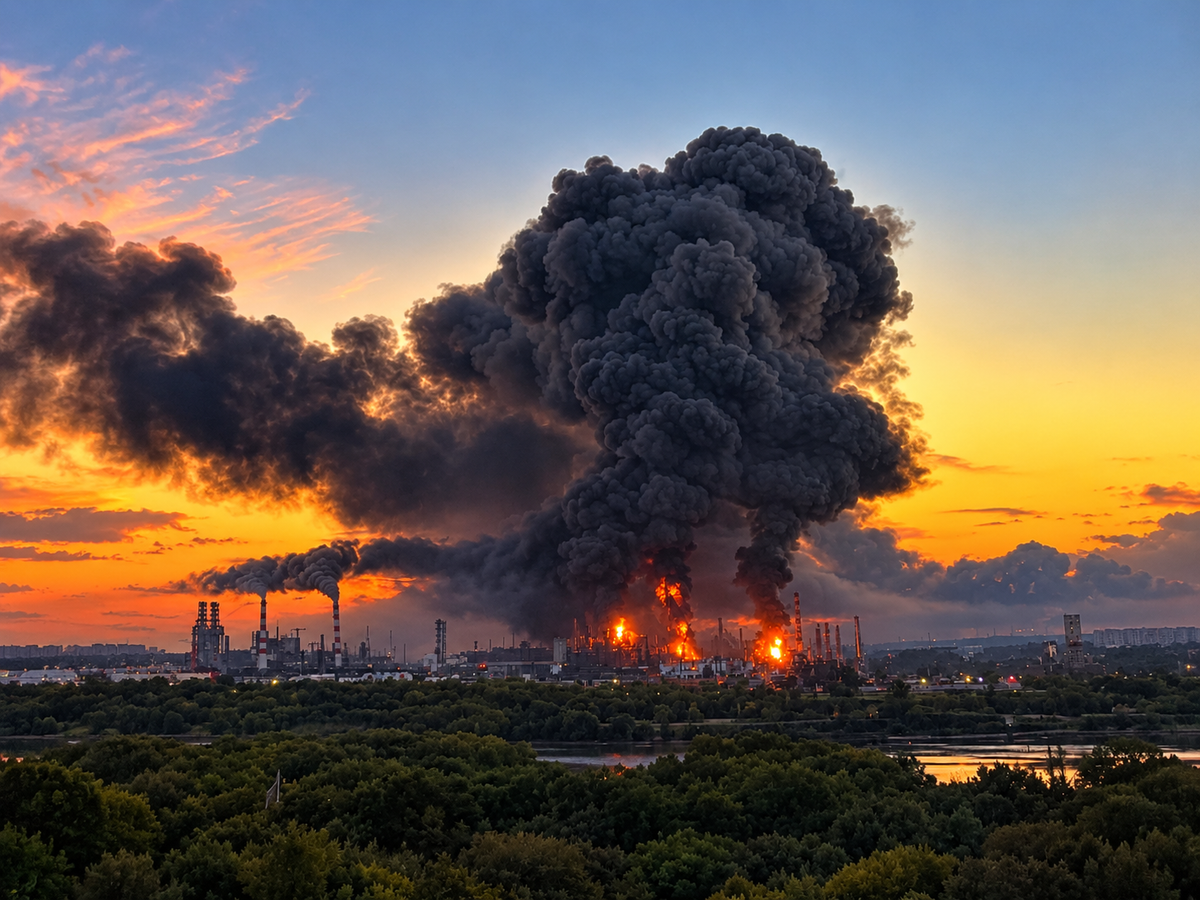
Ukraine has launched what Moscow authorities described as the largest drone attack ever directed at the Russian capital, sending hundreds of drones toward Moscow as part of a broader overnight strike involving more than 1,000 drones across Russia.
Moscow Mayor Sergei Sobyanin said more than 1,600 drones had been intercepted since Saturday, including around 450 headed toward Moscow. He called the scale of the attack unprecedented and accused Kyiv of trying to disrupt Russia’s parliamentary elections, which were entering their final day. Ukraine has not confirmed that electoral disruption was its objective.
The attack was not entirely stopped.
Russian authorities said several drones reached the Moscow Oil Refinery, while another struck a residential building. Reuters reported that three people were killed in the wider Moscow region after one of the victims later died in hospital. AP, using an earlier official update, reported two deaths and 20 injuries, reflecting the rapidly changing casualty count.
Around 400 people, including 70 children, were evacuated from a 21-storey residential building in the Ramenskoye district after damage from the strikes.
The Moscow refinery is a significant target.
It processed 11.6 million metric tons of crude in 2024 and produced millions of tons of gasoline and diesel for the Russian market. The facility has been hit before, but the latest attack comes as Ukraine intensifies a broader campaign against Russia’s energy and logistics infrastructure.
Ukrainian President Volodymyr Zelenskyy later said Ukrainian forces had used a combination of domestically produced drones and missiles to strike oil and logistics facilities. He argued that those targets generate the revenue and logistical capacity needed to sustain Russia’s war effort.
The strategy has become increasingly clear.
Rather than limiting the war to the front lines in eastern and southern Ukraine, Kyiv is trying to impose economic and military costs much deeper inside Russia. Long-range drones have allowed Ukraine to strike refineries, fuel depots, factories and logistics centers hundreds of kilometers from the battlefield.
Those attacks are beginning to have broader economic consequences.
Reuters reported that Ukrainian strikes have already knocked out a meaningful share of Russia’s refining capacity, contributing to fuel shortages, rising prices and long queues at petrol stations across several regions.
The Moscow attack is therefore important not simply because of its size.
It represents the continued expansion of Ukraine’s ability to strike the Russian capital and critical infrastructure around it.
Moscow is more than 400 kilometers from the Ukrainian border, and for much of the war Russian civilians in the capital experienced the conflict largely from a distance. That has changed as Ukraine’s long-range drone capabilities have improved.
The latest attack also came at a politically sensitive moment.
Russia was holding its first parliamentary election since the full-scale invasion of Ukraine in 2022. The Kremlin has presented the vote as evidence of domestic stability and public support for the government’s wartime direction, while opposition groups and Ukraine have challenged the legitimacy of voting in Russian-occupied Ukrainian territories.
Sobyanin explicitly accused Ukraine of timing the attack to disrupt the election.
But the larger strategic objective appears broader.
Ukraine has increasingly argued that Russia should experience more of the economic and security consequences of a war that has devastated Ukrainian cities and infrastructure for more than four years.
That logic has produced an escalating cycle.
Russia continues launching large-scale drone and missile attacks on Ukrainian cities and infrastructure. Ukraine is increasingly responding with long-range attacks against Russian energy, military and logistics targets.
That cycle has continued despite an announcement by U.S. President Donald Trump earlier this month that the two sides had agreed to stop targeting energy infrastructure. Reuters reported that both Russia and Ukraine continued carrying out energy strikes afterward.
The latest Moscow attack suggests that agreement, at least in practice, has not halted the energy war.
There is also a technological dimension.
Ukraine entered the war with a much smaller conventional military and air force than Russia. It has compensated partly by rapidly developing relatively inexpensive long-range drones capable of reaching targets deep inside Russian territory.
AP noted that Ukraine has become one of the world’s most advanced users and manufacturers of military drones, with domestically produced systems now being used alongside missiles in increasingly complex long-range operations.
That changes the economics of warfare.
A drone costing a fraction of the price of a conventional missile can force Russia to deploy expensive air-defense systems across enormous areas, protect refineries and airports far from the front and repeatedly disrupt civilian aviation.
For Moscow, defending the capital now means defending not only government buildings and military installations but also oil infrastructure, airports and densely populated residential areas.
For Kyiv, the strategy carries risks as well.
Long-range attacks that cause civilian casualties can strengthen Russian claims that Ukraine is targeting civilians, even when Kyiv says its intended targets are military or energy facilities. Ukraine and Russia both deny deliberately targeting civilians, but civilians have repeatedly been killed by strikes on both sides.
The immediate military impact of the Moscow attack is still being assessed.
But politically and strategically, its significance is already clear.
Ukraine has demonstrated that it can launch an attack involving hundreds of drones against the Russian capital while simultaneously striking targets across a much wider area.
For much of the war, Moscow was geographically distant from the fighting.
That distance is shrinking.