How Lebanese Food Changed After Traveling Around the World
When Lebanese emigrants began spreading across the world in the late nineteenth century, they carried their food with them. But kibbeh, sfeeha and other familiar dishes did not remain unchanged. They encountered new ingredients, new customers and new cultures.
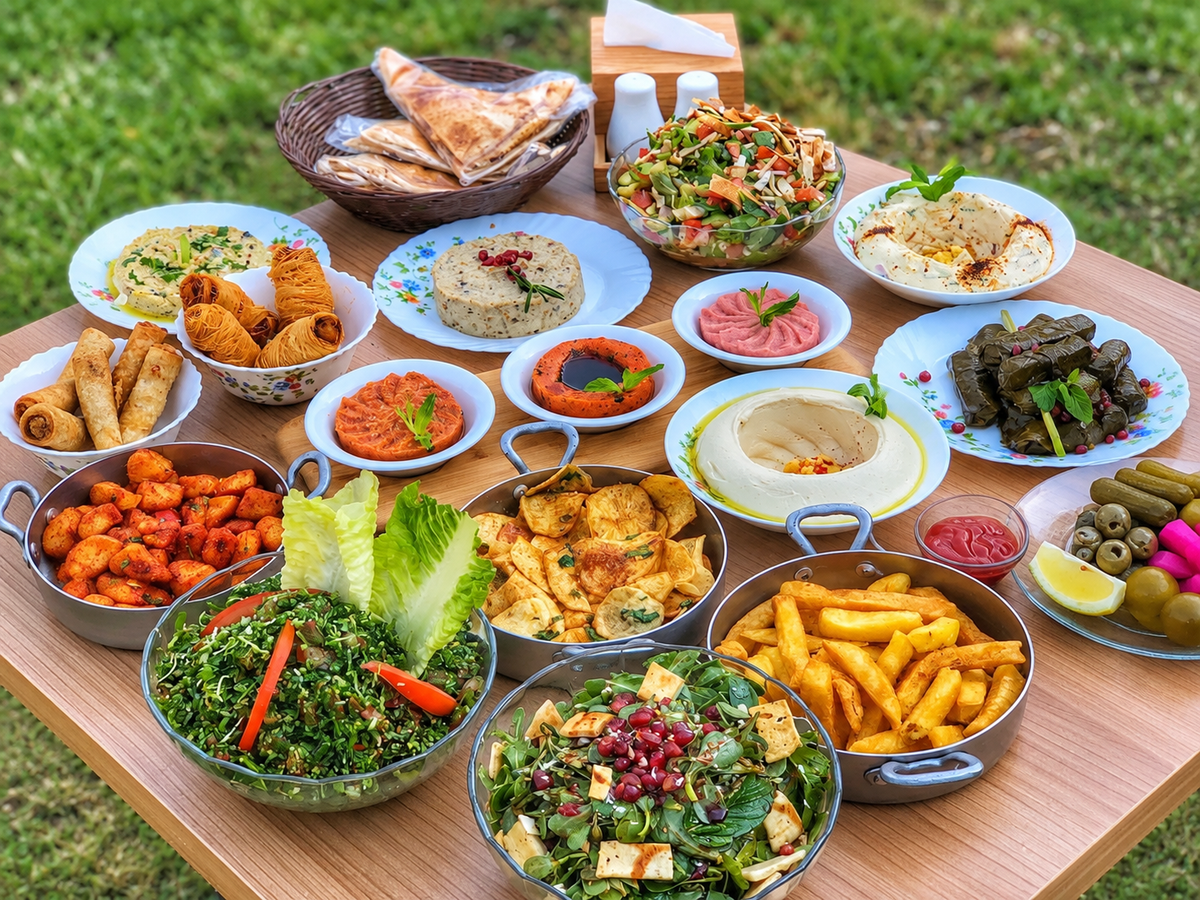
When hundreds of thousands of people began leaving Mount Lebanon and the surrounding Ottoman Syrian provinces in the late nineteenth century, they carried relatively little with them.
Many left as peddlers, merchants and laborers. They crossed the Atlantic for Brazil, Argentina, Mexico and the United States. Others eventually settled in Australia, West Africa and elsewhere.
But wherever Lebanese communities formed, something followed them almost immediately: their food.
Kibbeh, sfeeha, tabbouleh, stuffed vegetables, grape leaves, labneh and flatbreads survived journeys of thousands of kilometers. They were prepared in kitchens where Arabic sometimes disappeared within a generation or two.
The recipes, however, did not remain exactly the same.
In some places ingredients were unavailable. In others, Lebanese cooks encountered entirely new ones. Local customers developed different tastes. Children and grandchildren inherited their grandparents' recipes but began cooking them as Brazilians, Mexicans or Australians.
The result is one of the lesser told stories of Lebanese emigration.
Lebanon exported its cuisine to the world. Then the world began changing it.
From Mount Lebanon to the World
Large scale emigration accelerated during the 1880s and 1890s. Historian Akram Khater estimates that between 1890 and 1920, more than one third of the peasants of Mount Lebanon left their villages for the Americas. Another scholarly estimate, based on Ottoman records, places roughly a quarter of Mount Lebanon's population outside the territory by 1915. Either way, few regions of the Ottoman Empire experienced emigration on a comparable scale.
Most migrants did not arrive abroad as restaurateurs.
Food initially belonged to the home.
Families attempted to reproduce what they had eaten in Lebanon using whatever they could find locally. That made cooking an unusually durable connection to the country they had left.
A family could gradually stop speaking Arabic and still prepare kibbeh.
And once those dishes left Lebanese homes and entered bakeries, restaurants and street food, something more interesting happened.
They became local.
Brazil Made Kibbeh Brazilian
Few countries demonstrate this transformation better than Brazil.
Lebanese and other Levantine migrants began arriving there in significant numbers during the great migration of the late nineteenth and early twentieth centuries. Around 150,000 migrants from the Eastern Mediterranean reached Brazil beginning in the late nineteenth century, most from territories that would later become Lebanon and Syria. They settled particularly heavily in cities such as São Paulo and Rio de Janeiro.
With them came kibbeh.
In Brazil it became quibe.
Sfeeha became esfiha.
Today both are so thoroughly integrated into Brazilian food culture that they can appear alongside foods with no Middle Eastern connection at all.
Georgetown University's Center for Contemporary Arab Studies notes that kibbeh became widespread enough to be eaten alongside Brazilian staples such as pão de queijo and coxinha. Sfeeha underwent an equally dramatic transformation, becoming a mass-market food sold with fillings extending far beyond those traditionally associated with Lebanon. The Brazilian fast-food chain Habib's, founded by a Brazilian of Portuguese descent, has itself become evidence of how far the cuisine moved beyond the Lebanese community.
The transformation is significant because this is no longer simply Lebanese food being consumed by Lebanese immigrants.
It is Brazilian food with a Lebanese ancestor.
In Mexico, the Vertical Spit Became Something New
The Mexican story went even further.
Migrants from Lebanon and the wider Ottoman Middle East began settling in Mexico from the late nineteenth century onward. As their communities grew, their food encountered one of the world's great culinary traditions.
The result was not simply coexistence.
It was fusion.
Mexico's National Institute of Anthropology and History documents how Lebanese and Middle Eastern culinary traditions mixed with indigenous and Mexican ingredients. Kibbeh became locally known as kibi or kipe in different regions and developed distinctly Mexican variations. In Yucatán, for example, versions can be served with cabbage and chile habanero, while other adaptations even use fish.
But the most famous transformation involved meat rotating vertically beside a fire.
The shawarma tradition brought by Middle Eastern migrants helped give rise to tacos árabes in Puebla during the early twentieth century. The history is more complicated than attributing the dish exclusively to Lebanese migrants: Lebanese, Syrian and Iraqi communities were all part of the wider Middle Eastern presence that shaped this culinary exchange. What is clear is that the vertical spit technique associated with shawarma was adapted to Mexican ingredients and tastes.
In Puebla, pork eventually replaced the lamb or mutton associated with Middle Eastern preparations, while the meat continued to be cooked on a vertical spit and served in a wheat-based pan árabe.
From that culinary encounter came another transformation.
Tacos al pastor emerged later, replacing the flatbread with the corn tortilla and developing its own chile-based marinades and other distinctly Mexican characteristics. Food historian Jeffrey Pilcher dates al pastor's widespread rise to around the 1960s.
The precise genealogy is more complicated than the simplified claim that Lebanese immigrants directly "invented" the modern taco al pastor.
What is well established is that Middle Eastern migrants introduced the vertical spit tradition that became foundational to tacos árabes and subsequently influenced al pastor.
A cooking technique carried from the eastern Mediterranean had become unmistakably Mexican.
Sometimes the Country Changed Instead
Australia provides almost the reverse story.
Lebanese migration there dates to the nineteenth century. By the 1880s, communities were forming in Sydney, Melbourne and Adelaide, although racial restrictions under what became known as the White Australia Policy later severely constrained migration and naturalization. Later migration, particularly from the mid twentieth century and during and after Lebanon's Civil War, greatly expanded the Lebanese Australian population.
Early migrants often faced a basic problem.
The ingredients they needed simply were not available.
When Lebanese immigrant Adebi Trad arrived in Sydney in 1947, for example, she recalled that olive oil suitable for ordinary cooking was extremely difficult to obtain. The olive oil she could find came in small bottles from chemists and required a doctor's prescription. Her father eventually sent large tins from Lebanon. She remembered ingredients such as olive oil, zaatar, crushed wheat, nuts and dried figs becoming easier to obtain only later.
Migrants therefore did not only adapt their recipes to Australia.
Over time, they helped change what Australians could buy.
One striking example is something that now appears completely ordinary in Australian supermarkets: the Lebanese cucumber.
Lebanese migrants brought seeds with them and grew the smaller cucumber first in home gardens and later commercially. Lebanese Australian grower Youssef "Joe" Boustani, who arrived in 1972, recalled being among the farmers who helped cultivate the variety commercially in greenhouse operations. Australians initially found the Lebanese habit of eating cucumbers whole as a snack unusual. Eventually demand spread far beyond the Lebanese community.
Today the "Lebanese cucumber" is a standard category in Australian supermarkets.
The migrant kitchen had influenced the supermarket.
So Which Version Is Authentic?
Diaspora food inevitably creates arguments about authenticity.
A Lebanese visitor to Brazil might recognize quibe immediately but find the fillings of an esfiha strange.
A Lebanese person encountering Mexican kibi might wonder what chile habanero is doing beside kibbeh.
A shawarma and a taco al pastor now belong to entirely different cuisines, even though their histories intersect.
But perhaps that is exactly what diaspora food is supposed to look like.
Recipes have never existed in isolation. Lebanese cuisine itself developed through centuries of interaction across the eastern Mediterranean, incorporating ingredients, agricultural products and techniques that arrived through trade, empire and migration.
Even Mount Lebanon's kitchens were changing during the great migration itself.
Historian Akram Khater's research shows how consumption changed dramatically during the nineteenth century. Sugar imports through Beirut more than tripled between 1868 and 1888. Rice, once expensive enough to be largely restricted to wealthier peasants, became increasingly common. Coffee, previously associated particularly with local elites, spread into ordinary village social life.
Migration simply accelerated that process on a global scale.
What left Lebanon was reproduced from memory.
Then it encountered pork and chile in Mexico, Brazilian tastes in São Paulo, unfamiliar markets in Australia and generations of descendants who were simultaneously Lebanese and something else.
Each encounter produced another version.
And sometimes the transformation became so complete that the Lebanese or Middle Eastern origin almost disappeared from public memory.
Millions of Brazilians can eat quibe without thinking about Mount Lebanon. A Mexican can order tacos al pastor without thinking about the vertical spits of the eastern Mediterranean. An Australian can buy a Lebanese cucumber without knowing why it is called Lebanese.
That may be one of the most extraordinary consequences of Lebanese emigration.
The diaspora did not preserve Lebanese food inside a cultural museum.
It allowed it to change.
More than a century after the great migrations began, traces of Lebanese villages survive in foods eaten thousands of kilometers away, sometimes under different names, with different ingredients and by people with no Lebanese ancestry at all.
The recipe traveled.
Then it became part of somewhere else.