How Lebanese Identity Survived Abroad Even After Arabic Disappeared
Across Brazil, Argentina and the wider Lebanese diaspora, millions of descendants retained a Lebanese identity even as Arabic gradually disappeared from their families.
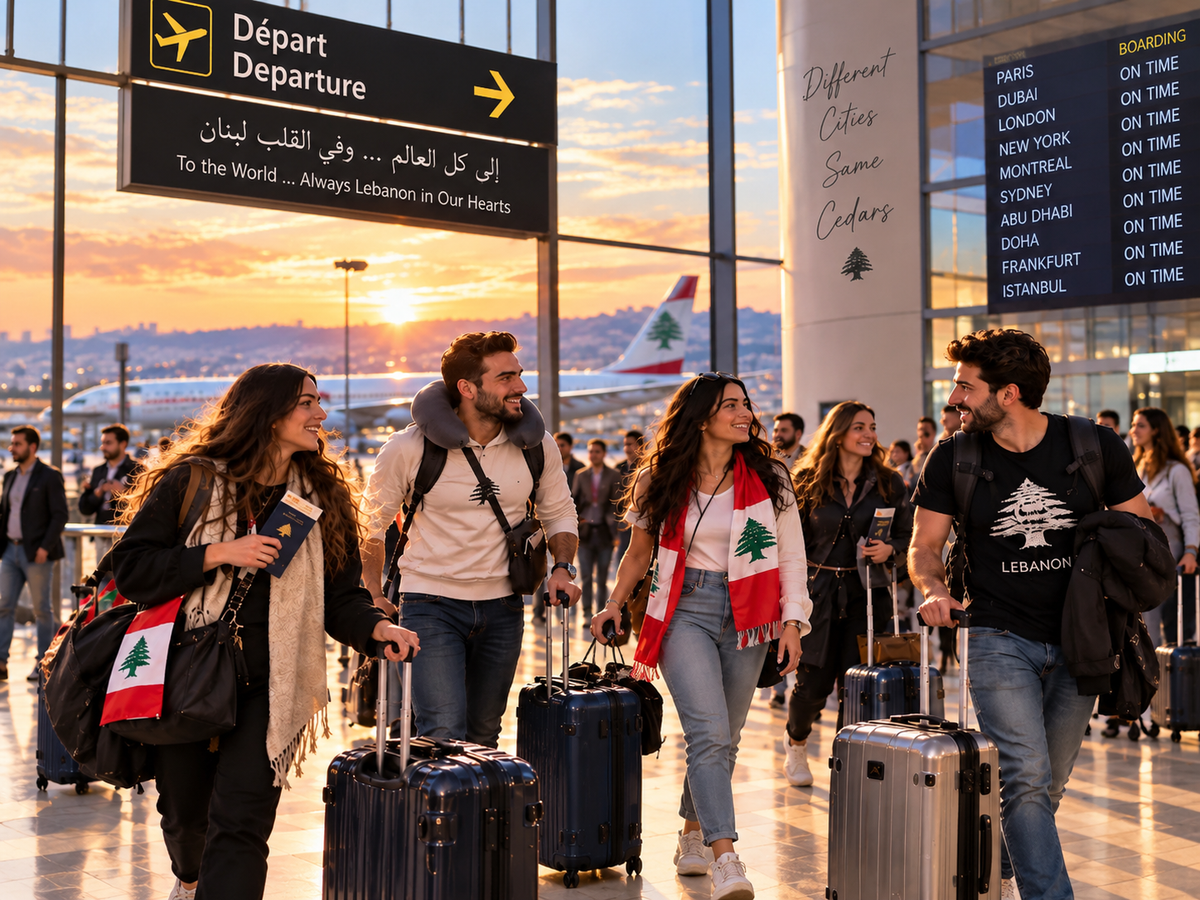
One of the most remarkable things about the Lebanese diaspora is how long its identity has survived.
In Brazil, Argentina, Mexico, the United States and elsewhere, there are families whose ancestors left Lebanon more than a century ago. Many are now in their third, fourth or even fifth generation.
A large number no longer speak Arabic.
Some have never visited Lebanon.
Yet they still call themselves Lebanese.
That raises an interesting question: how can an identity survive after one of its most obvious markers, language, disappears?
The answer is that Lebanese identity abroad was never transmitted through language alone.
It survived through family, food, religion, village origins, community institutions, stories and an unusually strong emotional attachment to a country that descendants sometimes knew only through their parents and grandparents.
The process began with the first major wave of emigration from Mount Lebanon and the surrounding region in the late 19th century.
Hundreds of thousands eventually left for the Americas, particularly Brazil, Argentina and the United States. Many arrived carrying Ottoman documents, meaning they were frequently classified as “Turks” or “Syrians” rather than Lebanese because an independent Lebanese state did not yet exist.
The first generation often spoke Arabic among themselves.
In Brazilian cities with large Syrian and Lebanese communities, Arabic could be heard in homes, shops, churches, mosques and social clubs. Arabic-language newspapers and magazines also flourished. One academic study estimates that Syrian and Lebanese communities in Brazil produced hundreds of Arabic publications between the late 19th and early 20th centuries.
But the language began disappearing surprisingly quickly.
Integration was part of the reason.
Immigrant parents wanted their children to succeed in their new societies. Portuguese in Brazil, Spanish in Argentina, English in the United States and French elsewhere increasingly became the languages of school, business and public life.
In Argentina, researchers have documented families that deliberately avoided teaching Arabic to their children because speaking it or having a strong Arab accent could expose them to ridicule or reinforce the stigma attached to being called a “turco.”
Intermarriage accelerated the process.
Many of the original migrants were young men who eventually married local women or members of other immigrant communities. Once Portuguese or Spanish became the common household language, Arabic became much harder to transmit to the next generation.
By the second and third generations, the pattern was clear.
The children were Brazilian or Argentine in virtually every practical sense.
They went to local schools.
They spoke the national language.
They entered local professions and politics.
Yet something Lebanese remained.
The first reason was family.
In diaspora communities, Lebanon was often transmitted through the household rather than the classroom.
Grandparents told stories about the village.
Families remembered whether they came from Zahle, Bsharri, Tripoli, Beirut, Marjayoun or another town long after descendants could no longer conduct a conversation in Arabic.
Research on Lebanese communities in Brazil found that identity was frequently rooted not simply in Lebanon as a nation, but in family name, religion and the specific city or village from which the family originated. One interviewee described descendants who did not speak Lebanese Arabic but still identified immediately as being from Zahle or Beirut.
That is one of the distinctive features of Lebanese identity.
A surname can become almost a geographical archive.
Families abroad may know exactly which village their great-grandfather left in 1895 even when they know only a handful of Arabic words.
And because family structures remained important, those stories were repeated.
At weddings.
At Sunday lunches.
At funerals.
At religious gatherings.
The country survived in conversation even when its language did not.
Food may have been even more powerful.
Arabic could disappear from a household while kibbeh remained on the table.
So could tabbouleh, stuffed grape leaves, hummus, labneh and other dishes carried abroad by emigrants.
Academic research on Lebanese communities in Brazil identifies cuisine as one of the strongest ways descendants maintained a sense of connection to their origins. Food survived precisely because it did not require fluency in Arabic.
Recipes moved from grandmother to daughter to grandchild.
Sometimes the names changed slightly.
Ingredients adapted to whatever was available locally.
Certain dishes became more Brazilian, Argentine or Mexican with every generation.
But the family continued describing them as Lebanese.
That matters.
A person who could not read Arabic might still know exactly how their family made kibbeh.
They might have no understanding of Lebanese politics but know that no one made stuffed vine leaves quite like their grandmother.
Culture could therefore survive through taste even when vocabulary disappeared.
Religion provided another anchor.
Lebanese Christians established Maronite, Melkite and Orthodox churches across the diaspora. Muslims built mosques and charitable organizations. These institutions gave immigrant communities somewhere to gather beyond individual households.
In Brazil, research found that churches, mosques, clubs and charitable organizations helped preserve both cultural traditions and group identity. Arabic survived longer inside some of these institutions than it did in ordinary households.
But eventually even religion adapted.
A fourth-generation Maronite in Brazil might attend a liturgy primarily in Portuguese.
An Orthodox family might use the local language at home.
Yet the institution itself still signaled that the family belonged to a particular historical community connected to Lebanon and the eastern Mediterranean.
Community clubs performed a similar function.
Wherever Lebanese communities became established, they created social organizations.
Lebanese clubs.
Syrian-Lebanese clubs.
Regional associations.
Charitable societies.
Sports organizations.
These institutions helped immigrants find employment, meet spouses, socialize and maintain connections with people from similar backgrounds.
As the original immigrant generation disappeared, many clubs changed their purpose.
They no longer existed primarily to help newcomers survive in a foreign country.
Instead, they became places where descendants rediscovered heritage.
In Argentina, researchers have documented Lebanese and Syrian associations now offering Arabic lessons, folkloric dancing, food events, cultural activities and even organized trips to Lebanon for younger generations.
That transition is fascinating.
The first generation created the club because they missed home.
The fourth generation may join because they want to discover it.
Identity therefore changed from something inherited automatically into something actively sought.
Arabic loss did not necessarily weaken that process as much as one might expect.
Sometimes it made the remaining symbols more important.
Food became more Lebanese because language was gone.
The village story became more important because the descendant had never seen the village.
The surname carried more weight because there were fewer other everyday connections.
Researchers studying Lebanese communities in Argentina have described how later generations construct belonging through emotional familiarity with ancestry, objects, stories and symbols even when their direct connection to the original immigrant world has faded.
There is another reason Lebanese identity traveled well.
It was highly compatible with becoming something else at the same time.
A person could become fully Brazilian without necessarily ceasing to feel Lebanese.
Studies of Middle Eastern migration to Brazil describe precisely this kind of layered identity: descendants negotiated a place for ethnic difference while becoming integrated members of Brazilian society.
The same happened in Argentina.
Research on Lebanese and Syrian associations found many descendants identifying themselves first as Argentine and then as Lebanese, Syrian or Arab. They did not see those identities as mutually exclusive.
That helps explain why assimilation did not erase the diaspora.
Lebanese identity often became additive rather than competitive.
Brazilian and Lebanese.
Argentine and Lebanese.
Mexican and Lebanese.
American and Lebanese.
The host-country identity could become dominant in everyday life while Lebanese ancestry remained meaningful culturally.
And success itself sometimes strengthened the attachment.
As Syrian and Lebanese migrants moved from peddling and small commerce into business, medicine, law, academia and politics, descendants often became more comfortable publicly celebrating an ancestry that earlier generations sometimes tried to downplay.
What could once have been treated as a stigma gradually became heritage.
Later generations began researching family trees.
Applying for Lebanese citizenship.
Visiting ancestral villages.
Learning dabke.
Taking Arabic classes their grandparents had never taught their parents.
Some Argentine Lebanese associations now organize heritage programs specifically designed to reconnect descendants with Lebanon.
In that sense, diaspora identity can move in cycles.
The immigrant arrives intensely Lebanese but wants the child to integrate.
The child becomes deeply integrated.
The grandchild grows curious about what was lost.
The great-grandchild begins searching for the village.
Language may weaken with every generation, but curiosity can sometimes move in the opposite direction.
Modern technology has accelerated that reconnection.
A descendant in São Paulo can now follow Lebanese news instantly.
Someone in Buenos Aires can watch Lebanese television, listen to Fairuz, follow Lebanese creators and message relatives in Beirut without waiting for letters or expensive international calls.
Cheap air travel also changed the relationship.
Lebanon stopped being merely the mythical homeland described by a grandfather and became somewhere a descendant could actually visit.
For many, that first visit can be surprisingly emotional.
The traveler may not understand the language.
They may know almost nothing about everyday Lebanese society.
Yet a family surname, church, village or meal can create an immediate sense of familiarity.
This does not mean diaspora Lebanese identity remained unchanged.
It often bears little resemblance to identity inside Lebanon.
Some traditions preserved abroad are older versions of Lebanese customs that have since changed in Lebanon itself.
Political divisions may be remembered differently.
Religious identity may become stronger or weaker.
Foods can evolve.
The image of Lebanon itself can become idealized, a country of mountains, cedar trees, grandparents, village homes and family gatherings rather than the complicated modern state experienced by people who actually live there.
Diaspora identity is therefore not simply Lebanese culture frozen abroad.
It is its own culture.
A mixture of memory and adaptation.
Something inherited from Lebanon but continuously reshaped in Brazil, Argentina, Mexico, Australia, Canada, West Africa and everywhere else Lebanese settled.
Perhaps that is why language was never the only thing holding it together.
Arabic mattered greatly to the first generation.
Its loss changed the community.
But Lebanese identity found other vessels.
A surname.
A recipe.
A church.
A village photograph.
A grandfather's story.
A club with a cedar tree above the entrance.
And sometimes simply the answer someone gives when asked where their family comes from.
Four generations after the original immigrant left Lebanon, the person answering may speak Portuguese or Spanish, have never lived in the Middle East and know almost no Arabic at all.
Yet the answer can still come immediately:
Lebanon.