Lebanon Before Refrigerators: How Families Preserved Food for an Entire Winter
Before refrigerators, Lebanese families relied on mouneh to survive winter: an entire system of drying, fermenting, salting, pickling and storing seasonal food.
Long before refrigerators became common in Lebanese homes, families faced a simple problem every year: how do you make the abundance of summer last through winter?
The answer was the mouneh.
Mouneh was not one specific food. It was an entire system of preservation built around drying, fermenting, pickling, salting, concentrating and storing seasonal produce so that a household could continue eating through the coldest months of the year. In rural Lebanon, especially in mountain villages and the Bekaa, preparing mouneh was once essential to winter survival.
The logic was straightforward.
Summer and early autumn brought tomatoes, grapes, figs, apricots, cucumbers, eggplants, dairy products, grains and olives in abundance. Winter brought far less.
So instead of trying to keep fresh food cold, Lebanese families transformed it into something that could survive without refrigeration.
In many homes, there was even a dedicated room for this purpose: the oudet el mouneh, or pantry, where jars, grains, oil, dried foods and other provisions were stored for months. Research on rural Baalbek describes these reserves as essential for ensuring a household’s food supply through winter.
One of the most important techniques was drying.
The Lebanese sun became a preservation technology in its own right.
Tomatoes could be dried or concentrated into thick paste. Fruits such as figs and grapes could be dried. Herbs were spread out and dehydrated. Even grains and legumes were exposed to the sun before storage to reduce moisture and insects.
In Baalbek, lentils, beans and peas were traditionally bought or harvested in large quantities, sun-dried for several days, cleaned and then stored for later use.
Kishk is perhaps one of the best examples of how sophisticated this system became.
Kishk combines fermented yogurt or milk with cracked wheat, or burghul. The mixture is fermented, dried thoroughly and then ground into powder.
Once dry, it can be stored for months.
During winter, a small amount of kishk can be turned back into a substantial meal simply by adding water and cooking it with onions, meat or vegetables. In mountain communities, it provided a way of preserving both dairy and grain at the same time.
Dairy required particularly clever solutions.
Fresh milk spoils quickly without refrigeration, so Lebanese communities transformed it into products that lasted much longer.
Milk became laban, labneh, cheeses, kishk, clarified butter and regional products such as labneh sirdeleh or ambarees.
Sirdeleh, traditionally made from goat milk, could be fermented inside earthenware jars, drained over time and later covered with olive oil for preservation. It was specifically designed to preserve seasonal goat milk for months when fresh milk was no longer available.
Olive oil itself was an important preservative.
Foods submerged under oil were partly protected from exposure to air. Dried labneh balls, cheeses, herbs and vegetables could all be stored this way.
This is one reason jars of labneh balls packed in olive oil remain such a familiar Lebanese pantry item even today.
Then there was salt.
Brining allowed vegetables to survive far beyond their natural season.
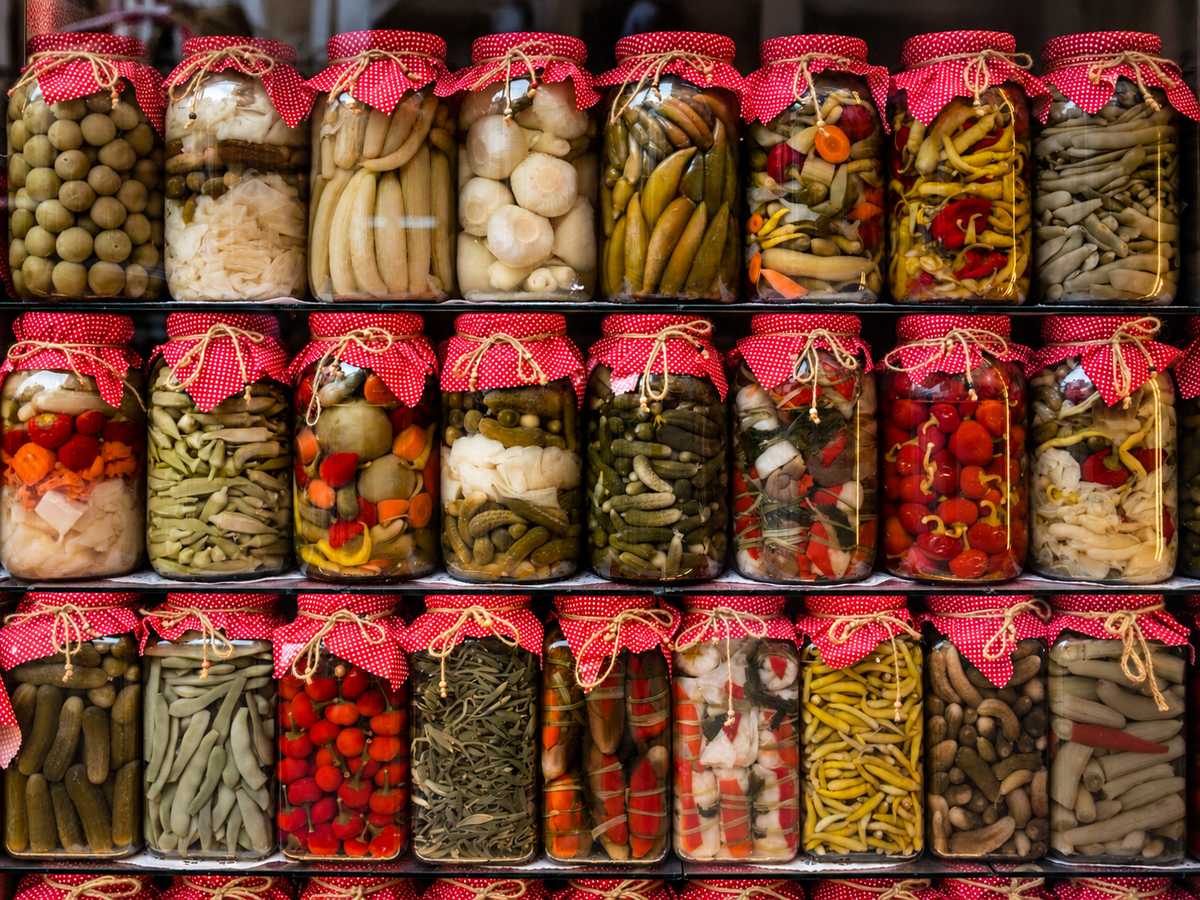
Cucumbers, turnips, peppers, olives and other vegetables could be submerged in salted water and allowed to ferment, producing the pickles that remain central to Lebanese meals.
Fermentation did more than preserve food.
It created entirely new flavors.
What began as a practical way to survive winter eventually became part of Lebanese cuisine itself.
Makdous is one of the clearest examples.
Small eggplants are cooked, salted and drained, then stuffed traditionally with walnuts, garlic and peppers before being packed in oil. What began as a way of extending the life of the eggplant harvest became one of the most recognizable foods of the Levant.
Fruit was treated differently.
Apricots, cherries, mulberries, figs and other seasonal fruits could be transformed into jams, syrups or concentrated pastes. Grapes became dibs, or grape molasses, through prolonged cooking and concentration.
Nothing had to remain in its original form.
That was the key principle of mouneh.
A tomato did not need to remain a tomato.
Milk did not need to remain milk.
Grapes did not need to remain grapes.
Families altered the food until it became stable enough to last.
Meat presented another challenge.
One traditional solution was awarma.
Meat was cooked and preserved beneath rendered fat, helping protect it from the air and allowing it to be stored much longer than fresh meat. In mountain villages, awarma could then be added gradually to winter meals such as burghul, kishk or pastries.
The preservation system extended even to bread.
Bread was often baked periodically rather than every day.
Families might produce large batches on a saj or in a tannour and store the bread dry. When needed later, it could be lightly moistened to make it soft and flexible again. One account from Akkar recalls families baking enough bread for several days and reviving older bread simply with water.
Storage itself mattered almost as much as preparation.
Traditional Lebanese homes used large clay jars known as khabiyeh for products such as olives, olive oil, kishk and grape preparations. Grain could be kept in dedicated containers and silos, while pantries were arranged around the idea that food had to remain dry, protected from insects and usable for months.
These practices were closely connected to the agricultural calendar.
A family did not simply go to a supermarket whenever something ran out.
Certain foods appeared once a year.
When apricots arrived, that was when apricot jam was made.
When tomatoes were cheapest and most abundant, families processed tomatoes.
When grapes were harvested, some became molasses, some were dried, some fermented and others eaten fresh.
When milk production peaked, dairy was preserved.
Anthropologist Aida Kanafani-Zahar has described mouneh as essentially preserving the richness of one season so that it could continue into another.
This made late summer an extraordinarily busy period.
Mouneh preparation was often communal and heavily dependent on women’s labor.
Mothers, daughters, sisters, neighbors and extended families worked together to wash, cut, boil, dry, grind and fill jars.
The scale could be considerable because they were not making enough for a few meals.
They were preparing for months.
In some communities, the process involved entire neighborhoods. Research in rural Lebanon describes food preservation as a deeply social practice passed between generations, particularly among women responsible for managing household food supplies.
Geography also determined what ended up in the pantry.
The Bekaa, with its broad agricultural lands, developed strong traditions around grains, dairy, vegetables and grapes.
Mountain regions such as the Chouf relied heavily on products such as kishk, awarma, preserved goat dairy and fruit.
Olive-growing areas naturally stored large quantities of olives and oil.
Villages therefore developed slightly different versions of mouneh depending on what could be grown locally.
And behind all of this was insecurity.
Winter was one reason to preserve food, but not the only one.
Lebanese history repeatedly exposed rural communities to war, interrupted roads, poor harvests and economic instability. A well-stocked pantry represented a form of household security.
If roads became impassable or markets became inaccessible, the family still had grain, oil, cheese, pickles, kishk and preserved meat.
In that sense, mouneh was also a kind of insurance policy.
Modern refrigeration changed the system dramatically.
A refrigerator allows fresh meat, milk and vegetables to be stored with almost no preparation. Freezers extend that even further.
Supermarkets also broke the old link between food and season. Tomatoes can now be purchased in January. Imported fruit appears throughout the year. Milk arrives daily in cartons.
There is no longer the same necessity to spend weeks preserving the summer harvest.
Yet mouneh never disappeared.
Lebanese families still make kishk, makdous, olives, jams, pickles, labneh balls and tomato paste, sometimes for economic reasons, sometimes because homemade versions are preferred, and increasingly because the process itself has become part of cultural heritage.
Even Lebanon’s electricity problems have given these old techniques a strange modern relevance.
Research on Lebanese households found that some families remain reluctant to depend heavily on freezers because unreliable electricity can spoil stored food. Traditional preservation techniques, by contrast, require no electricity once the food is properly prepared.
That is one reason mouneh remains more than nostalgia.
It represents an entire food system built around scarcity, seasonality and resilience.
Before Lebanese families had refrigerators, they did not preserve food by trying to stop time.
They changed the food so that time mattered less.
And many of the dishes now considered quintessentially Lebanese exist precisely because generations of families had to find a way to make summer last until spring.