Lebanon’s Businesses Are Growing Again, So Why Does the Economy Still Feel Broken?
Lebanon’s private sector expanded for a fourth consecutive month in September, with output and new orders reaching their strongest levels since February. Yet the World Bank still expects the overall economy to contract by 6.4% this year.
Something unusual is happening in Lebanon’s economy.
Businesses are expanding again.
Lebanon’s BLOM Purchasing Managers’ Index rose to 50.5 in September, up from 50.1 in August, marking a fourth consecutive month above the 50-point threshold that separates expansion from contraction.
Output rose to 50.7 and new orders climbed to 50.8, their strongest readings since February. The improvement was driven primarily by domestic demand. L'Orient Today
On paper, that sounds like recovery.
For many Lebanese, it feels nothing like one.
Prices remain high.
Electricity is expensive.
Bank deposits are still trapped.
Credit remains scarce.
Businesses continue operating largely in cash.
Households are paying privately for services that should normally be provided by the state.
And the World Bank expects Lebanon’s economy as a whole to shrink by 6.4% this year.
Both things can be true.
Lebanon’s private sector can be showing signs of life while the broader economic system remains fundamentally damaged.
The first reason is simple: growth is starting from a very low base.
Lebanon’s economy suffered a cumulative contraction approaching 40% between 2019 and 2024, according to the World Bank. Even after growth returned in 2025, the country remained dramatically poorer than it was before the financial crisis.
A restaurant increasing sales from a terrible year does not mean the country has recovered.
A retailer receiving more orders does not restore lost savings.
A construction company becoming busier does not rebuild a functioning banking system.
PMI data measure whether business conditions are improving compared with the previous month. They do not measure whether Lebanon has returned to its pre-crisis standard of living.
And the improvement itself remains modest.
A reading of 50.5 is expansion, but barely.
More importantly, the details reveal an economy still under considerable pressure.
Export orders fell to 45.7 in September, meaning external demand remained firmly in contraction. Employment declined slightly. Purchasing activity weakened. Businesses’ expectations for the next 12 months improved from 39 to 40.9, but remained deeply below the 50 threshold.
Businesses are therefore selling a little more today while remaining pessimistic about tomorrow.
The second problem is costs.
Input-price inflation in September reached its highest level in three and a half years as Lebanese companies faced higher fuel, food, construction, shipping, insurance and import costs.
This is particularly damaging in Lebanon because energy is not merely another business expense.
It is a structural tax on almost every productive activity.
Companies pay Electricité du Liban when power is available.
Then they pay private generator bills when it is not.
Factories need diesel.
Restaurants need refrigeration.
Hotels need air conditioning.
Retailers need electricity.
Employees need increasingly expensive transportation simply to reach work.
The regional energy shock therefore hits Lebanon harder than economies with functioning electricity systems.
Inflation is expected to reach 17.5% this year, according to the World Bank.
So even where salaries and business revenues are rising in nominal dollar terms, households may not feel richer.
Their money is buying less.
The third problem is banking.
A normal recovery is financed.
A company sees demand increasing and borrows to expand.
A young entrepreneur gets a loan to open a business.
A family obtains a mortgage.
A factory finances new machinery.
Savings move through banks toward productive investment.
Lebanon still does not operate that way.
The banking system remains severely weakened, deposits from before the crisis remain largely inaccessible, and meaningful commercial credit remains scarce. The IMF said in September that banking restructuring remains central to restoring the economy despite recent legislative progress.
That leaves businesses financing themselves primarily through retained profits, cash, family capital, diaspora money or offshore accounts.
It favors businesses that already possess dollars.
It disadvantages new entrants.
And it makes large, long-term investment far more difficult.
Lebanon has effectively built a recovery without a functioning financial system.
That is an extraordinary limitation.
The fourth problem is that the economy has become heavily dollarized and cash-based.
For people earning fresh dollars, this created a degree of stability after the collapse of the Lebanese pound.
For the country, however, it is not a substitute for financial normalization.
The World Bank has repeatedly warned that Lebanon’s huge cash economy reduces transparency, encourages informality and tax evasion, complicates monetary policy and restricts the ability of banks to finance investment.
There are therefore effectively two Lebanons.
One consists of companies, professionals and households receiving fresh dollars, remittances or foreign income.
They can participate in restaurants, retail, real estate and services.
The other consists of people whose salaries, savings or pensions never recovered from the collapse.
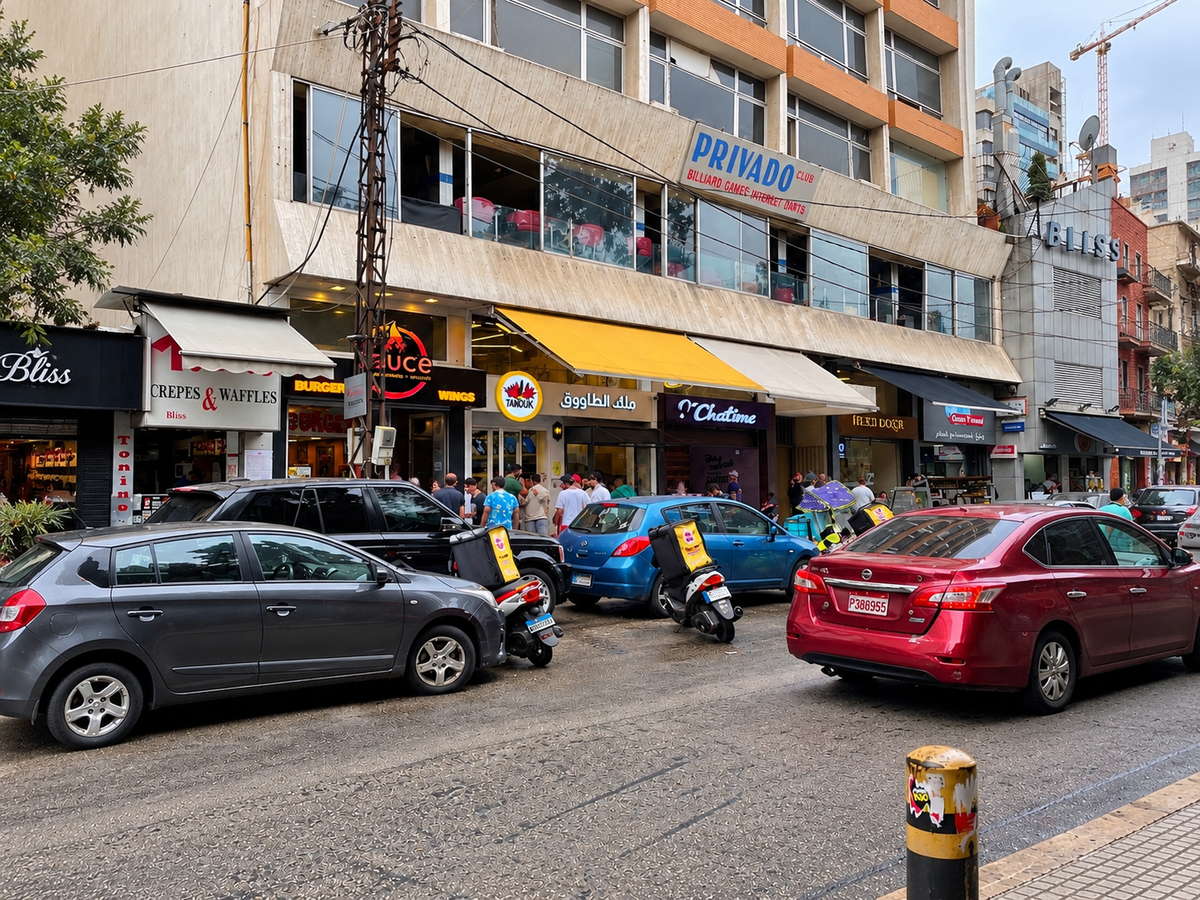
For them, a busy restaurant in Beirut is not evidence that the crisis is over.
It is evidence that somebody else still has dollars.
This helps explain why visible economic activity can coexist with widespread financial insecurity.
The fifth problem is that Lebanon remains dependent on consumption rather than productive investment.
The 2025 rebound was driven heavily by private consumption, tourism, remittances, real estate and construction.
Those sectors matter.
But a durable recovery requires more.
Lebanon needs productive companies capable of exporting.
It needs manufacturing.
Technology.
Agriculture.
Logistics.
Energy infrastructure.
Long-term capital investment.
And functioning banks capable of financing them.
September’s PMI provides a warning here too.
Domestic orders strengthened.
Export orders contracted.
Lebanese businesses are becoming busier largely by selling to people already inside Lebanon.
That can stabilize an economy.
It cannot by itself transform one.
Finally, there is the war.
The World Bank estimates that renewed conflict has reduced 2026 GDP growth by more than 10 percentage points compared with what might have occurred without it. Tourism, investment, consumption, infrastructure and confidence have all taken major hits.
This is why Lebanon’s current economic picture feels contradictory.
Entrepreneurs have adapted.
Companies have dollarized.
Consumers are spending again in parts of the country.
Businesses have learned to operate around broken banks, weak electricity and dysfunctional public services.
That resilience is producing genuine private-sector growth.
But adaptation should not be confused with recovery.
Lebanese businesses are increasingly succeeding despite the economic system rather than because of it.
The real test is not whether the PMI can remain at 50.5.
It is whether Lebanon can rebuild the institutions that allow private growth to spread across society: functioning banks, reliable electricity, affordable credit, stable security, modern infrastructure and a state that lowers the cost of doing business rather than adding to it.
Lebanon’s businesses are showing that there is still an economy worth rebuilding.
The country has yet to rebuild the system around them.