Lebanon’s First Israeli Withdrawal Experiment Is Failing to Deliver
Zawtar al-Gharbiyeh was supposed to prove that Israeli withdrawal, Hezbollah disarmament and Lebanese Army control could work together. Two months later, no second pilot zone has been agreed, Israeli troops remain nearby and only a small fraction of residents have actually resettled.
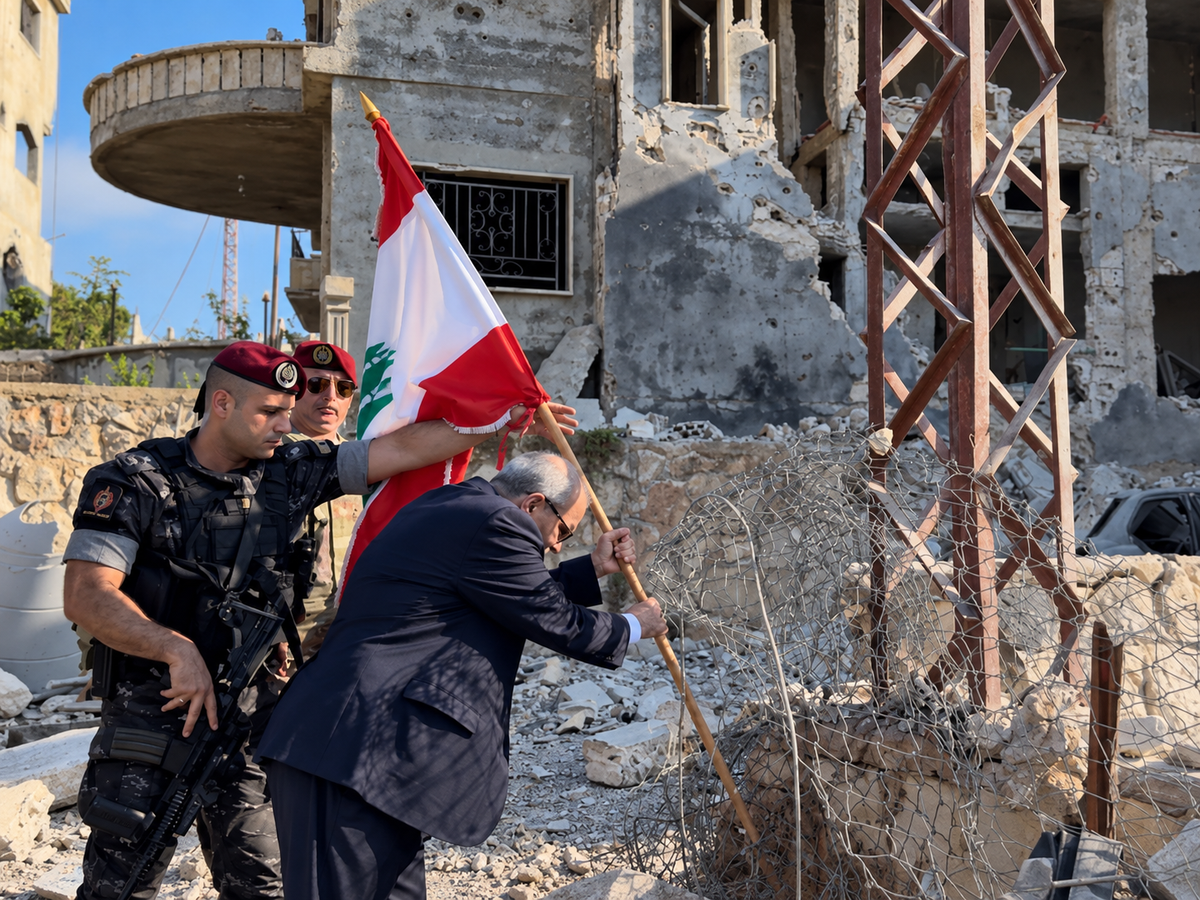
When Israeli forces withdrew from Zawtar al-Gharbiyeh in July, the village was supposed to become a model.
The idea was straightforward.
Israel would gradually pull back from occupied areas of southern Lebanon. The Lebanese Army would move in, remove Hezbollah weapons and infrastructure, and restore state control. Residents would return. Basic services would come back. If the experiment worked, the same formula could be repeated elsewhere.
Two months later, that model is already struggling.
No second pilot zone has been agreed.
Israeli troops remain only a few hundred meters away in neighboring Zawtar al-Sharqiyeh.
Residents of Zawtar al-Gharbiyeh still live under constant surveillance from Israeli drones, electricity and running water remain largely unavailable, and only a fraction of the village has actually resettled.
The first attempt to turn a military withdrawal into something resembling normal life has exposed just how far Lebanon still is from either sovereignty or reconstruction.
Zawtar al-Gharbiyeh was chosen as the first test of the U.S.-backed “pilot zone” plan created under the June 26 framework agreement.
Under that arrangement, Israeli withdrawal was explicitly linked to the verified disarmament of Hezbollah in the areas transferred to Lebanese state control.
The Lebanese Army deployed into Zawtar al-Gharbiyeh on July 21 after Israeli troops pulled back, while coordination took place through the U.S.-facilitated Military Coordination Group for Lebanon.
Even that first handover was difficult.
The Army said Israeli forces approached the outskirts of the town while Lebanese troops were deploying and opened fire nearby, endangering soldiers and obstructing the mission. Israel said Lebanese forces had crossed into a restricted area.
The disagreement showed how fragile the arrangement was from the beginning.
Since then, the Lebanese Army has established checkpoints, observation posts and continuous patrols around the initial pilot area.
According to the Army, its units confiscated roughly 1,818 weapons and munitions, including rocket launchers, rockets and drones, while clearing mines, explosives and roads.
The Army also says it has prevented armed groups and unauthorized military activity within the areas it controls.
Those can be considered as achievements.
But the broader bargain has barely moved.
Hezbollah still refuses to disarm nationally.
Israel still controls a wider security zone across southern Lebanon.
And the first pilot area has not yet created the conditions required to convince either side that the process can be expanded.
The result is visible on the ground.
Reuters reporters visiting Zawtar al-Gharbiyeh this month found Israeli soldiers operating so close that residents could hear their voices from neighboring positions.
Small surveillance drones reportedly followed residents working in gardens and descended to within meters of people in the village square.
Across the valley, residents of Zawtar al-Sharqiyeh could watch Israeli bulldozers and controlled explosions destroying parts of their still-occupied village.
Even agriculture has become a security issue.
Residents whose olive groves lie close to Israeli positions have had to seek permission through the U.S.-led coordination mechanism simply to reach their own land.
Some told Reuters they feared approval would arrive after the harvest was already lost.
This is not what a successful return to state control looks like.
Nor has reconstruction followed withdrawal.
The Lebanese Army says roughly 70% of Zawtar al-Gharbiyeh’s residents have been able to return to inspect their properties, but only around 16% have actually resettled.
The Army estimates that 85% of homes were completely destroyed and the remainder partially damaged.
The Council for the South delivered 16 prefabricated homes.
Most remain unused because they still lack electricity and water.
Workers have only recently begun extending new electricity lines after the previous network ran through the still-occupied neighboring village.
West Zawtar’s mayor, Abed Ezzedine, was blunt.
Asked whether the experiment had succeeded, he told Reuters: “In principle, I can tell you that no, it’s not successful.”
His reasoning was simple: the village was supposed to become a model town, and it has not.
The failure is not entirely one-sided.
Israel argues that it cannot continue withdrawing while Hezbollah remains armed and while weapons and military infrastructure continue to pose a threat.
The U.S. State Department has similarly said Hezbollah’s disarmament is an integral part of the process and that expansion of the pilot zones depends on Lebanese clearance operations being completed.
That is the central problem.
Lebanon wants Israeli withdrawal first.
Israel wants verified disarmament first.
Hezbollah refuses to surrender its arsenal.
The Lebanese Army is left trying to implement a formula that requires cooperation from actors who fundamentally disagree on the sequence.
The result is paralysis.
The Army says it has fulfilled its obligations inside the areas placed under its control, while accusing Israel of thousands of violations of the June agreement and of obstructing further implementation.
Israel, meanwhile, says the threat from Hezbollah has not been removed.
Meanwhile, ordinary Lebanese residents remain trapped between the two.
They return to destroyed homes but cannot rebuild properly.
They technically live in a “withdrawn” village while Israeli troops remain visible nearby.
They are told the Lebanese state has returned, yet they still lack electricity, water and freedom of movement.
And two months after the first supposed breakthrough, there is still no second zone.
That is why Zawtar al-Gharbiyeh matters.
It was supposed to demonstrate that Israeli withdrawal, Hezbollah disarmament and Lebanese state control could reinforce one another.
Instead, it has demonstrated how easily the entire process can stall when one part fails.
Israel will not leave more territory without progress on weapons.
Hezbollah will not disarm.
The Lebanese state cannot compel either side quickly enough.
And the reconstruction needed to make withdrawal meaningful is barely beginning.
The first pilot zone has not collapsed.
But it has failed to produce the momentum it was designed to create.
If Lebanon cannot turn one village into a functioning model of sovereignty, security and reconstruction, the question becomes much larger:
How exactly is the country supposed to replicate this process across the entire south?