Lebanon’s Middle Class Is Disappearing
Lebanon’s crisis has done more than increase poverty, it has hollowed out the middle class. Since 2019, frozen bank deposits, currency collapse, years of extreme inflation, dollarized expenses and deteriorating public services have destroyed the purchasing power and savings of ordinary families.
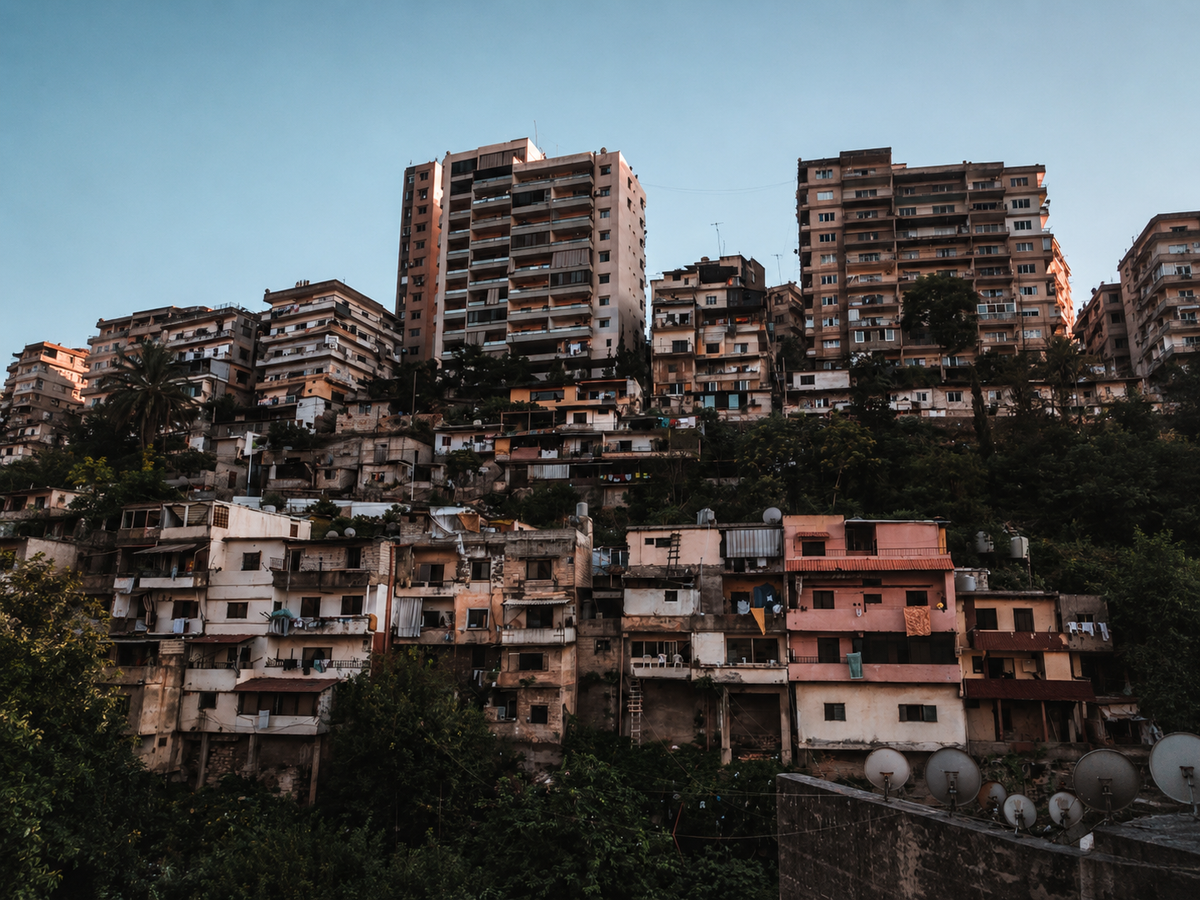
Lebanon’s economic collapse did not simply make the country poorer. It hollowed out the middle class that had long anchored its economy and social structure.
Before 2019, Lebanon already had deep inequality, weak public services and an economy overly dependent on banking, real estate, tourism and capital inflows. But a large segment of Lebanese families could still maintain something resembling a middle-class life: a salaried job, private schooling, healthcare, a car, occasional travel, some savings and, in many cases, the possibility of buying a home.
That model collapsed after 2019.
The first blow was the banking crisis. Banks imposed informal capital controls, trapping depositors’ savings and restricting access to dollars. People who had spent decades building savings suddenly discovered that their bank balances no longer represented money they could freely use. Dollar deposits were effectively “lirafied” or subjected to large implicit haircuts as withdrawals were made at exchange rates far below the market rate.
For the middle class, this was particularly destructive. Poor households often had little accumulated wealth to lose, while the very wealthy frequently had assets abroad, access to fresh dollars or diversified investments. The people caught in between — professionals, retirees, small-business owners and salaried families — often had their life savings concentrated in Lebanese banks.
Then came the collapse of the Lebanese pound.
From 2019 onward, the currency lost roughly 95% of its value, while salaries denominated in lira failed to adjust at anything close to the same pace. The result was an extraordinary destruction of purchasing power.
Inflation tells the story clearly. According to World Bank data, consumer-price inflation reached approximately:
- 84.9% in 2020
- 154.8% in 2021
- 171.2% in 2022
- 221.3% in 2023
- 45.2% in 2024
- 14.6% in 2025
Lower inflation today does not mean prices returned to where they were. It simply means they are rising more slowly. The cumulative increase since 2019 has permanently reset Lebanon’s cost of living at a much higher level.
A household that could once comfortably live on a salary denominated in Lebanese pounds increasingly found itself unable to afford the same groceries, school tuition, medical care, electricity or rent.
This created what is effectively a two-tier economy.
Those earning fresh dollars — especially employees of international organizations, foreign companies, parts of the technology sector, exporters and people receiving money from abroad — were partially insulated. Those earning primarily in Lebanese pounds were devastated.
The World Bank found that the rapid dollarization of the economy preserved the purchasing power of households with access to dollars while leaving others increasingly exposed to inflation. Remittances became a critical survival mechanism, rising from an average of around 13% of GDP before the crisis to roughly 30% in 2022.
By 2023, remittances were equivalent to around one-third of Lebanon’s GDP, one of the highest ratios in the world.
That means an increasingly important dividing line in Lebanese society is no longer simply rich versus poor. It is who has access to dollars and who does not.
The erosion of the middle class can also be seen in poverty statistics. World Bank research found that poverty across surveyed areas rose from around 12% in 2012 to 44% in 2022, while poverty among Lebanese citizens alone approximately tripled to 33%. Income inequality also worsened.
At the same time, Lebanon’s economy itself dramatically shrank. Real GDP contracted by nearly 40% between 2019 and 2024, one of the deepest peacetime economic collapses recorded globally in modern history.
GDP per capita illustrates the scale of the decline. In current dollar terms, it fell from around $8,906 in 2019 to $3,478 in 2023, before partially recovering to around $4,473 in 2024.
But income destruction was only one part of the story.
The crisis also transferred many expenses that should normally be provided collectively by the state directly onto individual households.
Lebanese families increasingly pay separately for private generators, private water, private healthcare, private education, internet, transportation and sometimes private security. A salary therefore has to cover not only consumption, but the cost of replacing basic state services.
Electricity is perhaps the clearest example. Instead of paying one affordable public utility bill, households often pay Electricité du Liban alongside expensive private-generator subscriptions, with costs fluctuating according to diesel prices and supply hours.
Education has become another major pressure point. Private schools, traditionally a central part of middle-class life in Lebanon, have increasingly shifted tuition toward fresh dollars as their own costs rose. Universities followed a similar path.
Healthcare underwent the same transition. Insurance premiums, hospital bills, medicines and medical consultations increasingly became dollarized, leaving families earning local-currency wages exposed to expenses that can consume a significant portion of monthly income.
Housing changed too.
Before 2019, subsidized mortgages and bank credit allowed many young professionals to buy apartments over long repayment periods. The banking collapse essentially eliminated conventional housing finance. For years, buying property became largely a cash market, automatically excluding most salaried households.
Even as Lebanon now discusses reviving public housing loans, the disappearance of mortgage credit for nearly seven years has already reshaped who can realistically own a home.
Then came emigration.
As salaries collapsed and professional opportunities disappeared, doctors, engineers, nurses, academics, entrepreneurs and young graduates increasingly left the country. The World Bank warned early in the crisis that skilled emigration represented a potentially permanent loss of human capital.
That creates a vicious cycle.
The people most capable of rebuilding a productive middle-class economy are often the people with the strongest ability to leave. Their departure weakens the tax base, reduces institutional capacity and leaves more households dependent on money sent home from abroad.
War then compounded everything.
The conflict that began in October 2023 and escalated sharply in 2024 displaced more than 1.2 million people at its peak and damaged or destroyed nearly 64,000 buildings, according to a UN assessment.
Lebanon briefly appeared to be stabilizing in 2025. Real GDP expanded by an estimated 4.2%, tourism and consumption recovered, the exchange rate stabilized and inflation fell sharply.
But renewed war in 2026 reversed much of that progress.
The World Bank now expects Lebanon’s economy to contract 6.4% in 2026, while inflation is forecast to rise again to around 17.5%, driven by supply disruptions, higher shipping costs and rising oil prices.
This matters because the Lebanese middle class has already absorbed years of shocks. There is far less savings, credit or financial resilience left to cushion another downturn.
The result is an increasingly unusual social structure.
At one end is a group earning substantial incomes in dollars, holding foreign assets, owning businesses or receiving large remittances. At the other is a growing low-income population struggling with basic expenses.
Between them is a shrinking group attempting to maintain a lifestyle that costs increasingly more than local salaries can support.
This is why Lebanon’s middle-class crisis is about more than wages.
It is the cumulative result of bank deposits being frozen, currency collapse, years of extreme inflation, salary erosion, disappearance of credit, dollarization, weak public services, rising private costs, emigration, political paralysis and repeated wars.
And there is a deeper transformation underway.
Lebanon increasingly rewards access to external income rather than domestic productivity. A teacher, engineer or civil servant working inside Lebanon can earn far less than a household receiving remittances from one family member abroad. Wealth and living standards therefore depend increasingly on connections to the global dollar economy rather than on a person’s position in Lebanon’s own labor market.
That is profoundly damaging to the idea of a middle class.
A functioning middle class normally rests on a simple expectation: education, work and saving should gradually produce greater economic security.
In Lebanon, that relationship has been broken.
People studied and worked for decades only to see their savings trapped, their salaries collapse and basic services become increasingly expensive.
Unless Lebanon restores a functioning banking system, generates productive jobs, rebuilds public services and creates confidence that savings and salaries will retain their value, the middle class may continue to shrink even if headline economic indicators improve.
The danger is not simply that Lebanon becomes poorer.
It is that it becomes a country increasingly divided between those with access to dollars, assets and opportunities abroad — and everyone else.