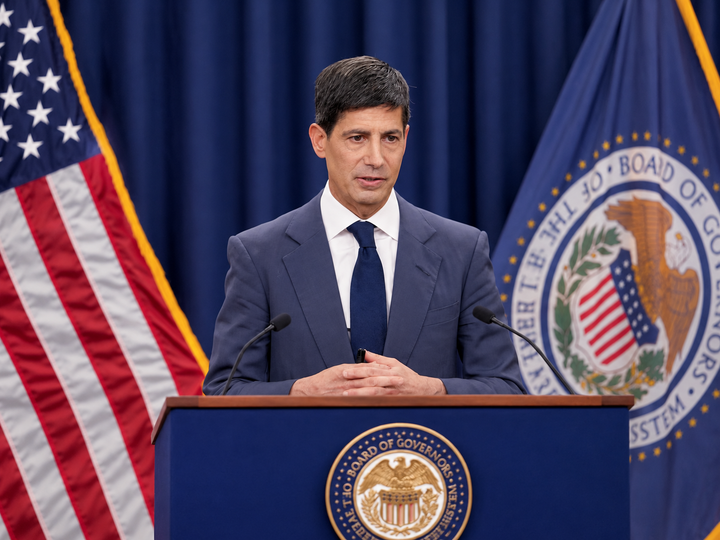
The Federal Reserve Raises Interest Rates for the First Time Since 2023
The Federal Reserve has raised interest rates for the first time since 2023, increasing its benchmark rate by 25 basis points to a range of 3.75% to 4.00%.
The U.S. Federal Reserve has raised interest rates for the first time in more than three years, marking a major reversal in monetary policy as persistent inflation and the renewed Middle East energy shock force Washington back into tightening mode.
The Fed voted unanimously on Wednesday to raise its benchmark federal funds rate by 25 basis points, lifting the target range to 3.75% to 4.00%. It was the first rate increase since July 2023.
The decision came after inflation proved more stubborn than expected. U.S. consumer prices were 3.4% higher in August than a year earlier, still well above the Federal Reserve’s 2% target.
The latest energy shock has made that problem more difficult.
Oil prices have remained above $100 a barrel as the war involving the United States, Israel and Iran disrupts energy markets, tanker flows through the Strait of Hormuz remain constrained and Saudi Arabia deals with the shutdown of its East-West pipeline. Those pressures are feeding into gasoline, transport and import costs across the U.S. economy.
At the same time, the American economy has remained stronger than some policymakers expected. Retail sales jumped 1.2% in August, while underlying spending was also robust, suggesting consumers are still spending despite higher prices.
That combination is uncomfortable for the Fed.
Strong demand makes it harder for inflation to fall, while high energy prices can push costs higher from the supply side. The central bank is therefore attempting to cool spending before another inflationary wave becomes entrenched.
Fed Chair Kevin Warsh also signaled that Wednesday’s move may not be the end of the tightening cycle. Updated projections point to at least one additional increase this year, with further moves possible in 2027 if inflation does not return toward target.
Markets reacted negatively.
The Dow Jones Industrial Average fell 1.2% after the decision, while the S&P 500 dropped around 0.4%. Treasury yields remained elevated, with the two-year yield climbing to roughly 4.72% and the 10-year yield around 5%.
Higher Fed rates eventually filter through much of the economy.
Credit cards and adjustable-rate loans tend to become more expensive relatively quickly. Auto financing can also rise, while mortgage rates are influenced more indirectly through longer-term bond yields. Existing homeowners with fixed mortgages are largely protected, but new borrowers face considerably higher financing costs.
Savers, by contrast, may benefit from better returns on high-yield savings accounts, certificates of deposit and short-term government debt.
The move also places the Federal Reserve in direct conflict with President Donald Trump.
Trump has repeatedly argued that U.S. interest rates should be lower and has pressured the central bank to cut borrowing costs. The Fed instead moved in the opposite direction, reinforcing its focus on controlling inflation despite political pressure from the White House.
That political tension could intensify if the Fed raises rates again.
Higher interest rates help suppress inflation by making borrowing more expensive and reducing demand. But they also slow housing, business investment and consumer spending, potentially weakening the economy ahead of the U.S. midterm elections.
Only months ago, financial markets were debating when the next interest-rate cuts would arrive.
Now the conversation has completely changed.
A new oil shock, stronger economic activity and persistent inflation have pushed the Federal Reserve back toward tightening, and policymakers are signaling that Wednesday’s increase may be only the beginning.
The global implications are significant as well.
Higher U.S. rates tend to strengthen the dollar and push global borrowing costs higher, particularly for emerging economies and governments carrying large amounts of dollar-denominated debt. Other central banks may also face pressure to keep their own rates elevated even as growth slows.
Hong Kong immediately followed the Fed by raising its base rate by 25 basis points to 4.25%, illustrating how quickly U.S. monetary policy can spread through the international financial system.
The world economy is therefore confronting an increasingly difficult combination: expensive energy, persistent inflation and rising interest rates.
For the Federal Reserve, the message is clear.
After three years without an increase, fighting inflation has once again become important enough to justify making money more expensive.