Whose Interests Is Hezbollah Defending? Qassem Rejects Disarmament While Praising Iran
Naim Qassem has rejected Hezbollah's disarmament, dismissed Lebanon's security framework with Israel and praised an Iran–U.S. agreement as a source of strength. His remarks expose a contradiction: Hezbollah condemns American interference while depending on Iranian financing and military support.
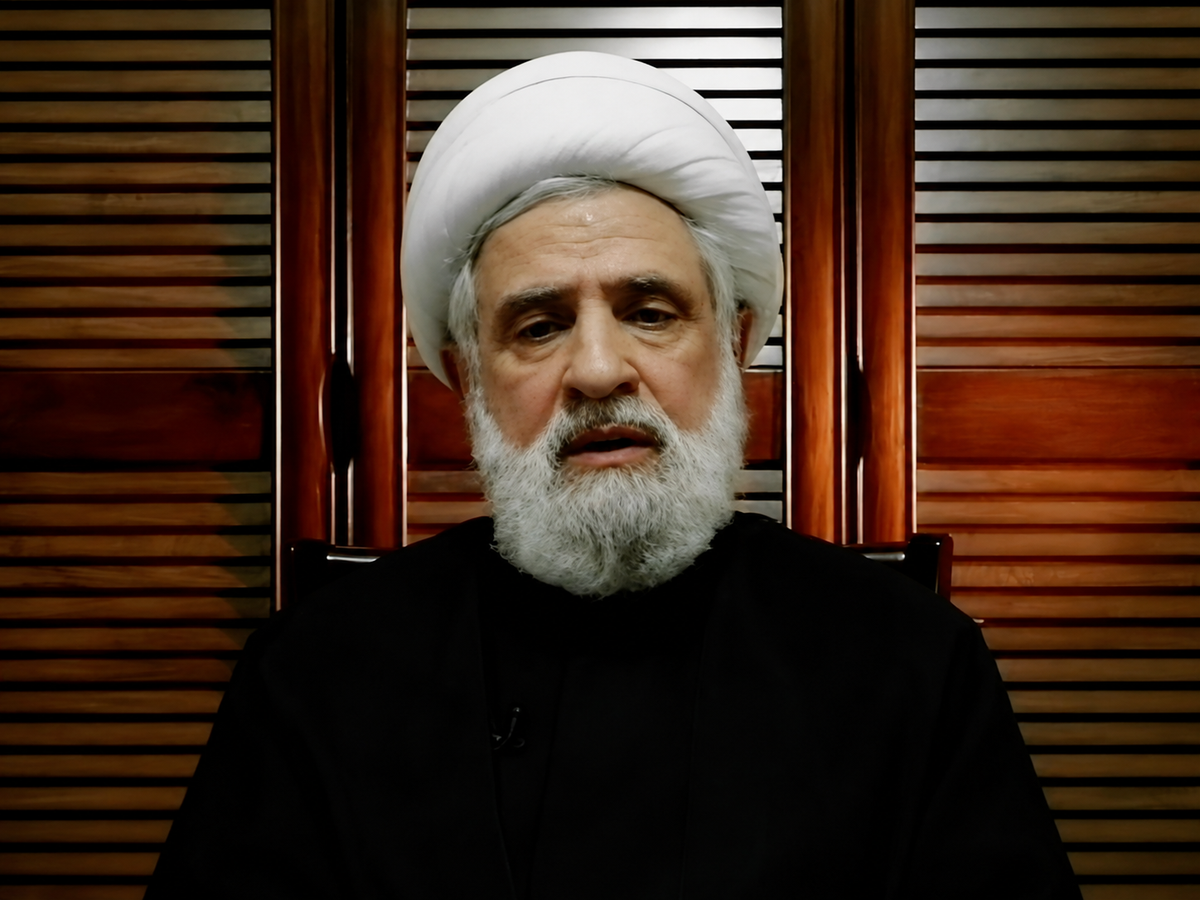
Hezbollah Secretary-General Naim Qassem has once again rejected disarmament, dismissed Lebanon's U.S.-brokered security agreement with Israel and presented negotiations between Iran and Washington as a source of strength for Lebanon.
His October 28 statement exposed a contradiction at the heart of Hezbollah's political position.
Qassem demands Lebanese sovereignty while defending an armed organization financed by Tehran. He condemns American influence over Lebanon while openly celebrating Iran's involvement in the country's security affairs.
And he claims to protect Lebanon while refusing to surrender the weapons that allow his organization to decide independently when the country goes to war.
For a nation still recovering from devastating conflict, these are not abstract political disagreements.
They concern who actually governs Lebanon.
Sovereignty, According to Qassem
Qassem rejected any discussion of Hezbollah's disarmament while Israeli forces continue occupying Lebanese territory.
He also dismissed the June security framework negotiated between Lebanon and Israel under American mediation, declaring it illegitimate and contrary to the Constitution and the Taif Agreement.
His argument is that Hezbollah's weapons remain necessary to protect Lebanon from Israeli aggression.
Israeli occupation and military strikes are genuine sovereignty concerns. Lebanon has every right to demand an end to both.
But neither provides Hezbollah with a mandate to maintain an army beyond state control.
Qassem's position effectively establishes a separate military authority whose weapons, operations and future are decided by Hezbollah rather than the Lebanese government.
If the president, prime minister and Cabinet cannot determine whether an armed organization should surrender its weapons, what authority do they actually possess?
More importantly, who gave Hezbollah permanent responsibility for deciding Lebanon's national defense policy?
Iran Is Apparently Acceptable. America Is Not.
The most revealing part of Qassem's statement concerned Iran.
He described an agreement between Tehran and Washington as an important source of strength, alongside Hezbollah's continued armed resistance.
He also praised Iran for reportedly prioritizing the cessation of Israeli attacks and withdrawal from Lebanese territory in its negotiations.
Qassem's criticism of American involvement stands in sharp contrast.
He repeatedly condemns Washington's influence as an infringement on Lebanese sovereignty.
Yet Hezbollah's relationship with Tehran goes considerably further than diplomatic influence.
Iran's Revolutionary Guards helped establish Hezbollah in the 1980s. Tehran has since provided the organization with financing, weapons, training and political support.
That relationship has allowed Hezbollah to maintain a military structure independent of Lebanon's national institutions.
The distinction is difficult to ignore.
Qassem objects to American involvement in Lebanese security negotiations but welcomes Iranian involvement in financing an armed organization operating on Lebanese soil.
He presents one foreign power's influence as unacceptable interference and another's as a strategic necessity.
That is not a consistent principle of national sovereignty.
It is a selective interpretation that protects Hezbollah's relationship with its principal foreign sponsor.
Lebanon should not be politically subordinate to Washington.
But neither should its security depend on Tehran.
Iran Sends Money. Lebanon Pays the Price.
Qassem's remarks came just two days after Reuters reported that Hezbollah had received tens of millions of dollars from Iran to rebuild its military capabilities.
According to Lebanese security sources, the organization has spent months acquiring explosives, manufacturing attack drones and restoring military command structures damaged during previous confrontations with Israel.
The funding was reportedly separate from approximately $200 million provided by Iran for displaced families.
These reports raise a fundamental question about the priorities of Hezbollah's leadership.
Large parts of southern Lebanon remain devastated.
Families are displaced, homes have been destroyed and communities face enormous reconstruction costs.
Yet Hezbollah is reportedly directing fresh Iranian resources toward preparing for another military confrontation.
Qassem calls these capabilities a "source of national strength."
But military strength should ultimately be measured by whether it makes the country more secure.
Lebanon has endured repeated destruction, displacement and economic disruption. Hezbollah has sustained severe military losses, and Israeli forces continue occupying Lebanese territory.
Its independent arsenal has not prevented those outcomes.
Hezbollah Wants the State to Protect Its Weapons
The recent Dahr al-Baidar explosives case illustrates the problem.
Lebanese security forces intercepted hundreds of kilograms of military explosives.
Hezbollah subsequently acknowledged ownership and demanded their return.
Reuters later reported, citing a Hezbollah official and a Lebanese security source, that the explosives were intended for the organization's drone program.
The shipment was therefore reportedly connected to the very rearmament effort now being financed by Iran.
When Lebanese authorities seized it, Hezbollah resisted.
When the government considered referring the case to the Judicial Council, political pressure contributed to postponing the decision.
This is the contradiction confronting President Joseph Aoun and Prime Minister Nawaf Salam.
The government has committed itself to restoring the state's monopoly over weapons.
Yet Hezbollah continues to assert an independent right to possess and transport military explosives.
A government cannot establish sovereignty merely by announcing it.
It must be able to enforce its laws, including when those laws affect powerful armed organizations.
Who Decides Whether Lebanon Goes to War?
Qassem's refusal to disarm becomes particularly troubling when viewed alongside Hezbollah's recent decisions involving Iran.
Before the March confrontation, Hezbollah reportedly assured Lebanese officials that it would not intervene in another war involving Tehran.
It subsequently launched attacks against Israel after the conflict escalated.
Lebanon then suffered another devastating Israeli offensive.
More recently, Hezbollah reportedly renewed its pledge to remain outside a future Iran war.
But the organization continues rebuilding its military capabilities.
Rearmament alone does not prove that Hezbollah intends to break its latest assurances.
It does, however, demonstrate that the decision remains in Hezbollah's hands.
The Lebanese government is left waiting to discover whether the organization's leadership will honor its promises.
That is an unacceptable arrangement for a sovereign country.
Lebanon's decision to enter an international conflict should not depend on consultations between Hezbollah, Iran and regional intermediaries.
It should belong to the Lebanese state.
Lebanon Needs Institutions, Not Another Armed Patron
Qassem repeatedly invokes national unity, the Constitution and the Lebanese Army.
But his position leaves the Army without exclusive control over national defense.
It leaves the government negotiating security arrangements that Hezbollah can reject.
And it leaves Lebanon vulnerable to military decisions influenced by the strategic calculations of Iran.
The distinction between Lebanese interests and Iranian interests matters.
Iran can negotiate with Washington, finance regional allies and adjust its military strategy according to its own priorities.
Lebanon must then live with the consequences of decisions made by an organization whose strategic relationship with Tehran remains central to its identity.
A genuinely sovereign Lebanon should be capable of demanding Israeli withdrawal, rejecting foreign domination and establishing exclusive state authority over weapons simultaneously.
Those objectives reinforce one another.
Qassem instead presents Hezbollah's continued armament as indispensable while treating Iranian support as a national advantage.
After years of conflict, that argument is no longer valid.
A military organization cannot indefinitely claim to defend the state while refusing to submit to it.
Nor can it invoke sovereignty only when convenient.
Lebanon's future cannot remain dependent on whether Tehran provides funding, whether Washington reaches an agreement with Iran or whether Hezbollah decides to launch another military operation.
The country needs functioning institutions, an accountable government and one national army responsible for its defense.
Qassem has made clear that Hezbollah is unwilling to surrender its independent military authority.
The question facing Lebanon is how its government intends to respond.