Why Can Two Neighboring Lebanese Villages Have Completely Different Accents?
Two Lebanese villages can sit only a few kilometers apart and still have noticeably different accents.
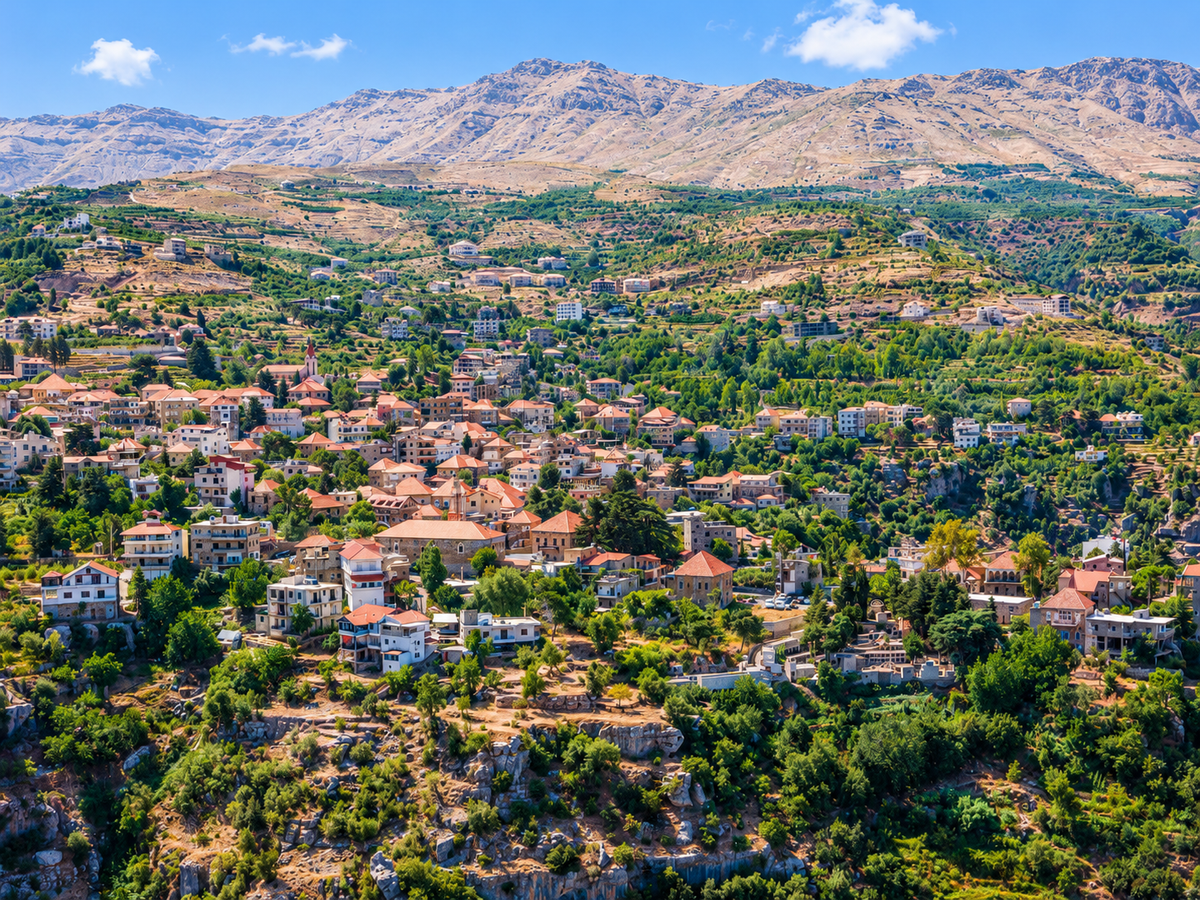
Drive ten minutes through parts of Mount Lebanon, the North or the Bekaa and something strange can happen.
The landscape barely changes. The villages may sit on opposite sides of the same valley. Their residents may shop in the same town, attend the same schools and belong to families that have known one another for generations.
Yet the moment someone starts speaking, the difference can be immediate.
One village stretches its vowels.
Another clips them.
One pronounces the Arabic letter qaf clearly as “q.”
Another turns it into a glottal stop, so qalb becomes alb.
A third may use words or expressions that sound unusual only a few kilometers away.
Lebanon is small geographically, but linguistically it is extraordinarily fragmented.
And that is not an accident.
“Lebanese Arabic” is not one perfectly uniform dialect. Linguists describe it more accurately as a collection of regional and local varieties within the broader Levantine Arabic continuum. A recent Oxford overview notes that Lebanese Arabic can be divided roughly by geographical area, while many of its local dialects remain surprisingly under-documented.
Researchers have noticed this diversity for more than a century.
As early as the 1920s, Lebanese linguist Michel Feghali divided Lebanon into several major linguistic zones, including distinctive northern, central and southern varieties. He noted differences not just in pronunciation, but in vocabulary, grammar and the survival of older linguistic influences.
But even those broad categories do not fully capture what happens on the ground.
Within the North, for example, Bsharri does not necessarily sound like Tripoli.
Zgharta does not necessarily sound like Koura.
Zahle has its own recognizable speech.
Baalbek-Hermel has another.
Southern Lebanese speech differs from Beirut, while Druze communities in the Chouf preserve features that immediately distinguish them from many surrounding populations.
And sometimes the differences exist between villages close enough to see each other.
Why?
The first reason is geography.
For most of Lebanese history, neighboring villages were far more isolated from one another than they appear today.
Modern Lebanon has highways, cars, buses and phones. A journey between two nearby mountain towns may now take 15 minutes.
A century or two ago, the same trip could involve steep footpaths, winter snow, river crossings or mountain passes.
Communities that look geographically close on a modern map could therefore remain socially separated for generations.
That matters because accents develop when groups of people repeatedly speak primarily to one another.
Small pronunciation changes appear almost randomly.
Children copy their parents.
Their children exaggerate or modify certain sounds.
Over generations, a village can develop a speech pattern recognizably different from the one next door.
Mountains are particularly good at producing this kind of linguistic fragmentation.
Lebanon’s landscape historically divided communities into valleys, plateaus and ridges, creating countless small population pockets.
But geography alone is not enough.
One of the most interesting examples is Kfarsghab in northern Lebanon.
The village became famous among linguists precisely because of its highly distinctive local accent. Henri Fleisch, one of the major scholars of Lebanese Arabic, devoted an entire study to the speech of Kfar-Sghab in the 20th century.
Local tradition jokingly attributed the accent to the village’s drinking water.
Linguistically, the explanation is more interesting: isolation and the preservation of a strong collective village identity allowed particular features of speech to survive even while neighboring communities developed differently.
That leads to the second major factor: identity.
People do not simply speak differently because they are separated.
Sometimes they continue speaking differently because the difference itself becomes meaningful.
An accent can tell another Lebanese person where someone comes from almost immediately.
Village.
Region.
Urban or rural background.
And historically, sometimes even religious or communal affiliation.
One of the clearest examples is the letter qaf.
In much of urban Lebanese speech, particularly Beirut, ق is commonly pronounced as a glottal stop.
So qalb, heart, becomes alb.
But in several rural and mountain communities, the original “q” sound remains much more common.
Research on Lebanese sociolinguistics notes that preservation of the qaf has historically been associated particularly with some Druze communities and certain mountain populations, making pronunciation a marker of group identity as much as geography.
That does not mean every Druze speaker uses qaf or that other Lebanese never do.
Language is never that neat.
But it demonstrates something important: pronunciation can become socially meaningful.
The way someone says a single consonant can communicate belonging.
Religion and communal history therefore played a role in preserving distinctions.
Lebanese villages were historically organized around relatively stable communities.
A predominantly Maronite village might sit beside an Orthodox village.
A Druze town might border a Christian one.
Shiite communities in the south and Bekaa developed within their own social networks.
Sunni urban centers such as Tripoli had different linguistic connections again.
Because marriage, religious institutions, schooling and social life often occurred heavily within these communities, linguistic features could remain surprisingly localized.
This helps explain why two neighboring villages might not gradually merge into a single accent even after centuries.
They could be geographically adjacent while belonging to different social worlds.
Researchers call this kind of phenomenon a “speech community.”
The important boundary is not necessarily physical distance.
It is who regularly talks to whom.
A mountain ridge may separate two accents.
But so can marriage patterns.
So can religion.
So can family networks.
So can political history.
Lebanon’s older linguistic history adds another layer.
Arabic did not arrive in an empty linguistic landscape.
Before Arabic became dominant, varieties of Aramaic and Syriac were widely spoken across Lebanon and the wider Levant.
When populations gradually shifted to Arabic, older languages did not disappear without leaving traces.
Historical studies of Levantine Arabic identify an Aramaic substrate — older pronunciation patterns, vocabulary and grammatical influences that became embedded in local Arabic.
Those traces were not distributed evenly.
Feghali argued that northern Lebanese dialects around places such as Bsharri, Ehden and Hasroun preserved particularly strong Syriac influences in vocabulary and vowel patterns, while central Lebanese speech contained a different mixture and southern varieties developed differently again.
That helps explain another characteristic of Lebanese accents: vowels.
Sometimes what makes a village sound distinctive is difficult for outsiders to identify because the consonants are almost identical.
The difference is in how vowels are shaped.
An “a” may become closer to “e.”
A vowel may be lengthened.
Stress may fall differently within a word.
Certain consonants may influence the sound of neighboring vowels.
Modern acoustic research on Central Mount Lebanon Lebanese has shown just how subtle these differences can be, with pronunciation involving measurable changes in the acoustic properties of vowels surrounding particular consonants.
To the untrained ear, someone simply “sounds like they are from the mountains.”
To another Lebanese person from the area, the difference might identify the exact village.
Vocabulary can be even more local.
Agricultural communities developed words connected to crops, tools, weather and landscapes that mattered specifically to them.
Coastal towns absorbed maritime vocabulary.
Northern Lebanon historically interacted closely with inland Syria.
Southern Lebanon sat within a linguistic continuum stretching toward Galilee.
The Bekaa had connections toward Damascus and the Syrian interior.
Arabic dialects never respected modern national borders because most of them developed long before those borders existed.
Research on dialects immediately south of Lebanon, for example, finds speech forms combining characteristics associated with southern Lebanon, Syria, Palestine, Jordan and Bedouin Arabic.
Lebanese accents therefore make more sense if Lebanon is viewed not as an isolated linguistic island, but as the meeting point of several older regional networks.
Trade mattered too.
A village located along an important commercial road encountered travelers, merchants and migrants.
A village higher in the mountains might remain comparatively isolated.
Port cities absorbed outside vocabulary and pronunciation much more rapidly.
Beirut is the clearest example.
As it expanded dramatically during the 19th and 20th centuries, people arrived from virtually every part of Lebanon.
Their dialects mixed.
Over time, a more generalized urban Beirut variety developed that increasingly functioned as a linguistic middle ground between Lebanese from different regions.
Television, radio and popular music reinforced that process later.
The voices of Fairuz, Lebanese television presenters, actors and Beirut-based media familiarized the rest of the country — and much of the Arab world — with a more standardized urban Lebanese sound.
That is slowly eroding some village differences.
A fascinating recent study of Arab Khalde, a traditionally semi-nomadic community just south of Beirut, found clear differences between generations. Older speakers maintained more distinctive local features, while younger speakers increasingly mixed their traditional dialect with the urban Beirut variety.
Education produces the same effect.
Someone may grow up speaking a strong village dialect at home, then attend university in Beirut and unconsciously soften it.
Certain pronunciations disappear.
Regional vocabulary is replaced by words everyone understands.
People sometimes deliberately modify an accent because they believe another variety sounds more urban, educated or prestigious.
This process is known as dialect leveling.
The strongest local features gradually weaken as communities interact more frequently.
But something interesting happens when people return home.
The old accent can come back.
A person may speak one way with university friends in Beirut and noticeably differently with grandparents in the village.
This is not necessarily deliberate.
Humans naturally accommodate their speech to the people around them.
Accent therefore becomes flexible.
It can signal intimacy.
Belonging.
Education.
Urban identity.
Village identity.
Sometimes even humor.
Lebanon’s Civil War gave accents a darker significance.
During periods of intense sectarian division, speech could identify where someone came from or which community others assumed they belonged to.
A 2026 study of dialect in postwar Beirut found that lexical and pronunciation differences once functioned as genuine “shibboleths” — speech markers capable of signaling belonging during the war. Younger Lebanese still notice those markers today, although their consequences have shifted largely toward teasing, stereotyping and social adjustment rather than the potentially deadly implications they could carry during the conflict.
That history helps explain why Lebanese people are often exceptionally sensitive to accent.
Someone may hear only a few words before asking:
“Enta men wen?”
Where are you from?
And remarkably often, they already have a guess.
The ability is partly linguistic and partly cultural.
Lebanese grow up hearing accents associated with specific places.
Tripoli.
Zahle.
Baalbek.
Bsharri.
Zgharta.
The Chouf.
The South.
Beirut.
Even neighborhoods inside Beirut historically developed recognizable speech patterns of their own.
So why can two neighboring Lebanese villages sound completely different?
Because distance is not measured only in kilometers.
For centuries, a mountain, a religious community, a marriage network or an old trade route could matter more than physical proximity.
Each village accumulated its own history.
Its own families.
Its own contacts.
Its own inherited sounds.
And eventually those differences became part of the identity of the place itself.
Modern Lebanon is gradually flattening those distinctions.
Young people move more.
Villages are connected by roads.
Television and social media expose everyone to similar speech.
University and work bring Lebanese from different regions together constantly.
Some of the strongest village accents are already becoming less pronounced among younger generations.
But they have not disappeared.
And that makes Lebanese Arabic something far more complicated than one national dialect.
It is almost an audible map of the country’s history.
Sometimes a Lebanese person does not need to ask where your family comes from.
They just need to hear you say a few words.