Why Do Lebanese Homes Have a Salon Reserved Almost Entirely for Guests?
Why did so many Lebanese families keep one of the nicest rooms in their home almost completely unused?
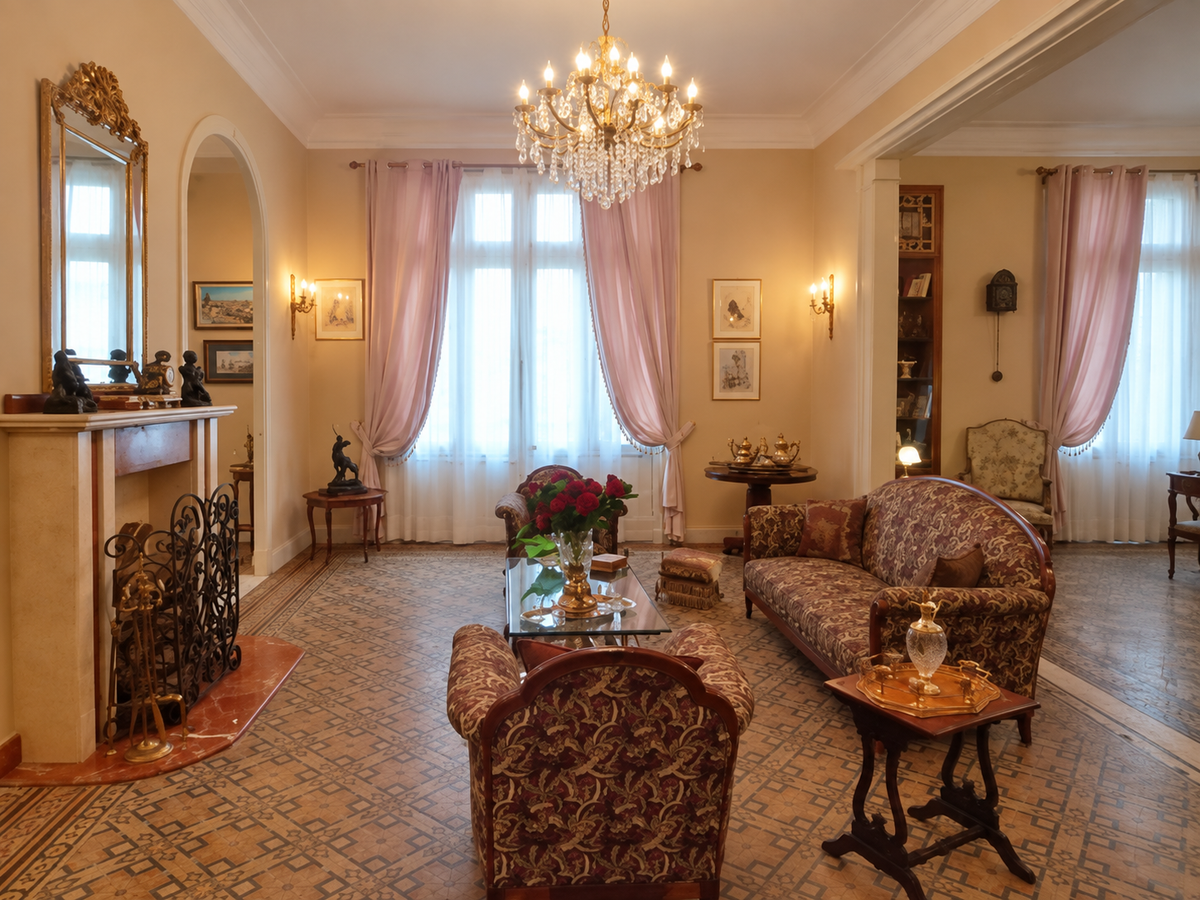
Walk into an older Lebanese apartment or family home and there is a good chance you will find a room that feels slightly different from the rest of the house.
The couches are cleaner. The furniture is more formal. There may be a glass cabinet filled with crystal, porcelain or silverware that is almost never touched. Family photographs sit carefully arranged. Curtains are heavier. Children may have grown up hearing some version of the same instruction: don’t play in the salon.
And despite often being one of the nicest rooms in the house, the family itself may barely use it.
The Lebanese salon is one of those ordinary features of domestic life that says far more about the country’s social history than it first appears.
Its purpose was never simply to provide additional seating. It was the room through which the household presented itself to the outside world.
For generations, Lebanese homes were organized around a strong distinction between family life and hospitality. Bedrooms, kitchens and everyday sitting areas belonged to the private world of the household. Guests, particularly visitors who were not close relatives, were received in a more formal space.
The salon effectively formed a buffer between those two worlds.
The idea is part of a much wider Levantine tradition. Across the region, homes often included dedicated spaces for receiving outsiders, whether known as a madafah, diwaniya, majlis or reception room. Research into traditional Levantine guest houses shows that hospitality spaces were often deliberately separated from the household itself and sometimes even given their own entrance.
In rural society, such rooms could have an even greater role. The madafah was not simply somewhere to drink coffee. It could accommodate travelers, host important family discussions, receive village dignitaries, settle disputes and serve as the public face of a household or extended family.
Lebanon gradually translated that older tradition into an urban form.
As families moved from villages into Beirut and other cities during the twentieth century, the separate guest house became impractical. Apartment living compressed the same social function into a single room.
The madafah became the salon.
That helps explain why the room often seems disproportionately formal compared with the rest of the apartment. It inherited the symbolic function of an older reception space even when the architecture around it changed.
The word itself also reveals another layer of Lebanese history.
“Salon” comes through French, reflecting the enormous French cultural influence on Lebanon’s urban middle and upper classes during the late Ottoman period and particularly under the French Mandate. By the twentieth century, European-style furniture, chandeliers, upholstered seating and formal dining rooms increasingly mixed with older Levantine ideas about hospitality.
The result was something distinctly Lebanese: a Western-looking room performing a very Middle Eastern social function.
The salon was where a family received people whose opinion mattered.
A prospective groom and his family might sit there during an early marriage visit. Priests, sheikhs, neighbors, distant relatives, business associates and people arriving to offer congratulations or condolences could all be received there.
Coffee was brought out. Sweets appeared. The best cups were used.
And because guests might form an impression of the entire household from that one room, families invested heavily in it.
That helps explain another familiar Lebanese phenomenon: the furniture that seemed too precious to actually live on.
For families whose incomes were modest, maintaining an immaculate salon could still matter because hospitality was tied closely to dignity and social standing. A family did not necessarily need to be wealthy. It needed to appear capable of receiving people properly.
The distinction is important.
The salon was partly about showing wealth, but more fundamentally it was about showing respectability.
Clean furniture meant the household was orderly. Good coffee meant generosity. A well-kept room suggested that guests were important enough to deserve something better than everyday life.
In that sense, the salon became a physical expression of the Lebanese concept of hospitality.
This also explains why certain objects accumulated there.
Crystal glasses saved for visitors. Silver trays. Embroidered tablecloths. Fine china brought back from abroad. Souvenirs from France, Brazil, Venezuela, Africa or the Gulf. Framed university degrees. Photographs of grandparents. Religious icons or Qurans. Wedding portraits.
The salon could quietly become an archive of the family itself.
Lebanon’s enormous diaspora strengthened this phenomenon. Migrants returning home often brought furniture, decorative objects and gifts from abroad, and the salon became one of the places where those objects were displayed.
A cabinet containing French porcelain, Brazilian crystal or a clock brought back from West Africa was therefore not merely decoration. It could tell the story of where members of the family had gone and what they had achieved.
The room also reflected a society in which visits were once far more central to social life.
Before WhatsApp, smartphones and constant restaurant culture, people appeared at one another’s homes more frequently. Sunday visits, Eid visits, Easter visits, condolence visits and spontaneous coffee calls were normal parts of social life.
A household therefore needed to be permanently capable of receiving people.
The salon was essentially always on standby.
That world has changed dramatically.
Lebanese families are smaller. Apartments are more expensive. Young couples increasingly live in compact homes where dedicating an entire room to people who visit occasionally makes little economic sense. Socializing has also moved outward into cafés, restaurants and public spaces.
Modern open-plan interiors blur the old separation between kitchen, living room and reception room.
The formal salon is consequently disappearing.
But traces of it remain almost everywhere.
Many newer apartments still have a “living room” that is suspiciously more formal than the place where the television actually sits. Some families maintain one set of couches for everyday use and another that remains almost untouched. Even people who no longer have a dedicated salon may still instinctively bring out different cups, plates or sweets when guests arrive.
The architecture is fading faster than the behavior.
And that may be the most interesting thing about the Lebanese salon.
It was never really about furniture.
It was about the idea that the visitor enters a version of the household prepared specifically for them.
For decades, Lebanese families sacrificed some of their most valuable domestic space to maintain that idea. In homes that were not particularly large, an entire room could sit unused most of the week simply so that, when someone knocked on the door, the household was ready.
Few features of Lebanese domestic life capture the culture quite as neatly.
The family lived in the rest of the house.
The salon belonged to everyone who might walk through the door.