Yemen’s Frozen War Is Thawing, and the Red Sea Is Becoming the Next Major Front
Yemen’s four-year military stalemate is beginning to unravel. The Houthis have launched their biggest ground offensive in years toward Taiz and the strategic Bab al-Mandeb, while government forces have responded with rare airstrikes and Saudi Arabia is again exchanging attacks with the group.
For several years, Yemen’s civil war appeared to have settled into a dangerous stalemate. The Houthis controlled Sana’a and most of the country’s populous northwest, while the internationally recognized government held much of the south and east. The main front lines had barely moved since a UN-backed truce in 2022.
That is now changing.
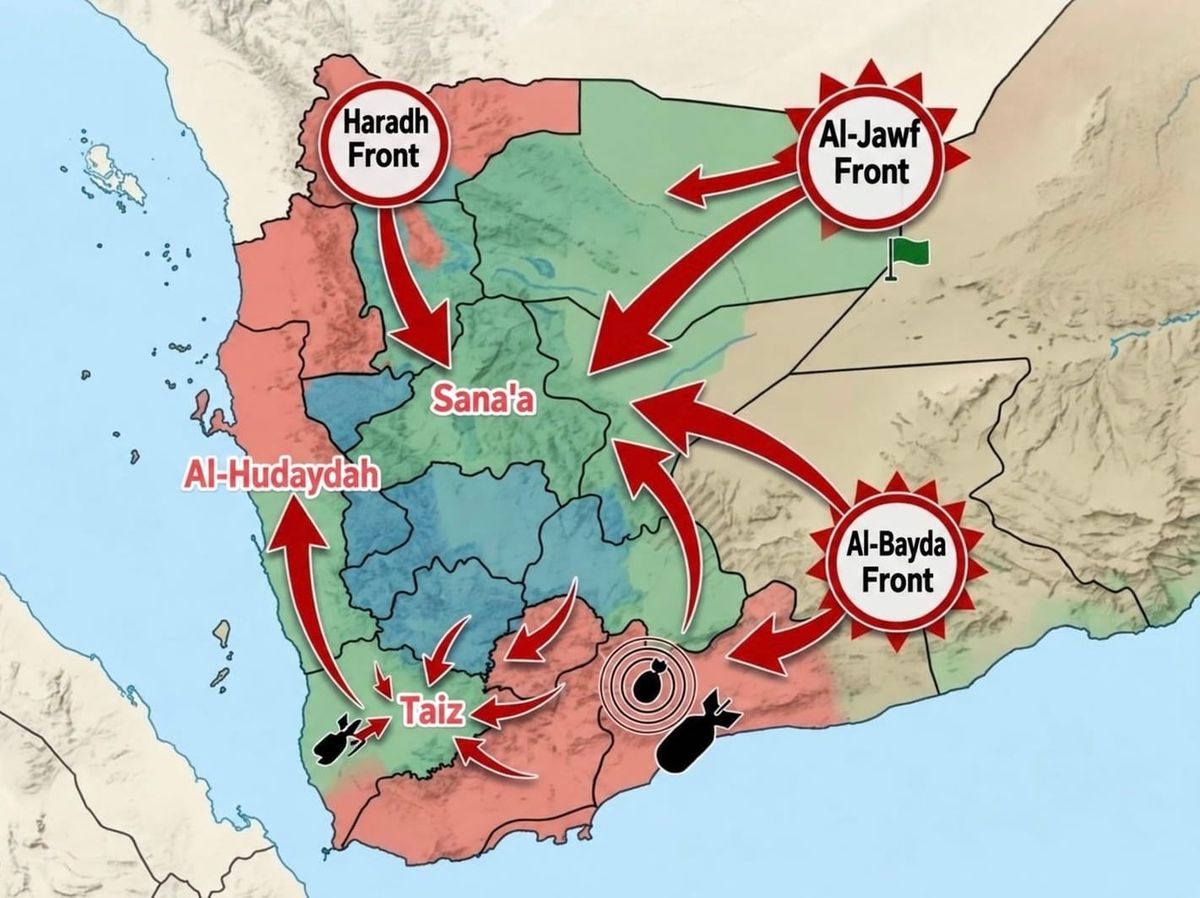
Over the past weeks, Yemen has seen some of its heaviest fighting in years. The Houthis have launched a major offensive toward western Taiz and the Red Sea coast, government forces have responded with their own airstrikes, Saudi Arabia is again being directly attacked, and the conflict is becoming increasingly intertwined with the wider U.S.-Iran war.
The latest escalation began when Houthi forces launched a multi-axis offensive across western Taiz and southern Hodeidah, using ballistic missiles, drones, artillery and ground forces. Their immediate objective appears to be gaining control of strategic high ground and threatening the corridor running between Taiz and the government-held port of al-Makha, close to the Bab al-Mandeb Strait.
That geography is crucial. Bab al-Mandeb sits at the southern entrance to the Red Sea and connects the Indian Ocean with the Suez Canal. Control over territory overlooking the strait gives the Houthis greater ability to threaten shipping through one of the world’s most important maritime routes.
Government forces initially lost some positions before counterattacking and recovering much of the territory. Several key hills remain contested, particularly around Jabal Numan, which overlooks the Taiz–al-Makha road.
The most striking development has been the response from Yemen’s internationally recognized government. Its air force carried out at least 15 strikes against Houthi positions in Taiz and Hodeidah, marking a rare return of government-controlled air power to the battlefield. During most of the earlier war, Saudi-led coalition aircraft had provided the overwhelming majority of air support against the Houthis.
That alone suggests that the post-2022 military balance is shifting.
But Yemen’s current escalation cannot be understood without the much larger regional war surrounding it.
The Houthis spent much of 2023–25 attacking ships in the Red Sea and firing missiles and drones toward Israel, initially presenting their campaign as support for Gaza. A U.S. bombing campaign in early 2025 ended after an Oman-mediated understanding under which Washington stopped striking Houthi positions and the group agreed not to target American vessels.
The Houthis later resumed attacks against some shipping and Israel, and when the U.S.-Israel-Iran conflict escalated in 2026, they openly re-entered the confrontation on Tehran’s side. In June, the group declared that Israeli maritime traffic in the Red Sea would be targeted.
The next step was even more consequential: confrontation with Saudi Arabia.
Relations between Riyadh and the Houthis had been relatively contained since the 2022 truce, with Saudi Arabia pursuing direct negotiations aimed at extracting itself from the Yemen war. But those efforts never produced a final peace settlement.
By July 2026, the Houthis were threatening Saudi-linked shipping and effectively announcing a maritime blockade against Riyadh. That brought Yemen directly into the wider struggle over Gulf trade routes and oil exports.
Now, the confrontation has spilled onto Saudi territory.
The Saudi-led coalition said on September 8 that 73 people had been injured in recent Houthi attacks on Saudi Arabia, including strikes affecting Abha, Khamis Mushait, Jazan and Najran. Saudi officials say civilian and economic infrastructure has been targeted and have promised retaliation.
The Houthis, meanwhile, accuse Saudi Arabia of renewed airstrikes inside Yemen. On September 7, they said a Saudi strike hit a prison facility in Jawf province, killing seven people, including a child. Saudi Arabia has not publicly confirmed responsibility for that strike.
The significance is difficult to overstate: the four-year period of relative restraint between Saudi Arabia and the Houthis is increasingly unraveling.
At the same time, Yemen’s anti-Houthi camp has itself undergone a major transformation.
For years, the internationally recognized government was an uneasy coalition of factions backed by both Saudi Arabia and the UAE. The most important of those was the Southern Transitional Council, or STC, which seeks independence for southern Yemen.
In December 2025, the UAE-backed STC rapidly expanded across southern and eastern Yemen and announced plans for an independence referendum. Saudi-backed government forces responded in January 2026 with a counteroffensive that reversed those gains. STC ministers were expelled from the government, the UAE withdrew its remaining troops, and Saudi Arabia emerged with substantially greater influence over the anti-Houthi camp.
That matters because Yemen’s war is no longer simply Houthis versus government. It has always contained overlapping conflicts: north versus south, separatists versus unionists, Saudi influence versus Emirati influence, and local tribal and political rivalries.
The STC’s decline temporarily simplified the anti-Houthi side, but southern separatism has not disappeared. Support for independence remains substantial in parts of the south, meaning another internal struggle could eventually re-emerge even if the Houthis were defeated.
The Houthis remain by far the most powerful single armed movement in Yemen.
They control Sana’a and most of northwestern Yemen, including the majority of the country’s population. The movement began as a Zaydi revivalist organization in northern Yemen before developing into an armed insurgency against the central government. It seized Sana’a in 2014, triggering the intervention of a Saudi-led coalition the following year.
Iran’s relationship with the movement has also deepened substantially. Tehran provided relatively limited support during the Houthis’ earliest wars, but over time supplied increasingly sophisticated military assistance, including technology and expertise related to missiles and drones.
That relationship now gives Iran something strategically valuable: an allied armed movement positioned directly beside the Bab al-Mandeb.
And that makes Yemen particularly important in the current regional conflict.
Iran can threaten the Strait of Hormuz from the east, while the Houthis can threaten Bab al-Mandeb from the west. Together, those two chokepoints sit on either side of the Arabian Peninsula and carry enormous volumes of global trade and energy.
This has become even more important in 2026 because disruption around Hormuz has pushed some Gulf trade and oil flows toward alternative Red Sea routes. Houthi pressure on Bab al-Mandeb therefore has potentially greater economic consequences now than during the earlier Red Sea crisis.
Beneath all of these geopolitical developments is the reality that ordinary Yemenis remain trapped in one of the world’s worst humanitarian crises.
Approximately 19.7 million people require humanitarian assistance, according to UNICEF. Around 49% of the population faces severe food insecurity, while 74% is estimated to live in extreme poverty.
Food insecurity is now deteriorating further. In government-controlled areas alone, about 5.4 million people — more than half the population there — are projected to face crisis-level hunger or worse between June and September 2026.
Across Yemen more broadly, earlier estimates projected 18.3 million people facing crisis-level food insecurity or worse in 2026, including 5.5 million in emergency conditions and tens of thousands potentially experiencing catastrophic hunger.
Children are suffering disproportionately. Yemen has some of the worst malnutrition rates in the region: around 17% of children are wasted, 49% are stunted and 41% are underweight. Around 3.2 million children are out of school.
The healthcare system is barely functioning. Roughly 40% of health facilities are partially functioning or completely out of service, while disease outbreaks remain widespread. Yemen recorded more than 93,000 suspected cholera cases in 2025 alone, and recurring outbreaks continue to threaten communities with poor access to clean water and sanitation.
Humanitarian operations have also become harder in Houthi-controlled areas. The Houthis have detained UN and aid workers whom they accuse of spying, prompting the United Nations to relocate some operations to Aden. Aid agencies have warned that declining funding and restrictions on access are reducing their ability to reach vulnerable populations.
So where does Yemen stand now?
The 2022 truce is effectively breaking down. The Houthis are again trying to alter front lines militarily, government forces are using air power against them, Saudi Arabia and the Houthis are exchanging attacks, and Yemen is once again being pulled directly into the wider Iran confrontation.
But this is not simply a return to the 2015 war.
The balance of power is different. The Houthis are stronger, more experienced and possess much more sophisticated missile and drone capabilities. Saudi Arabia has spent years trying to avoid being dragged back into the conflict. The UAE has reduced its direct military role. The internationally recognized government remains institutionally weak. And the Red Sea has become vastly more important to global politics.
The most dangerous scenario would be a simultaneous escalation on three fronts: renewed Houthi territorial offensives inside Yemen, sustained missile attacks against Saudi Arabia, and expanded operations against Red Sea shipping.
That would transform Yemen once again from a largely frozen civil war into a major regional battlefield — this time directly linked to the wider struggle between Iran, the United States and their allies.